Support

Sao Paulo/Congonhas Airport

About the Airport

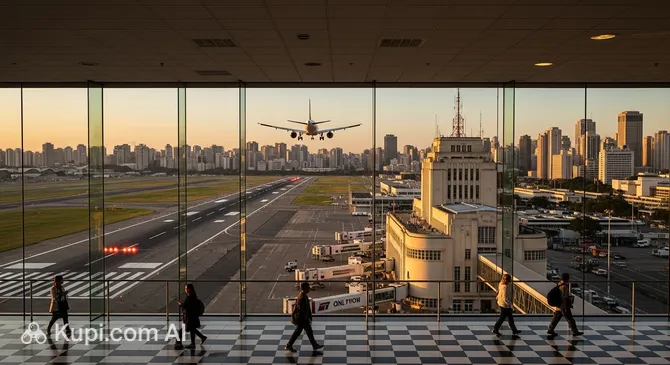
Sao Paulo/Congonhas Airport. Source: Kupi.com Binoculars

Congonhas Airport (CGH) is not just the air gateway to São Paulo, but a true symbol of the city, embedded in its urban landscape. Opened in 1936, it was the main international hub of Brazil for a long time, and today it is one of the busiest airports in the country for domestic flights. Located just 8 kilometres from the centre, it offers passengers breathtaking views of the metropolis's skyscrapers during take-off and landing. This makes it particularly convenient for business travellers and those who want to quickly be in the heart of the action.

IATA Code CGH
ICAO Code SBSP
City São Paulo
Distance to Centre 8 km
Status Domestic, formerly international.
Annual Passengers Over 22 million (based on 2023 data).
Popular Airlines Gol Transportes Aéreos, LATAM Airlines, Azul Brazilian Airlines.
Schedule Congonhas online flight board

The main feature of Congonhas Airport is its unique location within the dense urban development. Despite relatively short runways, the airport continues to be a key transport hub for domestic flights, connecting São Paulo with the largest cities in Brazil, such as Rio de Janeiro, Brasília, and Salvador. In 2023, the airport came under the management of Aena, which began a large-scale modernisation to improve comfort and efficiency. Thanks to this, as well as the coordinated work of all services, Congonhas regularly ranks among the world's most punctual airports.

Contact Information

  • Official Website: For the latest information on flight schedules, available services, and passenger regulations, it is recommended to visit the official website of Congonhas Airport, which is managed by Aena Brasil.
  • Information Desk Phone: For general enquiries and information, you can call the main airport number: +55 (11) 5090-9000.
  • Airport Address: Avenida Washington Luís, s/nº, Vila Congonhas, São Paulo - SP, CEP: 04626-911, Brasil.
  • Email: The airport does not provide a public email address for general queries. For communication, it is suggested to use the special contact form in the "Fale Conosco" (Contact Us) section on the official website.
  • Social Media: To follow news and operational updates, you can subscribe to the official pages of the operator Aena Brasil on popular social networks.
  • Lost and Found: If your belongings were lost within the terminal building, you should contact the Lost and Found service (Achados e Perdidos). Detailed information about its location and opening hours is available on the airport website. In case of loss or damage to checked baggage, you must contact your airline representative directly.
  • Passenger Support Contacts: For assistance or consultation, you can use the phone numbers listed above or the feedback form on the official airport web resource.

How to Get to the Airport

Congonhas Airport (CGH) is conveniently located within the city limits of São Paulo, making it easily accessible from most districts. It mainly serves domestic flights, acting as a key hub for travel across Brazil. There are several ways to get to the airport, suitable for any budget and level of comfort.

Public Transport is the most economical option. There is no direct metro line to the airport, but you can use a convenient metro + bus connection. The nearest metro station is São Judas (Line 1-Blue). From the metro exit, city buses regularly run to the airport, for example, route 609J/10 "Aeroporto". The bus ride takes only about 10-15 minutes. The total travel time from the city centre (e.g., from Avenida Paulista) will be approximately 45-60 minutes. The cost is equal to the price of one metro trip and one bus trip, making this the most budget-friendly method.

For greater comfort, you can use the dedicated shuttle buses, the Airport Bus Service. They connect Congonhas with the main international airport, Guarulhos (GRU), as well as bus terminals and key points in the city. These buses are more spacious, equipped with air conditioning and luggage storage. They are more expensive than regular city buses but offer an excellent compromise between price and convenience, especially for transit passengers.

Taxis and Ride-Hailing Apps (such as Uber or 99) are the fastest and most convenient way to reach the airport. A trip from the city centre without traffic will take 20-40 minutes. The cost will be significantly higher than public transport and can vary greatly depending on demand, time of day, and traffic conditions. This is an ideal option for travellers with a lot of luggage, families with children, or those who value their time.

If you plan to move around the city by car, you can use the car rental service. Offices of all major rental companies are present at Congonhas Airport. However, it is worth remembering that driving in São Paulo is a challenge due to intense traffic. There is parking at the airport, but it is quite expensive, especially for long stays. To save money, you can consider private car parks near the airport, which often offer better rates and free transfers to the terminal.

Terminals and Map

Congonhas Airport has a very simple and logical structure, making it convenient for passengers. It consists of one main passenger terminal, which serves all domestic flights. Thanks to this, you won't have to worry about complex transfers or searching for the right building — everything is under one roof.

The terminal layout is intuitive. It is divided into two main levels:

  • Lower Level (Ground Floor) — this is the Arrivals area. Here you will find baggage claim belts, car rental counters, official taxi services, and the exit to the city.
  • Upper Level (First Floor) — this is the Departures area. Here you will find a spacious hall with check-in counters for most airlines. After checking in, passengers proceed to the security screening area, beyond which lies the "airside" (secure area) with boarding gates, shops, and cafes.

Navigating the terminal will not be difficult. Clear signs in Portuguese and English are installed everywhere to help you find your way. Since this is one of the busiest airports in Brazil for domestic flights, it can be crowded during peak hours. It is recommended to allow at least 60-90 minutes for check-in and security screening, especially if you are flying in the morning or evening on a weekday. To complete all procedures calmly, it is better to arrive at the airport 2 hours before your flight's departure.

History of the Airport

The history of Congonhas Airport (CGH) is closely intertwined with the growth and development of São Paulo itself. Its official opening took place on 12 April 1936. At that time, the city was expanding rapidly, and there was an urgent need for a modern airport capable of handling the growing passenger traffic. Initially built in a sparsely populated area, Congonhas eventually found itself in the very heart of the metropolis, which became its unique feature and main challenge.

In the 1940s and 1950s, the airport experienced its "Golden Age". It became the main international and domestic hub of Brazil, welcoming and seeing off celebrities, politicians, and business people. The passenger terminal built during this period became a striking example of modernist architecture with Art Deco elements, and its interiors were decorated with impressive frescoes. Until the opening of Guarulhos Airport in 1985, Congonhas was the main point of arrival in São Paulo for travellers from all over the world.

After 1985, Congonhas refocused on domestic flights, but its popularity did not diminish. It became a key hub for business travel, serving the famous air bridge between São Paulo and Rio de Janeiro — one of the busiest routes in the world. In the early 2000s, the airport underwent a major reconstruction to meet modern requirements for comfort and safety. The terminal, waiting lounges, and check-in areas were renovated.

A turning point in the airport's history was the aviation accident in 2007, after which unprecedented measures were taken to improve safety. In particular, special drainage paving (grooving) was laid on the runways, and restrictions were introduced on the operation of large aircraft in rainy weather. These steps made Congonhas one of the examples of successful infrastructure modernisation in complex urban conditions.

Interesting fact: the airport was named not after the district, but in honour of the Viscount of Congonhas do Campo (Lucas Antônio Monteiro de Barros), the first governor of the province of São Paulo after the declaration of Brazil's independence. Today, Congonhas continues to be one of the busiest airports in the country, symbolising the dynamics and continuous movement of one of South America's largest cities.

Services and Amenities

Congonhas Airport (CGH) offers a wide range of services to make waiting for a flight as comfortable and productive as possible for every passenger. Regardless of the purpose of your trip, you will find everything you need here, from places to rest and work to various gastronomic offers.

For those feeling hungry, the terminal features numerous restaurants, cafes, and snack bars offering both Brazilian cuisine and international options. Here you can quickly grab a sandwich and a coffee or have a full lunch at a restaurant. In the numerous shops, you can purchase souvenirs, books, travel goods, and clothing.

Passengers wishing to relax in a calmer environment can use the services of VIP Lounges. They offer comfortable seating, complimentary beverages and snacks, high-speed internet, and fresh newspapers, allowing you to relax away from the noise of the main hall. Free Wi-Fi is available for all passengers in the terminal, as well as numerous charging stations for mobile devices.

Financial matters are easily resolved at the airport: bank branches, ATMs, and currency exchange points are at your service. In case of unforeseen health situations, a medical station is operating in the terminal, ready to provide first aid.

Families with children will appreciate the presence of nursing rooms where they can take care of babies in a quiet environment. For passengers with reduced mobility, all conditions for comfortable movement have been created: ramps, lifts, specially equipped toilets, and the possibility to request staff assistance for boarding.

If you have a long layover or an early flight, there are several hotels located in the immediate vicinity of the airport that are easy to reach. For business travellers who need to work, there are convenient zones in the airport, and VIP lounges are often equipped with business corners featuring necessary technology.

Where to Eat

At Congonhas Airport, you will find various dining options capable of satisfying both rushing passengers and those with time for a full meal. Most cafes and restaurants are concentrated in the public area before security control (landside), but there are also places to grab a bite in the departure area (airside).

For a quick snack, numerous coffee shops and bakeries are perfect. Be sure to try the famous Brazilian speciality — pão de queijo (cheese buns), which are served almost everywhere. Also popular are kiosks with sandwiches, pastries, and fresh juices. If you want to try a local superfood, look for places serving açaí — a thick berry smoothie served with fruit and granola. This is an excellent, healthy, and naturally halal-friendly energy boost before a flight.

If you have time for a full lunch or dinner, look for à la carte restaurants. Here you can find dishes of both Brazilian and international cuisine. Some establishments offer a self-service buffet format where you pay by the weight of the food — this is a popular and convenient format in Brazil. The price range varies from budget fast-food chains to mid-range restaurants. It is worth noting that prices at the airport are generally noticeably higher than in the city.

Most establishments open early in the morning and work until late at night to serve passengers of morning and evening flights. Regarding special dietary needs, vegetarian sandwiches and salads can be found in most cafes. Gluten-free or vegan options might be harder to find, but it is worth asking the staff — they can often offer fruit platters or adapt a dish for you.

Travel Tips

Congonhas Airport is one of the busiest in São Paulo, serving predominantly domestic flights. To avoid unnecessary stress, arrive well in advance. For domestic flights, it is recommended to be on-site at least 1.5-2 hours before departure. During peak hours, especially on Monday mornings and Friday evenings, as well as before holidays, traffic on the approach to the airport can be very heavy, so allow extra time for the journey.

To save time, always complete online check-in for your flight. This will allow you to go straight to the baggage drop counter (if you have any) or directly to security. Security checkpoints at Congonhas can be crowded. Have your boarding pass and documents ready, and take laptops and other large gadgets out of your bag in advance. Remember that rules for carrying liquids in hand luggage (usually up to 100 ml per container) also apply to domestic flights in Brazil. Sharp objects and other potentially dangerous items are prohibited.

When choosing a seat on a plane departing from or landing at Congonhas, try to book a window seat. It offers an impressive view of the endless metropolis. regarding transfers, Congonhas is mainly a "point-to-point" airport, and long layovers are rare here. If you do have a transfer, ensure you have enough time between flights, as you will have to go through security control again. Since the airport serves domestic flights, there is no international customs control here. All checks are limited to standard pre-boarding screening.

If your flight is delayed, first contact your airline representative for information and clarification. Depending on the length of the delay, Brazilian law provides passengers with the right to communication, food, and even hotel accommodation. There are several cafes and shops in the airport where you can spend time, as well as higher-comfort lounges, access to which can be paid for separately. Do not rush to buy food and drinks at the most expensive spots — sometimes it is enough to walk around the terminal to find better offers.

Reached the end of the page?

That means the route is fully explored