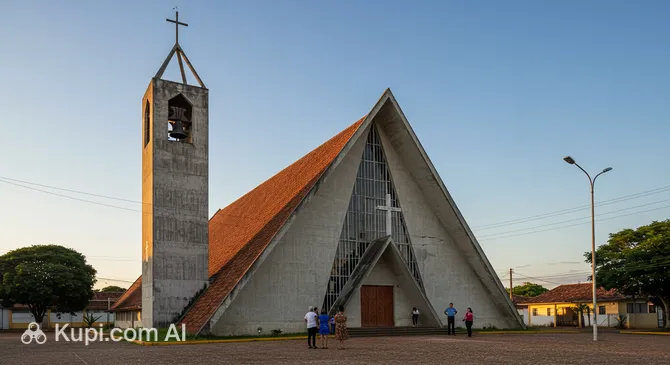
Standing atop the central hill of Teresina is the majestic Saint Benedict Parish — one of the most significant Catholic shrines that Brazil has given to the world. Built at the turn of the 18th and 19th centuries, this temple is an outstanding monument of colonial architecture, created from traditional materials — clay and earth.
São Benedito Parish. Illustration.
Source: Kupi.com AI
Traveler photos:
Known as the "church of the Black people," it was founded by the Afro-Brazilian community and dedicated to the patron saints Saint Benedict and Saint Ephigenia. The building's snow-white facade and austere grandeur harmoniously complement the appearance of Praça Liberdade, making it a center of attraction for pilgrims and history buffs.
Inside the parish, visitors will find an atmosphere of peace and unique interior designs. The unusual wooden benches, detailed wall paintings, and the skillfully crafted altar in the central nave deserve special attention. Thanks to its location, the church serves not only as a spiritual stronghold but also as a magnificent observation deck, offering panoramic views of the city blocks.
Contacts
For those planning to visit this historic site and wishing to clarify details for their upcoming visit, contact information is provided below.
Please note that the parish currently does not have an official website or active social media pages, so it is best to check for up-to-date information regarding holiday services on-site.
The climb to the church turns into a small adventure: as you ascend the hillside, stunning panoramic views of the city streets gradually unfold before you. It is an ideal spot for those who want to see the architectural ensemble of the city center from a bird's-eye view and take striking photos against the backdrop of historic buildings.
Once at the entrance, be sure to examine the carved doors. Legend has it that their patterns tell the dramatic love story of their creator, artist Sebastião Mendes. It's worth lingering inside to appreciate the unconventional wall paintings and feel the coolness of the stone vaults, which offers a welcome respite from the Brazilian heat. Attending during mass will allow you to hear profound sermons and experience the sincere faith of the local parishioners.
If you are lucky enough to be here during festivals such as the Festa de São Benedito or the Marujada, you will witness living traditions. Dancing, music, and folk festivities fill the square in front of the church with a special energy. After your visit, you can continue your walk by heading to the riverbank or stopping by nearby parks to complete your introduction to Piauí culture.
Getting There
Located on Praça Liberdade in the heart of the city, the parish is a major landmark. If you are in the center, you can reach it on foot, though be prepared for a short uphill climb that takes about 10–15 minutes.
For those arriving from more distant areas or from the Teresina Senador Petrônio Portella Airport (which is only 4 km away), it is most convenient to take a taxi or use ride-hailing services — the trip will take no more than 15–20 minutes. Also, the bus network is well-developed in this area, and many routes pass through the Centro, stopping in the immediate vicinity of the square.
Travelers by car should keep in mind that traffic in the center can be heavy and parking spaces are limited. Using a navigator with precise coordinates will help you quickly find your way through the colonial streets to the foot of the hill.
Nearest city: Teresina
History & Facts
The construction of the temple in the late 18th to early 19th century is closely linked to the history of the city's Afro-Brazilian community. The Saint Benedict Parish was built on the site of an old cemetery, where those whom society tried to ignore — the poor, lepers, and slaves — once found their final rest. This is why the church is still affectionately called "igreja dos pretos" (church of the Black people).
Construction was carried out using techniques unique for that time: taipa de pilão (rammed earth) and taipa de mão (wattle and daub). These methods allowed for the creation of a building that has not only stood the test of time but also become a vivid example of colonial architecture, reflecting the traditions of the state of Piauí.
A special place in the church's history is occupied by its doors. They are adorned with intricate carvings by the master Sebastião Mendes. Legend has it that the artist encoded the story of his unhappy, forbidden love in these wooden patterns, turning the entrance to the temple into an unspoken monument to human feelings. Today, the building is protected as an important cultural heritage site, preserving the spirit of old Brazil.
Time Needed
To leisurely explore the interiors, admire the panoramas, and take commemorative photos, 1–2 hours is usually sufficient. This time allows for the climb to the church and a thoughtful study of the architectural details of the facade.
If your visit coincides with a festive mass or one of the vibrant local festivals, it is worth setting aside 2–3 hours. At such times, the atmosphere of the place changes, allowing you to fully immerse yourself in the cultural and religious traditions of the people of Piauí.
Working Hours
The church doors are usually open to visitors throughout the day: from Monday to Saturday — from 06:30 to 17:00. On Sunday, the schedule changes slightly: the parish welcomes guests from 06:30 to 09:00 and, after a break, from 11:00 to 17:00.
Please note that during mass hours (usually early morning or on Thursday, Friday, and Sunday afternoons), access for tourist sightseeing may be limited. Visitors sometimes note inconsistencies in the schedule, so it is recommended to check information on-site or on official church resources, if available, before your visit.
Day
Working hours
Monday
06:30–17:00
Tuesday
06:30–17:00
Wednesday
06:30–17:00
Thursday
06:30–17:00
Friday
06:30–17:00
Saturday
06:30–17:00
Sunday
06:30–09:00, 11:00–17:00
Nearby
Exploring the area around Praça Liberdade will help you better feel the rhythm of local life and find interesting spots for family leisure.