Support

Museum Ship Valley Camp

About

Imagine a majestic steel giant frozen by the shore — that is how the Museum Ship Valley Camp greets its guests. This massive Great Lakes freighter, built in 1917, has been transformed into a fascinating floating museum. Located in the city of Sault Ste. Marie, this site is one of the most recognizable landmarks that Canada offers to travelers.
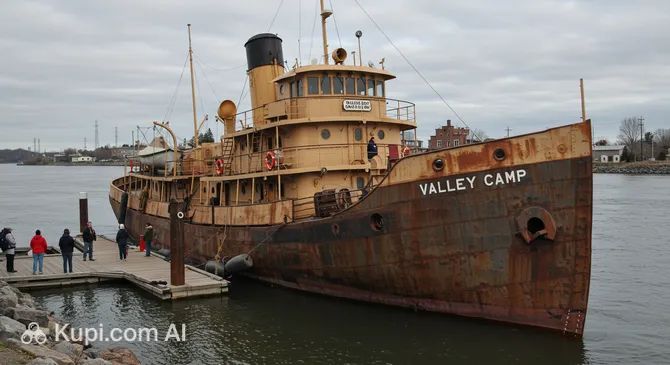
Museum Ship Valley Camp. Source: Kupi.com AI

At approximately 168 meters long, the vessel offers a unique opportunity to peek inside a true industrial veteran that sailed the waters for decades. After its retirement in 1966, the ship was not scrapped but became a large-scale cultural space, preserving the authentic atmosphere of maritime voyages from the last century.

Inside the Valley Camp lies an impressive museum complex spanning over 20,000 square feet. The former cargo holds house over a hundred exhibits dedicated to navigation, shipwrecks, and the daily lives of sailors. This place perfectly combines educational value with the romance of adventure, allowing everyone to feel like a part of the great history of the Great Lakes' exploration.

Contacts

To clarify details before your visit or to book group tours, you can use the following contact information. The museum is highly rated by travelers, which confirms the quality of its exhibits.

Address 501 E Water St, Sault Ste. Marie, MI 49783, USA
Phone +1 906-632-3658
Website saulthistoricsites.com
Google Maps View on map

What to Do

On board, a true immersion into the world of navigation awaits you. You can climb up to the wheelhouse to imagine yourself at the helm of a massive vessel, then head down to the crew's living quarters. Here, the contrast between the daily lives of different ranks is clearly shown: from the luxurious captain's cabins to the modest quarters of the sailors and firemen.

A highlight is the memorial exhibit dedicated to the legendary ship Edmund Fitzgerald. This is one of the museum's most moving areas, featuring two original lifeboats that survived the famous 1975 disaster. Visitors are also invited to watch an hour-long presentation detailing the events of that tragic night.

In addition to historical artifacts, the ship houses four giant aquariums. These are home to various fish species typical of the Great Lakes region, making a stroll across the deck interesting for both maritime enthusiasts and nature lovers. You are free to move around the vessel at your own pace, exploring every corner of this steel giant.

Getting There

Reaching this historic vessel is easy, as it is moored on the banks of the St. Marys River in the central part of the city. The exact address is 501 E Water St, Sault Ste. Marie. Its convenient location makes the ship a prominent landmark for anyone strolling along the waterfront.

If you are traveling by car, parking is available near the museum complex. For those who prefer a taxi, the ride from the city center will take only a few minutes. Public transport also runs nearby, allowing guests to easily combine a visit to the ship with other local attractions.

For those arriving from other regions via the nearest airports (for example, in Marquette), it is most convenient to rent a car or use intercity bus routes heading toward the border.

History & Facts

The history of this vessel began in 1917, when it was launched to transport heavy cargo across the Great Lakes. For nearly half a century, the ship dutifully delivered coal, iron ore, and limestone, witnessing the region's rapid industrial development. The longevity of such giants is due to unique conditions: the fresh water of the lakes is far less corrosive to steel hulls than salt water.

A special place in the ship's chronicle is its transformation into a museum after being decommissioned in 1966. Today, it is not just a vessel, but a guardian of maritime traditions. Its vast holds now house galleries telling the story of the sailors' hard work and the dangers they faced during storms.

One of the most emotional chapters of history presented here is the tragedy of the Edmund Fitzgerald, which sank in 1975. The exhibit includes authentic artifacts that remind visitors of the power of the elements and the courage of those who sail Lake Superior. The Valley Camp remains one of the few surviving representatives of its class, offering a glimpse into the bygone era of great lake freighters.

Time Needed

To explore all the decks at a leisurely pace, peek into the living quarters, and study the museum exhibits in the holds in detail, it is recommended to set aside 2 to 3 hours for your visit. The ship is enormous, and the abundance of small historical details deserves careful observation.

If you plan to watch the documentary presentation about the sinking of the Edmund Fitzgerald or linger by the aquariums with local fish species, your visit may take a bit longer. This site is perfect for a half-day family outing, offering a rich program for both adults and children.

Working Hours

The museum welcomes guests on a seasonal schedule, typically opening its doors from mid-May to mid-October. During this period, the vessel is open to visitors daily.

Standard operating hours: Monday through Saturday from 10:00 AM to 5:00 PM, and Sunday from 11:00 AM to 5:00 PM. It is recommended to arrive no later than an hour and a half before closing to have enough time to see the main exhibits.

Nearby

The area around the port offers many interesting locations that help you dive deeper into the atmosphere of this border region. A walk from the museum ship to nearby monuments and cultural centers will be a great addition to your sightseeing program.

Below are the sites located in the immediate vicinity, along with the approximate distance to them:

Name Distance (km)
Tower of History 0.4
John Rowswell HUB TRAIL MONUMENT 0.8
Gathering Place 0.9
Ermatinger Old Stone House 1.2
Spirits Rising Monument 1.2
Sault Ste. Marie Canal National Historic Site 1.9
Former Soo Line Railroad Freight Depot 2
Stone Child Statue 2.1
Canadian Sault Ste. Marie Canal Pier West 3
Wawanosh Residential School Monument 3.4

Reached the end of the page?

That means the route is fully explored