Support

Bangui Airport

About the Airport

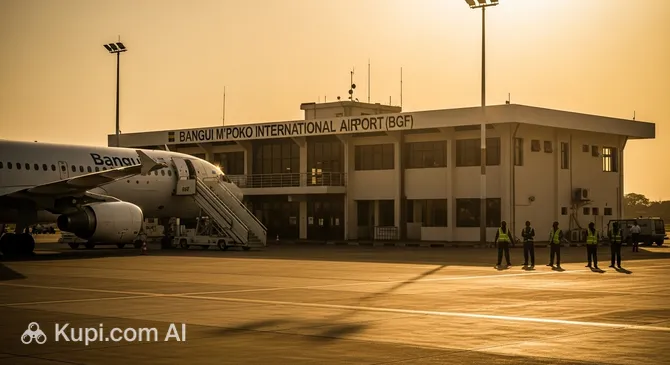
Bangui Airport. Source: Kupi.com Binoculars

Bangui M'Poko International Airport (BGF) is the main air gateway to the Central African Republic, playing a key role in the transport system of the entire region. Located just a few kilometres from the country's capital, the city of Bangui, it serves as the nation's key international aviation hub and one of the most important in the region. The airport connects the CAR with major African and European hubs, serving as a starting point for many travellers arriving in the very heart of Africa.

IATA Code BGF
ICAO Code FEFF
City Bangui
Distance to centre 7 km
Status International
Annual passengers over 100,000 people
Popular Airlines Air France, Royal Air Maroc, Ethiopian Airlines
Schedule "Bangui Airport" online board

Despite its modest size, Bangui M'Poko Airport possesses the necessary infrastructure to serve passengers. The terminal features basic amenities, including small cafes and lounges where you can have a snack while waiting for your flight, as well as a first aid station. For the convenience of travellers, car rental services are available, allowing easy access to the city or trips to its surroundings. The airport handles flights to major cities such as Paris, Casablanca, and Addis Ababa, ensuring the country's connection with the rest of the world.

Contact Information

  • Official website: Currently, the airport does not have its own official website. The airport is managed by ASECNA (Agency for Aerial Navigation Safety in Africa and Madagascar).
  • Inquiry service phone: +236 21 61 34 38. Please note that connecting via phone may be difficult.
  • Airport address: Avenue des Martyrs, Bangui, Central African Republic.
  • Email: There is no public email address for general inquiries. It is recommended to use the phone for communication.
  • Social media: The airport does not have official social media accounts.
  • Lost luggage information: For all issues related to lost or damaged luggage, please contact your airline's representative office directly.
  • Passenger support contacts: For assistance, it is recommended to call the general inquiry phone number or contact your airline directly regarding tickets and flight schedules.

How to Get to the Airport

Bangui M'Poko Airport (BGF) is the main air gateway to the Central African Republic, located just a few kilometres northwest of the city centre of Bangui. There are several ways to reach it, but for tourists, the choice often comes down to the safest and most reliable options.

Taxi and Transfer
This is the most common and recommended way to get to the airport. The trip from the centre of Bangui takes approximately 15–30 minutes, depending on traffic. The fare should always be agreed upon with the driver before starting the journey, as taximeters are rarely used. For greater safety and convenience, it is best to book a transfer through your hotel or use the services of a verified transport company. This guarantees a fixed price and timely vehicle arrival.

Car Rental and Parking
If you prefer independence in your movements, you can rent a car. Several car rental companies have offices in the city. This option is convenient for exploring the surroundings but requires confident driving skills and readiness for the specifics of local traffic. Parking is available at the airport where you can leave your car for the duration of your trip, though its capacity may be limited.

Public Transport
A formal public transport system, such as regular buses to the airport, is practically non-existent in Bangui. Locals often use shared taxis (minibuses), but for tourists with luggage, this option is highly discouraged. They do not have a fixed schedule, are often overcrowded, and do not offer a sufficient level of comfort and safety for travellers.

Recommendations
For a trip to Bangui M'Poko Airport, the most reliable and safe solution is a pre-booked transfer or calling an official taxi through your hotel. This will save you from unnecessary hassle and allow you to reach the terminal on time and without stress.

Terminals and Map

Bangui M'Poko International Airport (BGF) is a compact and functional aviation hub serving the capital of the Central African Republic. Its structure is quite simple, making navigation intuitively clear for passengers.

The airport operates one passenger terminal, which is used for both international and domestic flights. Thanks to this, passengers do not need to worry about transferring between different buildings — all procedures, from check-in to boarding, take place in one location. The terminal building is divided into two main zones: the departure zone and the arrival zone.

The Departure Zone includes airline check-in counters, passport control, and security screening. After completing formalities, passengers enter a small waiting lounge where the boarding gates are located. The Arrival Zone consists of a passport control hall, a baggage claim area with one or two belts, and customs control. Immediately after exiting the customs area, passengers find themselves in the general hall where they can be met.

Given the modest size of the airport, the time required to complete all procedures is usually less than in major international hubs. Nevertheless, it is recommended to arrive at the airport at least 2-3 hours before an international flight. This time will be sufficient for a calm check-in and screening process, even in case of possible delays. Since there is only one terminal and its layout is simple, it is practically impossible to get lost here, which is a significant plus for travellers.

Airport History

The history of Bangui M'Poko International Airport (BGF) began in 1967. Since its opening, it has become the main and sole air gateway of the Central African Republic, taking on the crucial mission of connecting this landlocked country with the rest of the world. Its creation was a key step for the development of international relations, trade, and tourism.

The main stages of the airport's development were associated with the gradual modernisation of its infrastructure. Over the decades, work has been carried out to renovate the runway, expand the passenger terminal, and improve navigation equipment. Significant reconstructions aimed at complying with international ICAO (International Civil Aviation Organization) safety standards were often carried out with the support of international partners. These projects allowed the airport to maintain its operations at an appropriate level.

Throughout its history, M'Poko Airport has played a key role not only in civil transport but also as an important logistics hub. It has repeatedly become a centre for humanitarian missions, ensuring the delivery of vital cargo and personnel to the region. It is through this airport that the country maintains the majority of its economic and diplomatic contacts with the outside world.

One interesting fact is related to its name: "M'Poko" is the name of a river flowing near the air terminal. Being the only international airport in the country, it holds a unique status. Despite its relatively modest size and passenger traffic compared to global giants, its strategic importance for the Central African Republic cannot be overestimated.

Services and Amenities

Bangui M'Poko International Airport (BGF) is the main air gateway to the Central African Republic. It is important to understand that this is a small airport, and the range of services here is rather basic, focused on meeting the essential needs of travellers. The terminal infrastructure is simple but functional for serving arriving and departing passengers.

For passengers waiting for their flight, the terminal building has several small cafes and kiosks where you can buy drinks, light snacks, and travel goods. The selection of shops, including duty-free, is limited. For a more comfortable wait, the airport provides a VIP lounge offering guests a quieter atmosphere. Access conditions should be checked in advance with your airline or at the information desk.

Internet connectivity options may be limited. Free Wi-Fi is not always available throughout the terminal, and a stable connection is most often found in the VIP lounge. The number of power outlets for charging electronic devices is also small, so travellers should carry a portable power bank. For financial transactions, there is a currency exchange and an ATM at the airport, but it is better to have some local currency (Central African CFA franc) with you in case they are not working.

The airport has a medical station for first aid. Passengers with children and persons with reduced mobility are recommended to notify their airline in advance of the need for special assistance so that staff can organise escort and support during control procedures and boarding. Specialised mother and child rooms or extensive children's play areas are absent.

There are no hotels directly on the Bangui Airport grounds. The nearest accommodation options are located in the city of Bangui itself, a short car ride away. Specialised conference halls or business centres are not provided in the terminal building, so the infrastructure of city hotels should be used for business meetings.

Where to Eat

Bangui M'Poko Airport (BGF) is a relatively small airport, and dining choices here are limited. Nevertheless, passengers can find basic options for a snack or a full meal while waiting for their flight. It is important to understand that the infrastructure here is not comparable to large international hubs.

In the airport's main and only terminal, there is usually a small restaurant or café-lounge. It is most often located in the public zone (before security control), making it accessible to both departing passengers and those seeing them off. In the departure zone after passport control, there may be a small kiosk with drinks and snacks, but the main selection is concentrated in the public part of the terminal.

The menu is generally simple and includes basic snacks such as sandwiches, pastries, as well as soft and hot drinks. If you wish to try some local cuisine, look for simple hot dishes. You can often order grilled chicken or fish with a side of rice or fried plantains (alloco). This is a good option for a hearty meal before your flight.

Finding specialised dietary dishes, such as vegan or gluten-free options, is practically impossible at Bangui Airport. Vegetarians may inquire about ordering rice with vegetables, but the choice will be extremely limited. Prices at the airport are significantly higher than in establishments in the city of Bangui itself.

Opening hours depend directly on the flight schedule — they open a few hours before the first flights and close after the last ones depart. We recommend having local currency (CFA Franc BEAC) with you, although some places may accept Euros or US Dollars at an unfavourable exchange rate.

Our tip: if you have strict dietary restrictions or prefer more varied food, it is better to eat in the city before travelling to the airport or bring light snacks with you. For a quick bite at the airport, coffee with pastries is suitable, and for a full meal — a hot dish from the local menu.

Travel Tips

To ensure your journey through the main airport of Bangui, the capital of the Central African Republic, goes smoothly, follow these tips. Bangui Airport serves fewer flights than major international hubs, so knowing certain nuances will help avoid stress and delays.

For international flights, it is recommended to arrive at the airport at least 3 hours before departure. This time will be sufficient to go through all procedures without rushing, which may take longer than expected. For domestic flights, if present in your itinerary, arriving 2 hours early is sufficient.

When going through check-in and security control, keep all documents handy: passport, visa, printed e-ticket, and vaccination certificate (especially for Yellow Fever). Procedures may not be fully automated, so be prepared for manual checks of documents and luggage. Follow the instructions of airport staff clearly.

To get your desired seat on the plane, try to check in online as soon as it opens. If you want to enjoy the views, choose a window seat. If you value the ability to stretch your legs and stand up freely, choose an aisle seat. Passengers rushing for a transfer are better off choosing seats in the front of the cabin for a quicker exit.

Hand luggage rules are mostly standard. Liquids, gels, and aerosols can be carried in containers up to 100 ml, packed in a single transparent bag. Always keep all valuables — documents, money, electronics, jewellery, and necessary medicines — with you in your hand luggage. Sharp objects and flammable substances are prohibited.

If you have a transfer planned in Bangui, check with your airline in advance whether you need to collect your luggage and check it in again. Also, check the visa requirements of the CAR for transit passengers. Allow sufficient time between flights, as delays are possible.

When passing through customs control, be prepared for questions about the purpose of your visit and the contents of your luggage. Familiarise yourself with the country's customs regulations in advance, especially regarding the import and export of currency, electronics, and souvenirs. Honestly declare all goods subject to declaration to avoid fines.

To save time, use online check-in. To save money, bring a light snack and an empty water bottle that can be filled after passing security. A transfer from the airport is best booked in advance through your hotel or a verified company, as this can be cheaper and safer than finding a taxi on the spot.

In case of flight delay or cancellation, contact your airline representative immediately. Keep all receipts for expenses (food, drinks) that may be compensated. Having travel insurance that covers such cases will significantly simplify the situation and help reimburse unforeseen expenses.
Reached the end of the page?

That means the route is fully explored