Support

Kashi Airport

About the Airport

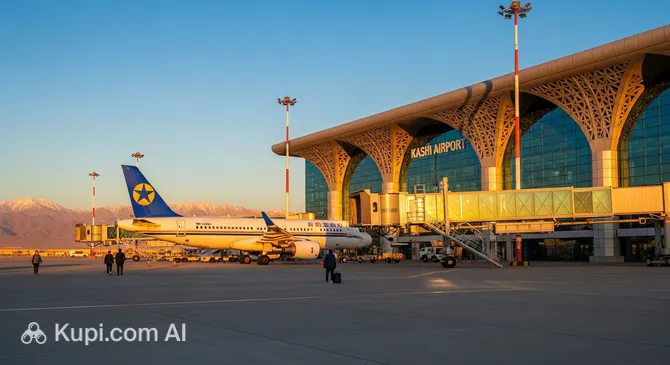
Kashi Airport. Source: Kupi.com Binoculars

Kashgar Airport (KHG), also known as Kashi Airport, acts as the modern gateway to one of the most ancient and enigmatic cities on the Great Silk Road. Located in the far west of China, it serves as a vital transport hub connecting the Xinjiang Uyghur Autonomous Region with the rest of the country and neighbouring states. Despite its remote location, the airport offers passengers modern infrastructure and comfortable conditions, serving as the starting point for journeys through this unique region rich in history.

IATA Code KHG
ICAO Code ZWSH
City Kashgar
Distance to Centre Approx. 9-10 km
Status International
Annual Passengers Approx. 2 million (based on 2018 data)
Popular Airlines China Southern Airlines, China Eastern Airlines, Air China
Schedule "Kashgar Airport" Online Board

Kashgar Airport is distinguished by its thoughtful and modern organisation. It consists of two terminals and is capable of handling even wide-body aircraft, with boarding carried out via aerobridges for passenger convenience. Inside the terminal, comfortable conditions have been created for waiting: there are zones with convenient tables for laptop work and charging points for electronic devices. The air harbour serves numerous domestic flights, linking Kashgar with Urumqi, Xi'an, Chengdu, and other major cities, and also operates international flights, for example, to Pakistan. You can reach the city centre by bus or taxi; the journey takes about 15-20 minutes.

Contact Information

For the most accurate and up-to-date information regarding services at Kashgar Airport (KHG), it is recommended to contact official channels. Below are the main contact details that may be useful for travellers.

  • Official Website: Kashgar Airport is part of the Xinjiang Airport Group. Current information can be found on their official portal: www.xjairport.com. Please note that the primary version of the site may be in Chinese.
  • Information Desk Phone: You can try contacting the airport at +86 998 292 8114. Please consider the international dialling code and potential language barriers; the availability of English-speaking staff is not always guaranteed.
  • Airport Address: Airport Road, Kashgar, Xinjiang, China.
  • Email: A direct public email address for general enquiries is typically not provided. For communication, it is recommended to use the telephone or contact forms on the official website, if available.
  • Social Media: Information may be published on Chinese social platforms, such as Weibo, on the official pages of the Xinjiang Airport Group.
  • Lost Luggage Information: In case of luggage issues (loss, damage, delay), you must first contact the Lost & Found service of your airline directly at the airport.
  • Passenger Support Contacts: For general questions and passenger support, please use the main airport information desk number.

How to Get to the Airport

Getting to Kashgar Airport (KHG) from the city centre is quite simple, as it is located just 9-10 kilometres northeast of the centre of Kashgar. Travellers have several transport options available, varying in cost, speed, and convenience.

Public Transport is the most budget-friendly method. Special bus routes (such as Airport Line 2) run to the airport, connecting the terminal with key points in the city. A bus trip will take approximately 40-50 minutes depending on the route and traffic conditions. The fare is minimal, making this an ideal option for economical tourists with light luggage. It is best to check the schedule in advance, as it may change.

Taxi or Private Transfer is the most comfortable and fastest option. A taxi ride from the city centre to the airport will take about 20-30 minutes. The cost will be approximately 30-50 RMB. It is recommended to use official taxis and ensure the driver uses the meter. Useful tip: save the name and address of the airport in Chinese beforehand to show the driver. You can also book a transfer in advance through your hotel or an online service, which is particularly convenient for late departures or early arrivals.

Car Rental offers maximum freedom of movement, especially if you plan to explore the city's surroundings and the picturesque landscapes of Xinjiang. However, it is worth noting that in China, foreign tourists usually require a Chinese driver's licence to drive. The process of obtaining one can be complex, so it is advisable to clarify all details with rental companies in advance.

For those travelling to the airport in their own or rented vehicle, parking is available on the airport grounds. There are both short-term and long-term parking zones. Regardless of the chosen method, it is recommended to leave with ample time, especially during peak hours, to avoid rushing and to pass through all pre-flight formalities without issues.

Terminals and Map

Kashgar Airport (KHG) consists of two terminals — T2 (old) and T3 (new), which was commissioned in 2021 and currently handles the vast majority of flights. The new T3 terminal has become the main passenger complex, offering modern amenities and significantly increasing the airport's capacity. Virtually all passenger operations, including check-in, security screening, and boarding, now take place here.

The airport layout is quite simple and intuitive, especially in the new T3 terminal. Generally, the Departures area with check-in counters and security checkpoints is located on the upper level, while the Arrivals area with baggage claim belts and the exit to the city is on the ground floor. Navigation causes no difficulties thanks to clear signage in Chinese and English. Transfer between terminals is usually not required, as almost all flights are centralised in T3. If movement is needed for any reason, the terminals are located in immediate proximity to each other.

Pre-flight formalities at Kashgar Airport are organised efficiently. For domestic flights, it is recommended to arrive 1.5–2 hours before departure, and for international flights (if applicable to your schedule) — 2.5–3 hours in advance. Waiting times at check-in and security are usually moderate, but queues are possible during peak hours and the tourist season. Spacious waiting lounges, shops, and cafes in Terminal T3 allow for a comfortable time before departure.

For navigation convenience, always check the departure terminal information on your ticket or the airline's website. However, there is a high probability that your destination will be the modern and functional Terminal T3. Follow the electronic boards and signs to easily find the correct gate and other airport services.

Airport History

The history of Kashgar Airport (KHG) is inextricably linked with the development of this ancient city on the Silk Road. The airport was built in 1953 and received its first flights as early as 1954, becoming a vital transport hub for the entire Xinjiang Uyghur Autonomous Region. In its first decades, it was a modest airfield, primarily serving domestic flights and ensuring the connection of remote Kashgar with other cities in China.

A turning point in the airport's history was a massive reconstruction completed in 2008. Within its framework, a new terminal and a modern runway capable of accepting larger aircraft were built. This gave a powerful impetus to the development of tourism and trade in the region. The next stage of modernisation occurred in recent years, with further work to expand infrastructure, including the construction of a new terminal to separate passenger flows on domestic and international lines.

One of the key achievements in the airport's history was receiving international status in 2013. This opened direct air corridors to neighbouring countries in Central and South Asia, strengthening Kashgar's role as a strategic centre within the "Belt and Road" initiative. Today, the airport not only serves tourists but acts as an important cargo hub supporting the region's economic ties.

Interesting fact: Kashgar Airport is one of the westernmost airports in China. Its geographical position makes it a unique gateway not only to Xinjiang but to all of Central Asia. Over more than half a century, it has journeyed from a small regional airfield to a modern international airport capable of serving hundreds of thousands of passengers a year and playing a key role in the life of one of the most colourful cities on the planet.

Services and Amenities

The airport of Kashgar (KHG) offers passengers all necessary services for a comfortable wait. Despite its relatively small size, the terminal is well-equipped and thoughtfully designed for the convenience of travellers arriving in this amazing corner of China or departing from it.

Dining and Shopping. In the airport building, you will find several cafes and eateries where you can have a snack before departure, drink coffee, or try dishes of local and Chinese cuisine. There are also shops where you can purchase souvenirs, travel essentials, and local products.

Lounges and Connectivity. Comfortable waiting halls are available for all passengers. The terminal offers free Wi-Fi, and charging stations for mobile devices are provided in departure zones. For travellers preferring enhanced comfort, there are VIP lounges offering a quieter atmosphere, snacks, and beverages.

Financial and Other Services. ATMs and currency exchange points are located within the airport, allowing you to settle financial matters immediately upon arrival. In case of necessity, passengers can contact the medical centre for first aid.

Facilities for Special Categories of Passengers. The airport is equipped for the comfortable movement of passengers with reduced mobility: there are ramps, special restrooms, and the option to request staff assistance. For families with small children, mother and child rooms are provided, where you can care for your baby in a calm environment.

Business Services and Accommodation. Although there may not be a specialised business centre at the airport, basic services for business travellers are generally provided in the VIP lounges. Several hotels are located in the immediate vicinity of Kashgar Airport, where you can stay in case of a long layover or early departure.

Where to Eat

Kashgar Airport (KHG) offers passengers several options for a snack or a full meal, allowing you to experience the unique local cuisine right before departure or immediately after arrival. Although the choice of establishments here is not as extensive as in capital airports, you certainly won't go hungry.

The main feature of the food court at Kashgar Airport is the emphasis on Uyghur cuisine. This is a wonderful opportunity to try authentic dishes, even if you had little time in the city itself. Look out for hits such as lagman (pulled noodles with meat and vegetables), hearty pilaf, aromatic lamb kebabs, and, of course, the famous pastry — samsa. These dishes are served in small cafes located both in the public area and in the departure lounge.

The main dining points are concentrated in the main terminal. Before security control (landside), there are usually a few cafes where you can sit quietly with those seeing you off. After screening (airside), the selection is generally more modest and oriented towards quick snacks, although you can find establishments with hot meals here too. Most restaurants and cafes operate according to the flight schedule, opening a few hours before the first departure and closing after the last one.

Regarding special dietary needs, virtually all food in the region is Halal by default, so there will be no issues in this regard. Vegetarians should look for vegetable-based dishes, such as vegetable lagman or salads, though the selection may be limited. Prices at the airport are expectedly higher than in city establishments in Kashgar, but remain moderate compared to major international hubs.

For a quick snack, fresh samsa with tea or coffee is perfect. If you have an hour or more to spare, feel free to order a full lunch in one of the cafes — it is an excellent way to conclude your journey along the ancient Silk Road.

Traveller Tips

To ensure your journey through Kashgar Airport goes as smoothly as possible, make use of these proven tips. A little preparation will help save time, nerves, and money, allowing you to focus on pleasant impressions from your trip to China.

Arrival Time and Check-in. We recommend arriving at the airport at least 2–2.5 hours before a domestic flight and 3-4 hours before an international one. Security control procedures in Chinese airports can be quite thorough and take more time than you are used to. If possible, complete online check-in in advance to save time in queues at the counters.

Security Checks. Be prepared for several stages of screening. Keep your passport and boarding pass close at hand. During screening, you may be asked to switch on electronic devices. Please treat this with understanding — it is a standard procedure. When leaving the country, customs control may check luggage for the export of cultural relics or large amounts of undeclared currency.

Hand Luggage. Pay special attention to carrying power banks (portable chargers). In China, they are permitted only in hand luggage, and the device must have a clearly visible marking indicating its capacity. Lighters and matches are generally prohibited even in checked luggage. The standard rule for liquids — no more than 100 ml in one container — also applies.

Seat Selection and Transfers. If your flight operates during daylight hours, choose a window seat. During takeoff and landing in Kashgar, stunning views of desert landscapes and foothills open up. For passengers with short layovers, seats in the front of the cabin are better suited for a quicker exit. If you have a connecting flight, clarify in advance whether you need to collect and re-check your luggage.

Savings and Delays. Prices for food and drinks at the airport are traditionally higher, so you can have a snack beforehand. To save on transport to the city, consider options other than the taxis at the terminal — often you can book a transfer in advance or use the bus. In case of a flight delay, contact your airline representative. Depending on the duration of the wait, you may be provided with drinks, meals, or even hotel accommodation.

Reached the end of the page?

That means the route is fully explored