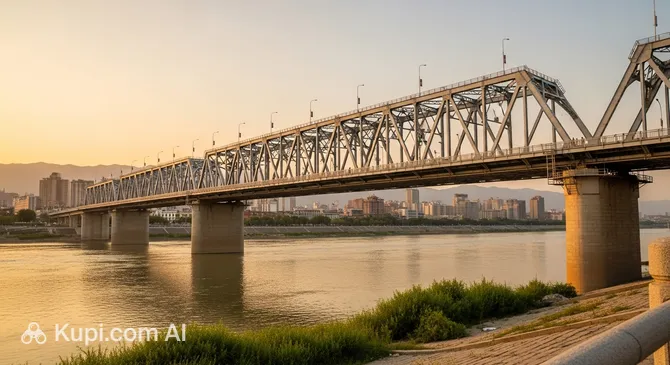
The famous Zhongshan Bridge is more than just an engineering feat; it is a true symbol of the city of Lanzhou. As the first permanent bridge across the great Yellow River, it earned the honorary title of "The First Bridge across the Yellow River." This elegant metal structure with its characteristic curved arches is a unique monument of early 20th-century industrial architecture.
Zhongshan Bridge. Illustration.
Source: Kupi.com AI
Traveler photos:
Built during the decline of the Qing Dynasty, the bridge replaced temporary pontoon structures that had been washed away by floods for centuries. Today, it is a major historical landmark carefully preserved in China. Named after Dr. Sun Yat-sen, the bridge serves as a reminder of the region's rich past as a vital hub on the Great Silk Road.
Visitors are drawn to the stark aesthetic of its iron structure, which looks especially impressive in the evening. As twilight falls, Zhongshan Bridge is illuminated with a soft golden glow from its lamps, creating a romantic atmosphere and offering magnificent panoramic views of the rushing waters of the Yellow River and the surrounding city hills.
Contacts
For those planning a visit to this historical crossing, it is helpful to check its location in advance. Since the site is located in a busy part of the city, it is easy to find.
Below are the official address details for navigation:
The main highlight of visiting Zhongshan Bridge is taking a stroll to feel the power of China's "Mother River." The bridge offers stunning views of the Yellow River, which are especially impressive when the current is at its strongest. It is an ideal spot for photography: the industrial rivets and massive beams provide an excellent backdrop for retro-style photos.
Be sure to wait until evening to see the yellow lighting turn the iron structure into a glowing golden thread over the dark water. After exploring the bridge, it is worth heading down to the Binhe Park embankment. There, you can see sculptures dedicated to Silk Road pilgrims and merchants, and observe local life, from street musicians to calligraphy masters painting with water on stones.
For those interested in culture, the Zhongshan Memorial Hall and ancient temples, such as Chongqing Temple, are nearby. During the warmer months, festivals and cultural events often take place in the square by the bridge, where you can try local snacks and immerse yourself in the authentic atmosphere of Lanzhou.
Getting There
The historic Zhongshan Bridge is located in the heart of the Chengguan District, making it easily accessible for tourists. You can take advantage of the extensive public transport network: numerous bus routes stop directly at the entrance to the bridge (look for the Zhongshan Bridge stop).
If you prefer comfort, a taxi ride from the Lanzhou central railway station will take approximately 20–40 minutes, depending on traffic. You can also use the metro (Lines 1 or 2), getting off at one of the stations in the city center and taking a short walk.
For outdoor enthusiasts, a walk along the scenic embankment of the Yellow River or using the city's bike-sharing services is an excellent option. Navigator coordinates: 36.064579, 103.816982.
Nearest city: Lanzhou
History & Facts
The history of this iron giant began in 1907, when the authorities of Gansu Province, with the support of the Qing Dynasty government, decided to create the first permanent crossing over the Yellow River. Before this, the shores were connected by the ancient Zhenyuan Bridge, which had existed for over five centuries but regularly suffered from devastating floods.
The project was realized through collaboration with foreign specialists — German engineers and American companies. The grand opening took place on August 19, 1909. Its construction was a true technical breakthrough for the time, and the structure itself became a symbol of the city of Lanzhou, combining Western technology and Eastern perseverance.
The bridge received its current name in honor of the prominent political figure Sun Yat-sen (Zhongshan). In the past, this structure played a critical role on the Great Silk Road, serving as the main gateway for caravans carrying silk and tea. Today, the bridge is recognized as a cultural heritage site and is under strict state protection in China.
Time Needed
For a leisurely walk across the bridge and to take memorable photos against the backdrop of the Yellow River, 1–2 hours is sufficient for most visitors. This is enough time to appreciate the architectural details of the antique trusses and enjoy the river scenery.
If you plan to complement your visit with a walk through the adjacent Binhe Park or a look at the nearby Silk Road monuments, you should set aside about half a day for the excursion. It is especially pleasant to linger here in the pre-sunset hours when the city illumination comes on.
Working Hours
Since Zhongshan Bridge is an active public space and pedestrian zone, it is accessible 24 hours a day. You can come here early in the morning to see the mist over the river or in the middle of the night.
Please note that the decorative artistic lighting usually turns on immediately after sunset and remains on until late evening. No special tickets or registration are required for entry, but visitors are advised to check official city tourism portals for information on local festivals, as the bridge can be particularly crowded on those days.
Nearby
Exploring the area around the bridge can greatly enrich your travel experience. Within walking distance or a short ride, you will find various entertainment centers and interesting locations.