Support

Leshan Giant Buddha

About

The Leshan Giant Buddha, also known as the Dafo, is a truly colossal stone statue carved directly into the cliffside in the city of Leshan in Sichuan province, China. This is not just any large statue; it is the world's largest stone-carved Buddha statue and the tallest pre-modern statue, reaching 71 meters in height. The monument rises majestically at the confluence of three rivers: the Minjiang, Dadu, and Qingyi, as if guarding these waters.
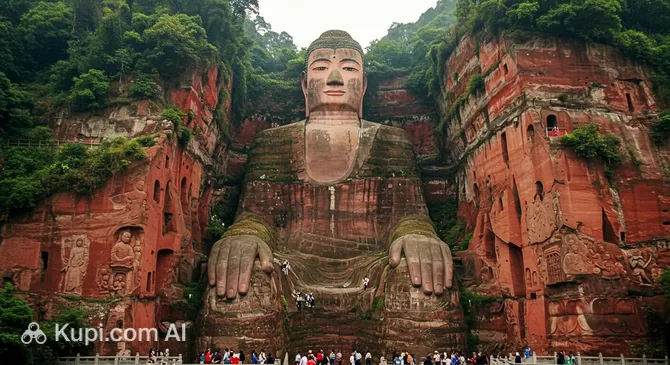
Leshan Giant Buddha. Illustration.
Source: Kupi.com AI

Traveller photos:

The creation of this wonder began in the 8th century AD and, according to legend, lasted about 90 years. The Leshan Buddha is not only an outstanding example of ancient art and engineering but also an important symbol of Buddhist faith and spiritual tranquility. The statue depicts Maitreya Buddha, the Buddha of the future, in a seated position with hands resting on his knees, his gaze directed toward the sacred Mount Emei.

Interestingly, the giant Buddha was originally protected by a thirteen-story wooden pavilion, which, unfortunately, was destroyed and has not survived to the present day. However, on both sides of the Buddha, carved into the cliffs along the river, one can still see two formidable guardian kings, each over 16 meters tall, who continue their silent watch. A visit to the Leshan Giant Buddha leaves an indelible impression, allowing you to touch ancient history and feel the scale of this incredible man-made wonder.

Contacts

The Leshan Giant Buddha is a majestic statue carved into the cliffside and one of the main attractions of the city of Leshan. To find out how to get to this unique site, as well as to get up-to-date information on opening hours and entrance fees, we recommend visiting the official tourism websites of China or the city of Leshan, or using the services of local tourist information centers. This information is typically available at information desks or tourist offices.

How to contactContact
Address2345 Ling Yun Lu, Shi Zhong Qu, Le Shan Shi, Si Chuan Sheng, China, 614099
Phone+86 833 230 2296
Websitewww.leshandafo.com

What to Do

Visiting the Leshan Giant Buddha is a unique opportunity to connect with the ancient history and culture of China. The main highlight is, of course, the colossal Maitreya Buddha statue itself, carved into the cliff at the confluence of three rivers. Visitors can admire this marvel of engineering both from above, at the platform by the Buddha's head, and from below, at his feet, allowing for a full appreciation of the monument's grandeur. Different angles offer completely different perspectives, each impressive in its own right.

Of particular interest is the ancient Nine-Bend Plank Road located to the right of the statue. This path, preserved from the Tang Dynasty, once served builders and pilgrims. The road is carved directly along the cliffside and is very steep and winding, adding a sense of adventure to the descent or ascent. Walking along it is not just a physical challenge but an immersion into the atmosphere of the past.

For a deeper understanding of the historical and cultural significance of the Leshan Giant Buddha, it is recommended to hire a guide. Various excursion programs are available, including one-day tours of the scenic Grand Buddha area. Many tourists also combine a visit to the statue with a trip to the nearby Panda Park or the ancient town of Huanglongxi. This provides a more complete picture of the region's rich heritage and ensures a variety of experiences during your trip to Leshan.

Getting There

The Leshan Giant Buddha is located in the city of Leshan, situated in the scenic Sichuan province, China. To reach Leshan itself, travelers can use train or bus services from major Chinese cities. Routes from Chengdu, the capital of Sichuan province, are particularly popular, with regular trains and buses departing for Leshan. The trip from Chengdu usually takes a few hours.

After arriving in Leshan, there are several ways to reach the Giant Buddha statue itself. One of the most convenient options is an organized tour. Many travel agencies offer excursions that include transfers from your accommodation in Leshan (and sometimes directly from Chengdu) to the base of the Buddha and back. These tours are often accompanied by guide commentary. If you prefer to explore the area independently, you can reach the site from central Leshan via local public transport, such as a bus, or by taking a taxi.

Once inside the complex where the Leshan Giant Buddha is located, several ways to view this unique landmark are available to tourists. You can descend a specially equipped, rather steep staircase to the Buddha's feet to experience its true scale and majesty from below. Alternatively, you can enjoy panoramic views from observation decks located at the level of the statue's head. Additionally, there is a popular option to view the Buddha from the water—boat tours are organized along the river, offering a completely different perspective on this wonder of the world.

Nearest city: Leshan

History & Facts

The Leshan Giant Buddha is not just a colossal statue, but a true testament to the centuries-old history and engineering genius of ancient China. Its creation began back in 713 AD, during the Tang Dynasty. This grand project was initiated by a Buddhist monk named Haitong. According to legend, he conceived the statue to calm the turbulent waters of the three rivers—the Minjiang, Dadu, and Qingyi—whose confluence at this point created dangerous whirlpools that led to frequent shipwrecks. The construction was a truly titanic labor that lasted over 90 years, finally being completed in 803 AD.

Interestingly, a grand seven-story pavilion, known as the "Great Buddha Pavilion" or the "Great Elephant Pavilion," was originally built to protect the giant statue from the elements. However, this wooden structure could not withstand the tests of time and historical cataclysms. Throughout the centuries, the pavilion was destroyed and rebuilt multiple times. According to some historical accounts, the protective structure was completely destroyed during the Mongol invasion, and since then, the majestic Buddha has remained in the open air, gazing over the passing ships and changing eras.

Throughout its long history, the Leshan Giant Buddha has undergone restoration work several times. Craftsmen have strived to preserve its original appearance by repairing damaged sections. There are even legends that at certain times, marks resembling tears appeared on the Buddha's face, which were wiped away during reconstructions. Recognizing the immense cultural and historical value of this monument, on August 16, 1956, the Leshan Giant Buddha was declared a cultural relic protection site by the Sichuan Provincial Committee. Later, on February 23, 1982, the State Council of the PRC included it in the second batch of key national cultural relic protection sites, highlighting its exceptional importance to China and world culture.

Time Needed

To fully enjoy your visit to the Leshan Giant Buddha and see it from all sides, it is recommended to set aside at least half a day. Approximately, this will take you 4-5 hours. During this time, you can not only see the majestic statue from various angles but also walk along the famous ancient Nine-Bend Plank Road that descends along the cliffside, as well as explore the surrounding park area and temple buildings.

Viewing the statue itself and its adjacent trails and stairs requires a certain amount of time and physical effort, especially if you want to descend to the Buddha's feet and then climb back up. Keep in mind that during peak season or on weekends, queues can form on narrow sections, which may increase your total stay time.

If your plans include not only visiting the Leshan Giant Buddha but also exploring other interesting places in the area, such as the ancient town of Huanglongxi or the Panda Park, you should plan a full day for such an extended itinerary. This will allow you to enjoy all the region's sights without rushing.

Working Hours

To get the most up-to-date information on the opening hours of the Leshan Giant Buddha, we strongly recommend visiting the attraction's official website or contacting local tourist information centers before your visit to Leshan. Opening hours may change depending on the season, weather conditions, or special events.

As a rule, major tourist sites in China are open to visitors daily, but for such a popular attraction as the Leshan Giant Buddha, it is recommended to arrive early to avoid long queues. During peak tourist seasons, it may be advisable to book tickets online in advance, if available, to guarantee entry and save time. The attraction is typically open year-round, but schedule changes may occur due to national holidays.

Nearby

Exploring the surroundings of the Leshan Giant Buddha is a wonderful opportunity to delve deeper into the culture and nature of the region. Don't limit yourself to just contemplating the majestic statue, as there may be equally interesting places nearby that can provide new experiences and broaden your perspective on Leshan.

While a detailed list of nearby attractions with exact distances is not provided here, rest assured that there are many other interesting spots in and around the city of Leshan that deserve your attention. To plan your route effectively and discover the region's hidden gems, we recommend consulting local guides or tourist information centers. They can provide up-to-date information and help create a program that suits your interests.

Reached the bottom of the page?

Looks like you know this route inside out