Support

Malikus Saleh Airport

About the Airport

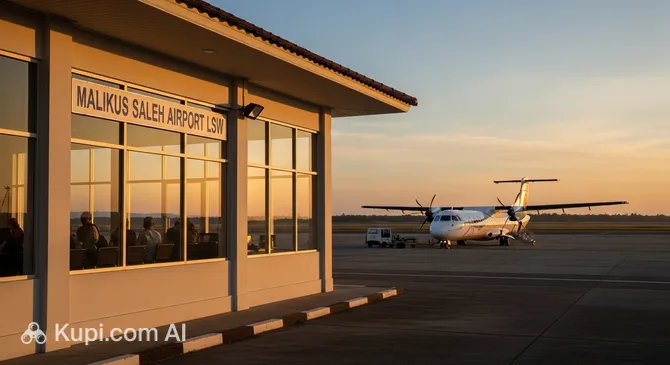
Malikus Saleh Airport. Source: Kupi.com Binoculars

Malikus Saleh Airport is not merely a regional transport hub, but a true aerial gateway to the historical heart of the Aceh province, known as the "Veranda of Mecca". Named after the first sultan of the great Samudera Pasai kingdom, this air harbour reminds travellers of the region's rich heritage even before they leave the terminal. Originally built for the needs of an industrial giant, today the airport hospitably welcomes tourists wishing to explore the unique culture and nature of North Sumatra without exhausting overland journeys.

IATA Code LSW
ICAO Code WITM
City Lhokseumawe (North Aceh)
Distance to centre ~28 km
Status Domestic
Passengers per year About 10,000 – 15,000
Schedule Check on official carrier websites

Airport Features and Highlights:

Unique History. The airport was created during the industrial boom era by PT Arun NGL. For a long time, it served exclusively gas industry specialists, but is now open to everyone, while maintaining an atmosphere of exclusivity and tranquillity.

Speed and Comfort. Thanks to the terminal's compact size, all pre-flight procedures here are completed as quickly as possible. Travellers are spared the long queues typical of major hubs, allowing them to arrive at the airport shortly before departure.

Strategic Location. Malikus Saleh is located in immediate proximity to the ruins of the ancient Samudera Pasai Sultanate and serves as an excellent starting point for journeys along the northern coast of Sumatra, connecting the region with the major hub in Medan.

Contact Information

To ensure your journey goes as smoothly as possible, keep the airport's main contacts at hand. Given that Malikus Saleh is a small regional hub, many issues are more effectively resolved through airline representatives or the administration's social media channels.

  • Official Airport Website: There is no dedicated website. It is recommended to check current information on the Directorate General of Civil Aviation of Indonesia (Hubud Dephub) page or the airport's social media.
  • Information Desk Phone: +62 645 845 2215 (UPBU administration). Please note: getting through can be difficult; it is better to use alternative communication channels for urgent questions.
  • Airport Address: Jl. Bandara Malikussaleh, Desa Pinto Makmur, Kec. Muara Batu, Kabupaten Aceh Utara, Aceh, Indonesia.
  • Email: malikussalehairport@gmail.com (for official inquiries to the administration).
  • Airport Social Media: Official news and announcements are often published on the administration's Instagram account (UPBU Malikussaleh).
  • Lost & Found Information: There is no centralised Lost & Found service. In case of loss or damage to belongings, you must immediately contact airline staff (usually Wings Air) in the arrival area or at the check-in counter.
  • Passenger Support Contacts: An information desk is located in the terminal's general hall, however, its operating hours may depend on the flight schedule.

How to Get to the Airport

Malikus Saleh Airport is located approximately 28 kilometres west of Lhokseumawe city centre, in the Muara Batu district. Given that this is a small regional airport, the transport infrastructure here has its own specificities. Travellers should plan their logistics in advance, as options common in metropolises, such as the metro or express trains directly to the terminal, are absent here. The journey from the city centre usually takes between 45 to 60 minutes, depending on traffic density on the main road.

Taxi and Transfer

The most convenient and reliable way to get to or from the airport is by taxi. Since there may not be official taxi counters in the small terminal, it is recommended to arrange a transfer in advance through your hotel or host.

  • Regular Taxi: Drivers often wait for flight arrivals in the parking lot. Be sure to agree on the fare before getting into the car, as meters are rarely used. The estimated cost of a trip to central Lhokseumawe can vary from 100,000 to 150,000 Indonesian Rupiah (IDR).
  • Online Services: Apps like Grab or Gojek are popular in Indonesia, but their availability in the North Aceh area may be limited, and the pick-up zone at the airport may have restrictions for online taxi drivers. It is better to have cash and a backup plan.

Public Transport

For tourists with luggage, this option is the least comfortable and is practically unused.

  • Minibuses (Labi-Labi): Local minibuses run along the main Banda Aceh — Medan road. To use them, you will have to exit the terminal and walk (or take a motorbike taxi) about 500–700 metres to the highway. This is a cheap method (about 10,000 – 20,000 IDR), but extremely inconvenient.
  • Train: There is a small railway line in North Aceh (Krueng Geukueh — Krueng Mane), but it is rather local in nature and does not have a station directly at the airport, so it is not considered a transfer method for air passengers.

Car Rental and Parking

Counters for international rental agencies (Avis, Hertz) are absent at Malikus Saleh Airport. In this region of Indonesia, renting a car with a driver is most common. This eliminates issues with navigation and the local driving style. This service needs to be arranged in the city in advance.

If you arrive by private transport or are being dropped off, there is an open parking lot equipped in front of the small terminal building. There is usually plenty of space, and parking rates are very reasonable.

Alternative Airports Nearby

Since the number of flights to Lhokseumawe is limited, many travellers choose to fly into larger hubs, from where they reach North Aceh by land transport. Here is a list of the nearest major airports that can serve as an alternative entry point to the region:

Airport Code City Distance
Sultan Iskandar Muda International Airport BTJ Banda Aceh 172.7 km
Kualanamu International Airport KNO Medan 276.4 km
Langkawi International Airport LGK Kuah (Malaysia) 331.0 km
Phuket International Airport HKT Phuket (Thailand) 353.2 km
Penang International Airport PEN George Town (Malaysia) 368.8 km

The most popular alternative route is flying into Medan (KNO), from where Lhokseumawe can be reached by comfortable bus or taxi in approximately 6–7 hours.

Terminals and Map

The infrastructure of Malikus Saleh Airport fully reflects its status as a small regional hub. There are no confusing corridors, complex gate systems, or need to use internal transport here — everything is extremely compact, simple, and functional.

Number of Terminals and Their Purpose

The airport serves passengers through one general terminal. This small single-storey building handles exclusively domestic flights. The terminal combines departure and arrival areas under one roof, making it cosy and understandable even for inexperienced travellers. There are no transfers between terminals, as the entire airport complex consists of a single structure.

Airport Layout and Service Zones

The interior space is organised linearly and logically:

  • Check-in Zone: Located immediately upon entering the building. Here you will find airline check-in counters (usually only 1–2 counters operate, serving the current flight).
  • Security Zone: The security checkpoint is located directly behind the check-in counters and separates the "landside" area from the sterile waiting area (airside).
  • Waiting Hall (Boarding Gate): A small room with seats for passengers awaiting boarding. From here, you exit directly onto the apron. There are no aerobridges (jetways) at the airport; boarding the aircraft is done on foot across the airfield, allowing you to see the aircraft up close.
  • Arrival Zone: Located in the side part of the building. Arriving passengers enter the terminal from the apron, proceed to the baggage claim area, and immediately exit to the station square.

Service Features and Amenities

The terminal offers only a basic set of amenities necessary for a short wait:

  • Facilities: The hall has restrooms and a small rest area.
  • Prayer Room: As everywhere in Aceh, a Mushola (prayer room) is provided in the terminal, which is important for the local way of life.
  • Dining and Retail: Inside the "sterile" zone, opportunities to buy food may be severely limited. The main kiosks with snacks and drinks are often located outside, at the terminal entrance or in the parking lot.
  • Baggage: Baggage claim often takes place in a simplified mode (sometimes manually by staff), so the process may take a little longer than expected for such a small flow.

Processing Time

Thanks to low passenger traffic, all formalities at Malikus Saleh are completed very quickly. There are practically no queues here.

  • Check-in and Security: Usually take between 10 to 20 minutes.
  • Time Recommendations: Despite the high speed of service, it is recommended to arrive at the airport 60–90 minutes before departure to calmly check in luggage and avoid force majeure, as check-in counters close strictly according to schedule.

Navigation

It is impossible to get lost in Malikus Saleh Airport. The entire passenger path — from entrance to aircraft seat — is visible almost all the way through. Information screens may be absent or turned off, so listen carefully to voice announcements from staff.

Airport History

The history of Malikus Saleh Airport is a mirror of the economic development of the entire North Aceh region. Unlike many air harbours that were created immediately for passenger transport, this airport was born thanks to an industrial boom and remained a closed facility for a long time.

Era of the "Gas Giant" (1980s)

The airport's founding is inextricably linked to the discovery of one of the world's largest natural gas fields in Lhokseumawe. In the early 1980s (around 1985), the company PT Arun NGL, a giant of the gas industry, built a runway for its own needs. At that time, it was an exclusively private airfield intended for transporting engineers, specialists, and cargo necessary for the plant's operation. It was impossible for ordinary tourists to get here.

Transfer to the People and Opening the Skies

A crucial turning point in the airport's history came as gas reserves depleted and industrial sector activity declined. Infrastructure that previously served the corporation needed to start serving the people. The airport's assets were transferred from the oil company to the local government (North Aceh Regency) and the Ministry of Transportation of Indonesia. This event marked the transformation of Malikus Saleh from a closed industrial facility into a civil airport accessible for commercial flights.

Stages of Modernisation and Expansion

Since transitioning to public airport status, Malikus Saleh has undergone several reconstruction stages aimed at improving safety and capacity:

  • Runway Extension: Initially designed for small private planes, the runway has been successively lengthened. From its initial parameters, it has grown to 1,850 metres, allowing it to accommodate turboprop aircraft such as the ATR 72 and Hercules C-130 military transport planes.
  • Future Plans: Currently, work and planning are underway to further extend the runway to 2,250 metres. The goal of this large-scale modernisation is to enable the airport to receive narrow-body jet liners (such as the Boeing 737 or Airbus A320), which will connect Lhokseumawe with direct flights to Jakarta.

Significant Events and Role in Regional Life

Although the airport is small, it has played a key role during critical moments in the region's history. The airfield was actively used for logistics and delivering humanitarian aid during recovery efforts after the 2004 tsunami, albeit on a smaller scale than the airport in Banda Aceh.

In recent history, the airport has repeatedly received presidential aircraft. Visits by Indonesian President Joko Widodo to inaugurate infrastructure projects in Lhokseumawe have confirmed the strategic importance of this air gateway for reviving the region's economy.

Interesting Facts

  • Name of the First Sultan: The airport bears the name Malikus Saleh (Malik as-Salih) — the founder of the first Islamic sultanate in Southeast Asia, Samudera Pasai. This is a tribute to the great past, as the ruins of the ancient capital are located just a few kilometres from the runway.
  • From Industry to Tourism: This is one of the rare examples in Indonesia where a corporate airfield has been successfully repurposed into a public transport hub, becoming a driver for tourism development, not just industry.

Services and Amenities

The infrastructure of Malikus Saleh Airport (LSW) corresponds to its status as a small regional hub. You will not find luxury Duty Free boutiques or global coffee shop chains here. The range of services is minimal and designed for passengers spending very little time in the terminal before departure. Nevertheless, the basic needs of travellers are met here.

Restaurants, Cafes and Shops

The food and retail area at the airport is very modest. Inside the terminal (in the waiting area), opportunities to grab a bite may be limited to one small counter.

  • Cafes and Kiosks: The main food points are located in the public area or outside in front of the terminal entrance. These are traditional Indonesian warung (small family cafes) and kiosks. Here you can buy water, sweet drinks, snacks, instant noodles (Pop Mie), and, of course, the famous Aceh coffee.
  • Shops: There are no souvenir shops inside. If you want to take something home as a memento of Lhokseumawe, it is better to purchase it in the city beforehand. Only travel essentials are sold at the airport.
  • Important: Sharia law applies in the Aceh province, so alcohol is not sold or served at the airport (as in the entire region).

Banking Services and Communication

  • ATMs: An ATM is usually installed in the public access area (most often BSI bank — Bank Syariah Indonesia, as traditional banks in Aceh have been replaced by Islamic ones). It is recommended to withdraw cash (Indonesian Rupiah) in the city in advance, as the ATM may be temporarily out of order or empty.
  • Currency Exchange: There are no currency exchange points at the airport. If you have arrived from abroad via Medan or Jakarta, take care of exchanging money there.
  • Wi-Fi and Charging: Public Wi-Fi may be absent or unstable. Travellers are strongly advised to have a local SIM card (Telkomsel has the best coverage in the region) with a mobile data package. Charging stations (sockets) are available in the waiting hall, but their number is limited — it is better to carry a power bank.

Lounges and VIP Service

The airport does not feature business lounges from international networks or airline lounges accessible via loyalty cards.

  • General Waiting Hall: A spacious room with rows of seats, equipped with air conditioning and a television.
  • VIP Room: There is a separate VIP room, which is used primarily for receiving government delegations and high-ranking officials. Access for ordinary passengers is usually closed.

Services for Passengers with Special Needs and Children

Thanks to its single-storey layout, Malikus Saleh Airport is quite convenient for citizens with reduced mobility, as there are no stairs or escalators.

  • For Passengers with Disabilities: Entrance to the terminal and exit for boarding are at ground level. Airport staff are usually very helpful and ready to assist with transporting a wheelchair to the aircraft stairs (there are no special ambulifts; boarding is done via stairs). Toilets are equipped with basic amenities.
  • For Passengers with Children: There is no specialised mother and child room or play areas in the terminal. Changing or feeding will have to be organised within the conditions of the general waiting hall or restrooms.

Medical Services and Safety

There is no full-fledged medical centre or pharmacy in the airport building. In emergencies, first aid can be provided by airport security staff (Avsec) or quarantine service representatives if they are on site. The nearest hospitals and pharmacies are located in settlements along the main highway.

Hotels and Accommodation near the Airport

There are no hotels within the airport territory or within walking distance. The airport is located in a rural area, so for overnight stays, you need to travel to the city of Lhokseumawe (about 45–60 minutes drive).

  • Popular Hotels in Lhokseumawe:
    • Hotel Lido Graha — one of the most well-known hotels in the city, suitable for business trips.
    • Rajawali Hotel — a budget-friendly and popular option in the centre.
    • Wisma Kuta Karang — a guest house located closer to the former PT Arun plant complex, which slightly shortens the journey to the airport.

Business Services

Conference rooms, business centres, photocopying or printing services are not provided in the terminal. The airport functions exclusively as a transit point.
Where to Eat

The airport of Lishui city offers passengers the opportunity to discover the gastronomy of China, particularly the cuisine of Zhejiang province. Although the choice of establishments in a regional airport may not be as wide as in major international hubs, here you will find several cosy cafes and eateries where you can have a tasty and satisfying meal before your flight.

Most catering establishments are concentrated in the public area (landside), before security control. This is convenient for well-wishers and those who arrived at the airport early. After passing control, in the sterile area (airside), the choice is usually more modest and may be limited to a small cafe with drinks and packaged snacks. Therefore, for a full lunch, it is better to allocate time before checking in for the flight.

In local cafes, it is worth paying attention to regional cuisine dishes. Zhejiang province is famous for its fresh ingredients and balanced taste. We recommend trying:

  • Noodle Soup (Mian Tiao) — a popular and filling dish often prepared with various additions of meat, vegetables, or mushrooms, for which the Lishui region is famous.
  • Steamed Baozi Buns — an excellent option for a quick snack with various fillings.
  • Rice Dishes — for example, fried rice with vegetables and egg, a classic of Chinese cuisine.
  • Green tea Longjing — a famous variety of tea from this province, which can be found in local coffee shops.

Prices at the airport are generally higher than in the city but remain acceptable. Finding vegetarian dishes is usually not difficult — many menus feature items with tofu or vegetables. However, finding specialised vegan or gluten-free options may be challenging. Opening hours of establishments are usually synchronised with the flight schedule: they open before the first departures and close after the last ones. Local bank cards and mobile payment systems (Alipay, WeChat Pay) are most commonly accepted for payment.

Travel Tips

Travelling through a small regional airport like Malikus Saleh has its own specifics. To make your trip to or from Lhokseumawe as comfortable as possible, we have compiled practical tips considering the features of this transport hub and the Aceh region in general.

Optimal Arrival Time

Despite the airport being very compact with no long queues, do not arrive right before departure. The optimal arrival time is 90 minutes (1.5 hours) before the flight.

  • Check-in counters usually close 30–45 minutes before flight departure.
  • Allow extra time for the journey: the road from central Lhokseumawe can be congested, especially during peak hours or heavy rains.

Check-in and Security: What You Need to Know

Procedures at Malikus Saleh are conducted in a relaxed but strict manner.

  • Documents: Keep your passport and e-ticket handy (can be on a smartphone screen). Security staff check documents right at the terminal entrance.
  • Dress Code: Remember that you are in the Aceh province, where Sharia norms apply. Although the airport is a federally regulated zone, it is recommended to choose modest clothing covering shoulders and knees to show respect for local culture and avoid awkward situations.

Seat Selection on the Plane

Flights to Lhokseumawe are mainly operated by turboprop aircraft like the ATR-72. The flight takes place at a relatively low altitude, offering excellent views.

  • For Best Views: Choose a Window seat. When taking off towards Medan, the left side often offers a panorama of the Malacca Strait coast and green rice fields.
  • Comfort: On ATR planes, boarding is often done through the rear door, so seats in the tail allow you to disembark first upon arrival. However, it may be slightly noisier there due to the engines.

Hand Luggage: Local Nuances

Baggage rules in Indonesia are standard, but there are points that receive special attention:

  • Power Banks: This is the most checked item. External batteries must be carried only in hand luggage. Devices with a capacity exceeding 20,000 mAh may be prohibited if the rating marking on the casing is worn off.
  • Prohibited Products: It is categorically forbidden to carry fruits with a strong odour, especially durian. Even airtight packaging will not help — you will be asked to discard it before boarding.
  • Alcohol: Bringing alcohol into Aceh is strictly limited by local laws, and while transit in checked luggage is theoretically possible, it is better not to risk it and not to display alcohol in hand luggage.

For Passengers with Connections

There are no direct international flights to Lhokseumawe, so a connection in Medan (Kualanamu) is the most frequent scenario.

  • Time Buffer: Flights on small planes are sensitive to weather conditions. Allow at least 3 hours for a connection in Medan.
  • Baggage: If you are flying with different airlines (or on separate tickets), your baggage will not be transferred automatically. You will have to collect it in Medan and check it in again.

Customs Control

Since the airport serves domestic flights, there is no customs or passport control upon arrival. However, checks for prohibited substances (drugs) are conducted very thoroughly, including the use of service dogs. Penalties for drug offences in Indonesia are extremely severe.

How to Save Time and Money

  • Cash: Be sure to withdraw Indonesian Rupiah (IDR) in advance. The ATM at the airport may not work, and cards are not accepted everywhere.
  • Transfer: Do not rely on catching a taxi "off the kerb" by the meter. Arrange a pick-up with your hotel or find a local driver's contact in advance — this will save both nerves and budget, as the price will be fixed.
  • Food: Snack prices at the airport are slightly higher than in the city, and the selection is meagre. Buy water and snacks at a city supermarket before leaving.

If the Flight is Delayed

Flight delays due to tropical downpours or fog are not uncommon for this region.

  • Communication and Entertainment: Wi-Fi in the terminal is unstable. Download films, books, or music to your phone in advance to pass the time.
  • Comfort: Air conditioning in the waiting hall may operate at full power. Take a light cardigan or shawl to avoid getting cold while waiting.
  • Information: Monitor flight status via apps (e.g., FlightRadar24), as voice announcements in the small terminal may be hard to hear or given only in Indonesian.

Reached the end of the page?

That means the route is fully explored