Support

Giant Wild Goose Pagoda

About

Imagine a majestic structure that for thirteen centuries has remained a silent witness to the changing of dynasties and the flourish of the Silk Road. The Giant Wild Goose Pagoda is not just an architectural masterpiece, but the true heart of Buddhist culture, gracing the ancient city of Xi'an. This seven-story brick building, standing 64 meters high, is one of the most recognizable symbols that China has given to the world.
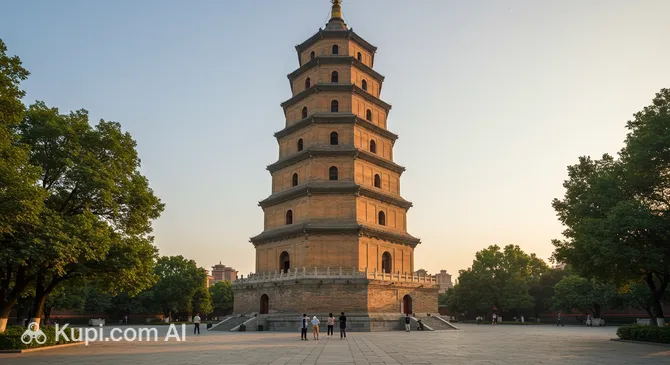
Giant Wild Goose Pagoda. Illustration.
Source: Kupi.com AI

Traveler photos:

In 2014, this landmark was officially included in the UNESCO World Heritage list. The pagoda is distinguished by its strict symmetry and elegant forms characteristic of the Tang era. One of its fascinating features is a slight tilt to the west, which developed over time due to soil movement, making the structure resemble a famous leaning tower but in an Eastern style.

Inside, priceless Buddhist relics and statues of Buddha engraved on stone by the famous 7th-century artist Yan Liben are preserved. Each level of the pagoda is decorated with murals telling stories of spiritual quests and dangerous travels. This place attracts not only history buffs but also those seeking tranquility amidst the bustle of a modern metropolis.

Contacts

For more details before your visit or to organize group tours, you can use the following contact information. We recommend saving the address in Chinese for your taxi driver.

How to contactContact
Address1 Ci En Lu, Yan Ta Qu, Xi An Shi, Shan Xi Sheng, China, 710064
Phone+86 29 8552 7958

What to Do

One of the main experiences for guests is the climb to the top of the pagoda. After conquering 248 steps of the internal staircase, you will find yourself on the upper tier, which offers a breathtaking panoramic view of Xi'an. Through the brick arches located on all four sides of each floor, you can see how ancient temple buildings contrast with modern skyscrapers on the horizon.

Be sure to take the time to explore the Da Ci'en Temple complex surrounding the tower. An atmosphere of peace reigns here, perfect for quiet walks and contemplation. You can see intricate stone carvings on the door lintels of the first floor depicting celestial kings and enjoy the architectural grace of the Buddhist pavilions.

On the spacious South Square in front of the pagoda, you can see the monumental statue of the monk Xuanzang and stroll through the landscaped gardens. This spot is particularly popular with tourists for its fountains and water bridges. Immersing yourself in the history of Buddhism by viewing ancient artifacts and walking through the sacred halls of the temple will allow you to briefly forget the city noise and touch the spiritual roots of ancient China.

Getting There

Located outside the ancient city walls, the Giant Wild Goose Pagoda is situated in the southern part of the modern metropolis. Getting here is quite easy: the site is a key landmark on the tourist map and is served by numerous public transport routes. You can take city buses or the metro to the nearest station, from where the entrance to the temple complex is just a few minutes' walk away.

If you prefer comfort, the most convenient way is by taxi. A trip from the city center will take no more than 20–30 minutes, depending on traffic. For those arriving from Xi'an Xianyang International Airport, airport express buses, rental cars, or transfers are available to take you directly to the attraction.

The site is in close proximity to the Shaanxi History Museum, so many tourists choose to visit both locations on the same day. Exact coordinates for navigation: 108.9641518, 34.2182433. A good landmark for the driver is the South Square with the monumental statue of the monk Xuanzang.

Nearest city: Xian

History & Facts

The history of this majestic structure dates back to the 7th century, during the reign of the prosperous Tang Dynasty. The original construction was erected in 652 AD to house priceless Buddhist relics, Sanskrit scriptures, and Buddha statues. All these treasures were brought back from a legendary 16-year journey to India by the famous monk and scholar Xuanzang, whose figure became the prototype for the hero of the classic novel "Journey to the West."

The first version of the pagoda was built of rammed earth and faced with brick, but half a century later, the structure began to deteriorate. In 704, by order of Empress Wu Zetian, the pagoda was completely rebuilt. It became taller and took on its modern appearance as a seven-story square tower, symbolizing Buddhist cosmology and the strict architectural proportions of that era.

Over its centuries of existence, the pagoda has survived many trials. In the 16th century, a powerful earthquake destroyed the top three tiers, after which it remained seven stories high. During the Ming Dynasty, a large-scale restoration was carried out: the walls were reinforced with an additional layer of brick 60 centimeters thick, giving the tower its current monumentality. Interesting fact: today, the pagoda has a noticeable lean of several degrees to the west, which only adds to its mystery in the eyes of travelers.

Time Needed

To leisurely explore the pagoda, climb to its upper levels, and walk through the adjacent grounds of the Da Ci'en Temple, most travelers need about 1.5–2 hours. This is enough time to appreciate the architectural details, examine the ancient murals, and take panoramic photos of the city.

If you also plan to visit the South Square with its fountains and gardens or spend some time in meditation, it's worth setting aside about half a day. In the evening, the area around the pagoda is transformed by spectacular lighting, so many tourists prefer to arrive an hour before sunset to see the attraction in both daylight and evening lights.

Working Hours

Currently, the official operating schedule of the pagoda may vary depending on the season and any ongoing holiday events. Specific opening and closing hours are not provided in available sources.

Before your visit, it is highly recommended to confirm the current day's schedule by calling the contact number +86 29 8552 7958 or checking information on Xi'an's official tourism portals directly on the day of your visit.

Nearby

The area around the pagoda is a cultural hub where historical heritage harmoniously blends with modern parks and recreational areas. A walk through the neighborhood will allow you to better experience the atmosphere of the ancient capital and find interesting places for family leisure.

In the immediate vicinity of the temple complex, you'll find aquariums, amusement parks, and themed areas that will be especially interesting for those traveling with children. Below are some nearby locations:

NameDistance
Shaanxi History Museum1 km
Bell Tower of Xi'an4.8 km
Drum Tower Museum5 km
Great Mosque of Xi'an5.5 km
Xi'an City Wall6.7 km

Reached the end of the page?

That means the route is fully explored