Support

Yiwu Airport

About the Airport

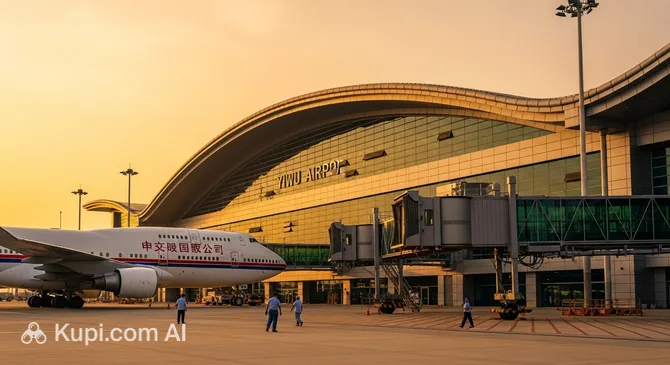
Yiwu Airport. Source: Kupi.com Binoculars

Yiwu Airport is not merely an aerial gateway to one of the world's largest wholesale trade centres, but also a vital transport hub for Zhejiang Province. Located in immediate proximity to the famous Yiwu International Trade City, the airport plays a key role in the development of business travel in the region. It has become a starting point for thousands of entrepreneurs from around the globe seeking to establish business ties in China. Since its opening in 1991, the airport has been continuously modernized to meet growing passenger traffic and international standards.

IATA Code YIW
ICAO Code ZSYW
City Yiwu
Distance to centre approx. 5.5 km
Status International
Annual Passengers over 2.9 million (2023)
Popular Airlines China Southern Airlines, China Eastern Airlines, Air China
Schedule online flight board "Yiwu Airport"

Yiwu Airport holds a 4D status and is equipped with a 3,000-metre runway, allowing it to accommodate medium-class aircraft such as the Boeing 737 and Airbus A320. It consists of two terminals: one serves domestic flights, while the second handles international destinations, including flights to Hong Kong and Macau. This separation makes navigation through the airport simple and clear for passengers.

A key advantage of the airport is its strategic location. It is situated just a few kilometres from the city centre and major exhibition complexes, which is particularly convenient for business travellers. Transport connections to the city are primarily provided by taxis, with the journey to the centre taking minimal time. The airport is constantly working on expanding its route network, adding new international and domestic flights, which contributes to strengthening Yiwu's status as a global trading hub.

Contact Information

For your convenience, we have compiled the main contact information for the airport in Yiwu (YIW). We recommend verifying the data on official resources before your trip.

  • Official Website: Generally, the most accurate and up-to-date information can be found on the airport's official website — www.ywairport.com (the site may be available in Chinese).
  • Inquiry Service Phone: A unified information centre, where you can address most questions, is available at +86 0579-96555.
  • Airport Address: Yiwu Airport, Yiwu City, Zhejiang Province, China.
  • Lost & Found Information: If you encounter issues with your luggage, please contact the Lost & Found service at: +86 0579-85669123.
  • Social Media: The airport actively uses WeChat to inform passengers. A QR code to subscribe to the official account is usually displayed on the main page of the website.
  • Email: A public e-mail for general communication is not provided. It is recommended to use the contact phone numbers for resolving issues.

Important Note: When calling from outside China, do not forget to use the international country code — +86.

How to Get to the Airport

Getting to the airport in Yiwu is quite simple, as it is located just a few kilometres from the centre. Travellers can choose the most convenient method depending on their budget, amount of luggage, and available time. The main options include public transport, taxis, and car rentals, each having its own specifics in the context of modern China.

The most economical way is the city bus. Several routes connect the airport with different districts of the city, including the railway station and the Futian trade centre. A bus ride is inexpensive but may take longer due to stops. This option is excellent for travellers with light luggage who wish to save money. The journey from the city centre usually takes between 40 to 60 minutes depending on the route and traffic conditions.

For those who value comfort and speed, a taxi is the ideal choice. Cars can be easily found anywhere in the city or ordered via an app. The trip from the centre to the airport takes approximately 20–30 minutes barring traffic jams. The cost will be significantly higher than the bus, but you get the convenience of "door-to-door" travel. You can also book a private transfer in advance, which is particularly convenient for large groups or families with children.

If you plan to move around the region actively, consider renting a car. This offers maximum freedom of movement, allowing you to explore not only Yiwu but also its surroundings. Most rental companies have counters directly at the airport. Please note that driving in China may require a local driving licence or a special permit. Parking is available on the airport territory for both short-term and long-term stays.

When planning your route, do not forget to check flights to neighbouring airports, which might be more convenient or cost-effective. The main international hub in the region is Hangzhou Xiaoshan International Airport (HGH), located approximately 105 km from Yiwu. Besides this, consider other options: the nearest Dongyang Hengdian Airport (HEW) is just 32 km away, and Jiande Qiandao Lake Airport (JDE), Quzhou Airport (JUZ), and Ningbo Lishe International Airport (NGB) are also available. This gives additional flexibility when planning your journey.

Terminals and Map

Yiwu Airport (YIW) has a simple and logical structure, making it convenient for passengers. It consists of two main terminals, clearly separated by flight type, which minimizes confusion and simplifies navigation.

Terminal 1 (T1) — this is the main and older terminal, which fully services domestic flights within China. It is significantly larger than the international one and offers a wide selection of services: numerous check-in counters, shops, cafes, and restaurants. The departure area is located on the upper floor, while the arrival and baggage claim area is on the lower floor.

Terminal 2 (T2) — a newer and more modern terminal designed exclusively for international flights. It is smaller in size but fully equipped for passing border and customs controls. Here you will find Duty-Free shops and currency exchange points. Since the terminals are located in immediate proximity, walking between them takes just a few minutes — no shuttles or buses are required.

The airport layout is intuitive. Signs are duplicated in English, which facilitates orientation for foreign tourists. Passing check-in and security on domestic lines usually takes 30-60 minutes, but it is better to arrive with time to spare during peak hours. For international departures, it is recommended to arrive at the airport no less than 2.5-3 hours before departure to go through all formalities, including passport control, without rushing.

Main navigation tip: always check your ticket or the airline's website in advance to see which terminal — domestic (T1) or international (T2) — your flight departs from. This is key information that will save your time.

Airport History

The history of Yiwu Airport is a clear reflection of the rapid economic growth of Yiwu city itself and its transformation into a global trade centre. Originally built as a military airfield, it opened its doors to civil aviation on April 1, 1991. In its early years, it was a modest airport serving primarily domestic flights and connecting the city with key business and industrial centres of China.

As the fame of the Yiwu wholesale market grew in the 1990s and 2000s, attracting businessmen from all over the world, the old airport infrastructure could no longer cope with the increasing passenger traffic. This triggered massive development. The main stages of modernization were aimed at increasing capacity, extending the runway to accommodate larger aircraft, and improving the quality of passenger service.

A key moment in the airport's history was 2014, when it officially received international status. This event was marked by the opening of a new modern international terminal equipped with all necessary services, including customs and border control. The launch of the first international flights, particularly to Hong Kong, marked a new era, allowing foreign entrepreneurs to reach Yiwu without transfers in other major cities of the country.

An interesting fact: unlike many other airports, the main passenger flow here consists not of tourists, but specifically of entrepreneurs and wholesale buyers. The history of Yiwu Airport is not just a chronicle of construction and renovations, but a vivid example of how transport infrastructure develops following the booming growth of trade, turning a small regional airfield into an important node on the map of global business travel.

Services and Amenities

Yiwu Airport (YIW) is designed to ensure passengers have a comfortable and peaceful wait for their flight. In the terminal, you will find various cafes and restaurants where you can grab a quick sandwich and coffee or have a full meal, trying dishes of local and international cuisine. For shopping enthusiasts, there are shops, including Duty-Free, where you can purchase souvenirs, branded goods, and products from all over China.

To stay connected, passengers can use free Wi-Fi throughout the terminal. Numerous power outlets and special charging stations are provided for electronic devices. If you prefer to wait for your flight in more comfortable conditions, VIP lounges are at your service. For an additional fee, they offer comfortable seating, snacks, drinks, and a more private atmosphere.

Financial matters can be easily resolved at the airport. There are ATMs and currency exchange points here where you can withdraw cash or exchange money before your trip. In case of unforeseen health situations, a medical station is available in the terminal, ready to provide first aid.

For travellers with children, special mother and child rooms are equipped where you can take care of your baby in a quiet environment. The airport also provides services for passengers with reduced mobility: ramps, elevators, and specially equipped restrooms are available. If necessary, you can request an escort service from the airline in advance.

Although there are no hotels directly inside the airport building, many accommodation options are located in the immediate vicinity — from budget to business-class hotels, which can be quickly reached by taxi. For business travellers, basic amenities such as work zones may be available in VIP lounges. Full-scale conference rooms and business centres for meetings and events can be found in nearby major hotels.

Where to Eat

The airport of Yiwu offers passengers several options for a snack or a full meal, mostly focused on traditional cuisine of China. Although the selection here is not as vast as in major international hubs, you certainly won't go hungry.

In the public area, before passing security control (landside), there are usually several restaurants and cafes. This is a great place for a full lunch or dinner, especially if you have plenty of time before your flight or are seeing off loved ones. Here you can find establishments offering classic Chinese dishes such as noodles, rice with various toppings, and dumplings. Prices here are generally slightly lower than in the departure zone.

After passing inspection, in the sterile departure zone (airside), the choice is focused on establishments for a quick bite. These are small cafes where you can order coffee, tea, pastries, sandwiches, as well as spots with instant noodles or ready-made meal sets. This is an ideal option if there is little time left before boarding.

If you want to try something local, look for noodle soups or fried rice — these are popular and filling dishes often found in airport cafe menus. For vegetarians, rice and vegetable-based dishes are usually available, but it is worth checking the ingredients with the staff. Finding specialized vegan, Halal, or gluten-free options might be difficult. Most establishments operate according to the flight schedule, opening early in the morning and closing after the last plane departs.

Tips for Travellers

To ensure your journey through Yiwu Airport goes as smoothly as possible, take advantage of these tips. The airport serves one of the world's largest wholesale trade centres, so knowing some nuances will help save time and reduce stress.

Arrival Time: For international flights, it is recommended to arrive at the airport 2.5-3 hours before departure, and for domestic ones — 1.5-2 hours. This time is sufficient to calmly go through all procedures, especially during peak hours when the airport may be busy due to a high flow of business travellers.

Check-in and Security: Use online check-in whenever possible to avoid queues at counters. Keep your passport, visa, and ticket ready. When passing security control, be prepared to remove all electronic devices and liquids from your hand luggage. China has strict rules regarding power banks — ensure your device clearly states its capacity and does not exceed the airline's limits.

Seat Selection: If you want to enjoy the views, choose a window seat. An aisle seat suits those who plan to get up often during the flight. Seats at emergency exits offer more legroom, but typically cannot be occupied by passengers with children or those who do not speak the crew's language.

Hand Luggage: Standard rules prohibit carrying sharp objects and liquids in containers larger than 100 ml (all must be packed in one transparent bag). We recommend checking with your airline in advance regarding exact weight and size limits for hand luggage, as well as restrictions on carrying lithium-ion batteries.

Connecting Passengers: If you have a connecting flight, verify in advance whether you need to collect and re-check your luggage in Yiwu. Leave enough time between flights, especially if you have to pass border and customs control. Check if you require a transit visa.

Customs Control: When entering or leaving, be prepared to declare large sums of cash and expensive goods. Keep receipts for purchases to confirm their value if necessary. If you are unsure whether an item needs to be declared, it is better to use the "Red Channel".

Saving Time and Money: Book tickets in advance. To get to or from the city, consider public transport options or booking a taxi via an app — this can be cheaper than taking a car directly at the terminal exit. Food inside the airport is generally more expensive than in the city.

In Case of Flight Delay: Check your flight status online before leaving for the airport. If the flight is delayed, contact the airline representative to learn about your rights to food, drinks, or hotel accommodation. Always keep essentials in your hand luggage: a portable charger, a light snack, medication, and hygiene items.

Reached the end of the page?

That means the route is fully explored