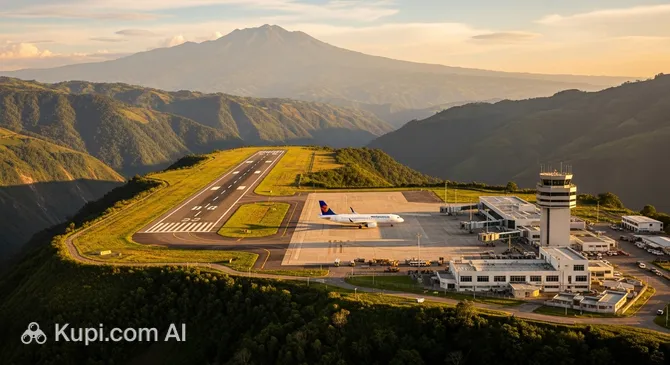
Source: Kupi.com AI
| Characteristic | Value |
|---|---|
| IATA code | PSO |
| ICAO code | SKPS |
| City | Pasto |
| Country | Colombia |
| Time zone | America/Bogota |
| Popular airlines | Latam Airlines Group, Avianca |
| Schedule | Online timetable |
| Characteristic | Value |
|---|---|
| IATA code | PSO |
| ICAO code | SKPS |
| City | Pasto |
| Country | Colombia |
| Time zone | America/Bogota |
| Popular airlines | Latam Airlines Group, Avianca |
| Schedule | Online timetable |
If you need to contact the administration of Antonio Nariño Airport (PSO), please use the following contact details. Please note that the airport is managed by the Special Administrative Unit of Civil Aeronautics of Colombia (Aerocivil), so many contacts lead to their central services.
Antonio Nariño Airport (PSO), serving the city of Pasto, is located approximately 30 kilometres north of the city, in the municipality of Chachagüí. The journey from the city centre to the terminal usually takes between 40 to 60 minutes, depending on traffic conditions. There are several ways to reach the airport, each with its own specific features.
Taxis and Shared Taxis (colectivo) — the most common and convenient method. Official taxis can be found in the city or booked by phone. The cost of a private taxi ride is usually between 40,000 and 50,000 Colombian pesos. A more budget-friendly option is the colectivo, or shared taxi. These vehicles depart once full from specific stands in the centre of Pasto and cost significantly less, around 10,000 - 15,000 pesos per person. This is an excellent choice for solo travellers or couples without a large amount of luggage.
Public Transport in the form of buses also connects Pasto with the airport area, but this option is less convenient for tourists. Routes can be confusing, and buses do not pull up directly to the terminal, which will require an additional walk or a short ride in a local taxi. This method is suitable primarily for experienced travellers who speak Spanish and wish to save as much as possible.
If you plan to explore the picturesque surroundings of Colombia, a good solution might be car rental. Several rental agencies operate in Pasto, and you can pick up or drop off the car directly at the airport. This provides complete freedom of movement. Antonio Nariño Airport provides parking for both short-term and long-term stays.
Finally, many hotels in Pasto offer their guests an airport transfer service. It is recommended to check the availability and cost of this service when booking your accommodation. This can be the most comfortable and hassle-free way to start or end your journey, especially if you are travelling with family or a large number of suitcases.
Antonio Nariño Airport (PSO), serving the city of Pasto and its surroundings in Colombia, is a small regional air hub. Its key feature is the presence of just one passenger terminal, which handles both domestic and the few international (charter) flights. Such a compact structure makes the airport very simple and convenient to navigate.
The terminal layout is extremely simple. All infrastructure is located in one building, eliminating the need for transfers between terminals. Departure and arrival zones are situated in close proximity to each other. Typically, airline check-in counters are located at the terminal entrance, followed by the security checkpoint leading to a small waiting lounge with boarding gates. The arrival area with the baggage claim belt is also located right here. Getting lost in Cano Airport is practically impossible.
Thanks to its small size and moderate passenger flow, passing through check-in and security usually does not take much time. Nevertheless, it is recommended to arrive at the airport at least 1.5–2 hours before a domestic flight departure. This buffer is sufficient to check in luggage without rushing, complete all formalities, and enjoy a coffee before boarding, especially during peak hours or the holiday season.
The main recommendation for navigation is not to worry about finding the right gate or counter. All important information is on the departure and arrival screens, and staff are always ready to assist. Because everything is located in one place, you will orient yourself quickly. Antonio Nariño Airport is an excellent example of how a small and functional terminal makes the start and end of a journey comfortable and fast.
The history of Antonio Nariño Airport (PSO), which serves the city of Pasto and the entire Nariño Department in Colombia, is a fascinating tale of overcoming complex geographical conditions. Although it is sometimes called Cano (Caño), possibly due to its proximity to a river canyon, its official name honours the national hero Antonio Nariño.
The airport was inaugurated in 1972. Its construction was a real breakthrough for the region, as it replaced the old airfield located right in the city. The former airport had a very short runway and was surrounded by mountains, making flights risky and limiting the types of aircraft it could accommodate. The new airport, built in the neighbouring municipality of Chachagüí, ensured the necessary level of safety and opened the region to larger aircraft.
One of the main historical challenges for the airport has always been difficult weather conditions. Due to its high-altitude location, proximity to the Galeras Volcano, and the Pastaza River canyon, thick fog and strong crosswinds are frequent here. For many years, this was the main reason for flight delays and cancellations, becoming an integral part of the history and even local folklore.
To cope with these difficulties, the airport has undergone several stages of significant modernisation. In the 2010s, a large-scale reconstruction began: the passenger terminal was expanded and updated, the runway was modernised, and a new control tower was built. The main achievement was the installation of a modern Instrument Landing System (ILS), which allowed for significantly increased flight reliability and safety during poor visibility.
Interesting fact: despite the airport being the main air gateway to Pasto, it is located at a distance of about 35 kilometres north of the city. Today, Antonio Nariño is a modern and strategically important transport hub that plays a key role in the economic and tourism life of the region, reliably connecting this picturesque corner of Colombia with the rest of the world.
Cano Airport (PSO), serving the city of Pasto, represents a small but functional terminal offering passengers all essential amenities for a comfortable wait for their flight. Despite its modest size, the airport is well-organised and meets the basic needs of travellers.
Within the terminal, you will find several cafés and eateries where you can enjoy famous Colombian coffee, pastries, and light local dishes. It is an excellent place to have a snack before your flight. There are also small shops selling souvenirs, handicrafts, and travel essentials. The selection is not as extensive as in international hubs, but interesting local goods can be found here.
Comfortable waiting areas are available for all passengers. While Cano Airport may not feature luxurious VIP lounges from international networks, comfortable conditions for rest have been created here. Free Wi-Fi is available throughout the terminal, allowing you to stay connected. There are also charging stations for mobile devices located in the waiting halls.
Regarding financial services, ATMs are installed in the airport where you can withdraw cash. Currency exchange points may be absent or have limited opening hours, so it is recommended to exchange money in the city beforehand. For emergencies, a medical point is available to provide first aid. The airport is also equipped to serve passengers with reduced mobility and provides facilities for travellers with small children, including nursing rooms.
There are no hotels directly on the airport grounds; however, many accommodation options can be found in the city of Pasto, which is about a 40-60 minute drive away. Specialised conference halls or business centres are not provided at Cano Airport, as it is primarily oriented towards serving passenger flights within Colombia.
Antonio Nariño Airport (PSO), serving the city of Pasto, is a small regional air hub, so the choice of dining establishments here is quite modest. Nevertheless, it is sufficient for a snack before departure. The main food outlets are small cafés and snack bars located in the general hall of the terminal, before security control (landside).
In several cafeterias, you will be offered a standard traveller's set: sandwiches, pastries, crisps, and various drinks. Since you are in Colombia, do not miss the opportunity to drink a cup of excellent local coffee — this is perhaps the main gastronomic experience one can have at the airport. To get acquainted with local cuisine, look for popular snacks such as empanadas (fried pastries with filling) or arepas (corn cakes). This is a great option for a quick and filling snack. For a more substantial lunch, you can grab a large sandwich or, if you are lucky, the "plato del día" (dish of the day), which is sometimes offered in local cafés.
Please note that the choice for passengers with special dietary requirements is extremely limited. Vegetarians or vegans will likely have to settle for fruit or plain black coffee, and gluten-free options are practically non-existent. If you follow strict dietary rules (such as Halal), it is strongly recommended to bring food with you. Prices in the airport establishments are moderate, only slightly higher than the average in the city. After passing through security, in the departure zone (airside), the selection becomes even more scarce and usually comes down to a small kiosk with drinks and packaged snacks.
Most establishments operate in accordance with the flight schedule: they open a few hours before the first departure and close after the last plane departs. This ensures that passengers can have a snack at any time the airport is operating.
Travelling through Antonio Nariño Airport, serving the city of Pasto and its surroundings, will be more comfortable if you consider a few nuances in advance. This airport, located in the mountainous terrain of Colombia, has its own characteristics, and our tips will help you save time and peace of mind.
Preparation and Arrival at the Airport. We recommend arriving at the airport at least 2 hours before the departure of a domestic flight. Although the airport is small, it can be crowded during peak hours and tourist seasons. To save time, complete online check-in for your flight in advance and save the boarding pass on your smartphone. This will allow you to head straight to baggage drop or, if you are travelling light, to the security checkpoint.
Check-in and Security Control. Procedures are standard: check-in counters, baggage drop, and security screening. Keep your passport (or cédula for Colombian citizens) and boarding pass ready. Hand luggage rules generally correspond to international standards: liquids in containers up to 100 ml must be packed in a transparent bag, and sharp or flammable items are prohibited. It is always better to verify baggage and hand luggage allowances on your airline's website.
Seat Selection and Transfers. When flying from or to Pasto, try to get a window seat. Breathtaking views of Andean landscapes and volcanoes will open up to you. Regarding transfers, Antonio Nariño Airport mainly serves domestic flights, so long layovers here are unlikely. If your itinerary includes a transfer in a major hub, such as Bogotá, ensure you have enough time between flights, as mountain weather can cause delays.
Customs Control. Since the airport is focused on domestic transport, most passengers do not undergo customs control. If you are arriving on an international flight with a transfer in another Colombian city, you will complete all customs and immigration formalities at the first airport of arrival in the country.
What to do in case of flight delay? Delays and cancellations due to weather conditions (fog, wind) are not uncommon for high-altitude airports. Regularly check your flight status online. In case of a delay, have a book, a charged power bank, or other entertainment with you. Ask the airline representative about your rights regarding the provision of meals or accommodation in case of a long wait.
Have you reached the end of the page?
So the route has been studied inside and out