Support

Goma Airport

About the Airport

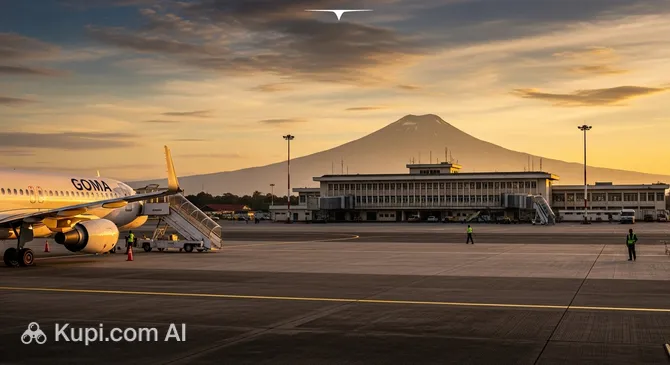
Goma Airport. Source: Kupi.com Binoculars

Goma International Airport is not merely a transport hub; it is a true gateway to the heart of Africa, situated at the very foot of the active Mount Nyiragongo volcano. Upon approaching the city, passengers are treated to a breathtaking panorama: on one side, the endless expanse of Lake Kivu, and on the other, majestic volcanic cones and solidified lava fields, serving as a reminder of nature's power. This airport, literally reborn after a devastating eruption, today serves as the main starting point for travellers seeking to see the mountain gorillas in Virunga National Park. Despite its modest size, it plays a key role in the life of the region, connecting Eastern Congo with the outside world.

IATA Code GOM
ICAO Code FZNA
City Goma
Distance to Centre 2 km
Status International
Annual Passengers No official data publicly available
Schedule

Features and Advantages of the Airport

Goma Airport boasts a unique geography and history that distinguish it from other aviation hubs around the world. One of its main features is its extreme proximity to the city centre: the terminal is just a few minutes' drive (about 2 km) from major hotels and business districts, allowing travellers to save time on transfers.

An important advantage for tourists is the airport's status as a major hub for eco-tourism. It is from here that routes to the famous Virunga National Park begin. Following a large-scale reconstruction completed in recent years, the runway has been restored and extended, enabling the airport to accommodate larger aircraft and enhance flight safety standards. Despite the compact and simple terminal, a special atmosphere reigns here, imbued with the spirit of adventure.

Contact Information

Finding precise and up-to-date contact information for Goma Airport can be challenging. Below are the most reliable data and recommendations for contacting the airport and its services.

  • Official Website: Goma Airport is managed by the Régie des Voies Aériennes (RVA), the aviation authority of the DRC. The most current information should be sought on their official website: www.rva-drc.com.
  • Information Desk Phone: A direct public phone number for the airport is not always available or may change. For questions related to your flight, it is recommended to contact your airline directly.
  • Airport Address: Goma International Airport (GOM), Goma, North Kivu Province, Democratic Republic of the Congo.
  • Email: There is no dedicated email address for general inquiries. It is recommended to use the contact forms on the RVA management company's website or your airline's website for communication.
  • Social Media: There are no official and regularly updated social media pages for the airport. Please be cautious of unofficial accounts.
  • Lost Luggage Information: For issues regarding lost or damaged luggage, you should speak directly to your airline representative at Goma Airport. The air carrier is responsible for luggage.
  • Passenger Support Contacts: For assistance with booking, check-in, flight schedules, and other services, please contact your airline's customer support service.

How to Get to the Airport

Getting to Goma Airport (Goma International Airport, GOM) from the centre of Goma is quite simple due to its close proximity. However, the transport system in Congo (DRC) has its own peculiarities, so it is worth familiarising yourself with the available options in advance to choose the most suitable one for you.

Taxis and Moto-taxis

The most common and convenient way to get to the airport is by taxi. There are two main types in Goma:

  • Moto-taxi (boda-boda): This is the fastest and cheapest option for a solo traveller with light luggage. A trip on a motorcycle allows you to bypass traffic jams, but it comes with certain risks. Be sure to negotiate the price before the trip starts and ask for a helmet if possible.
  • Car Taxi: A more comfortable and safer method, suitable for groups or tourists with multiple suitcases. As with moto-taxis, meters are a rarity here, so the cost of the trip must be agreed upon with the driver in advance. Your hotel can also assist in calling a trusted taxi or organising a private transfer, which would be the most reliable, albeit more expensive, option.

Public Transport

The public transport system in Goma is mainly represented by shared taxis (minibuses). This is the most budget-friendly way to travel, allowing you to immerse yourself in local life. However, such transport has no clear schedule, routes can be confusing for a tourist, and the cabins are often overcrowded. This option is suitable for experienced travellers without heavy luggage and with plenty of time. There are no direct bus routes, trains, or metro lines to the airport in the city.

Car Rental and Parking

It is possible to rent a car in Goma, but this option is recommended only for experienced drivers accustomed to the nuances of African road traffic. Roads may be in poor condition, and the driving style of locals can be chaotic. A more practical alternative might be renting a car with a local driver. There is a parking area at the airport suitable for short-term stops when dropping off or picking up passengers.

Travel Time and Estimated Cost

The airport is located very close to the city centre. Depending on traffic conditions, the journey takes from 15 to 30 minutes. The cheapest option will be a moto-taxi or minibus. A trip in a private taxi will cost more but ensures greater comfort. The most costly, but also the most predictable in terms of price and service, will be a transfer booked through your hotel.

Terminals and Map

Goma Airport (GOM) is a small but important transport hub in the east of the Democratic Republic of the Congo. Its infrastructure is quite simple, making navigation intuitive even for those visiting for the first time.

The airport consists of one main terminal which serves both domestic and international flights. Due to its compact size, all zones are within walking distance of each other, and there is no need for transfers between terminals. The terminal layout is extremely simple: the building is divided into an Arrivals area and a Departures area.

The Departures area includes airline check-in counters, passport control, and security screening. After completing formalities, passengers enter a small waiting hall with limited seating. The Arrivals area consists of a hall where passport control is conducted and a baggage claim area. Processes here may not be fully automated, so it is worth being prepared for some waiting.

Given the operational nature of the airport, it is recommended to arrive for check-in well in advance. For international flights, it is best to arrive 2.5–3 hours before departure, and for domestic flights, at least 2 hours. This time will be sufficient to calmly go through all procedures, which can sometimes take longer than expected. Navigation through the terminal will not cause difficulties due to its small size, but it is always useful to have all necessary documents ready to speed up the control process.

Airport History

The history of Goma Airport (GOM) is inextricably linked to the turbulent history of the entire eastern region of the Democratic Republic of the Congo. Founded during the colonial period, it played a strategically important role from the very beginning, providing transport connections for one of the most densely populated and economically significant areas of the country. Located on the shores of the picturesque Lake Kivu and in immediate proximity to active volcanoes, the airport has always operated under unique and challenging conditions.

The most dramatic event in the airport's history was the eruption of Mount Nyiragongo on 17 January 2002. A stream of molten lava reached the city of Goma and flowed directly across the airport territory, destroying the northern third of the runway and part of the taxiways. Overnight, the runway length was reduced from 3,000 to approximately 2,000 metres, making the landing of large long-haul aircraft impossible. The solidified lava remained a stark reminder of nature's force for many years.

Despite partial destruction, the airport did not cease operations. On the contrary, its importance as a key humanitarian hub only increased. With a shortened runway, it continued to receive UN and numerous NGO aircraft delivering vital aid to the region. Restoration was a long and arduous process: work to clear the solidified volcanic rock and repair the surface was carried out over many years with the support of international partners.

In recent years, a new chapter in the airport's history has begun. Large-scale projects have been launched to fully reconstruct and extend the runway to its original dimensions, as well as to modernise the passenger terminal and navigation equipment. These efforts are aimed at enabling Goma Airport to once again accommodate large aircraft, which should provide a powerful boost to tourism development, particularly for visiting the famous Virunga National Park, and strengthen the economy of the entire region.

Services and Amenities

Goma International Airport Goma (GOM) is a key transport hub in the east of the Democratic Republic of the Congo and provides passengers with a basic set of services for a comfortable wait before their flight. Despite its relatively small size, the terminal offers several amenities. Here you can find small cafes serving drinks and light snacks, as well as a few shops. They sell essentials, souvenirs, and local handicrafts, which make for excellent reminders of your trip.

General waiting halls are provided for rest before departure. Information regarding the availability and access conditions for the VIP lounge should be checked with your airline representatives. Internet connectivity options may be limited; paid Wi-Fi or access points are sometimes available in cafes or designated zones. The number of charging stations for electronic devices is also limited, so it is best to carry a portable power bank.

Generally, currency exchange points and ATMs operate within the airport building, but it is recommended to carry some local currency in case of technical failures. For urgent assistance, a medical point is available to passengers where first aid can be obtained for ailments or injuries.

Basic amenities may be provided for travellers with children, such as a mother and child room, but their availability should be confirmed on-site. Passengers with reduced mobility are provided with assistance for moving through the terminal, boarding, and disembarking from the aircraft. To receive this service, it is necessary to notify your airline in advance when booking your ticket.

There are no hotels directly on the Goma Airport premises, but many accommodation options can be found in the city itself, which is a few minutes' drive away. Specialised business centres or conference rooms are absent at the airport, but basic business services, such as faxing or document copying, may be provided in administrative offices or the VIP lounge upon request.

Where to Eat

Dining options at Goma International Airport (GOM) are quite modest, which is typical for small regional airports. Do not expect a wide variety of restaurants or fast-food chains here. Nevertheless, passengers can find a few options to grab a bite before departure.

The majority of catering establishments are concentrated in the main and only terminal, usually in the public area (landside) before passing through passport control and security. The selection in the secure area (airside) is typically even more limited and may be reduced to a small kiosk with drinks and packaged snacks. Cafe opening hours are most often linked to the flight schedule and may not cover early morning or late evening hours.

For those wishing to try something from the local cuisine, some cafes may offer simple dishes popular in Congo (DRC). Look out for fried fish (often tilapia), served with fufu (a thick porridge made from cassava) or fried plantains. This is a great opportunity to get acquainted with the region's gastronomy. For a quick snack, local pies called "sambosa" or sandwiches are suitable.

Regarding special dietary needs, finding vegetarian, vegan, gluten-free, or certified Halal dishes at GOM airport can be extremely difficult. Vegetarians might rely on side dishes of rice or vegetables, but the selection will be very limited. If you have strict dietary restrictions, it is strongly recommended to bring food with you from the city.

Prices at the airport are generally noticeably higher than in city establishments. A full lunch in a small cafe will cost more than average, while drinks and snacks at kiosks will carry the standard airport markup. It is recommended to have local currency or US dollars in small denominations with you.

Travel Tips

Planning a trip through Goma Airport? To ensure your journey goes smoothly, make use of our tips. These recommendations will help you better orient yourself at the airport and avoid common difficulties.

Arrival Time and Check-in. We recommend arriving at the airport in advance, especially if you have an international flight — allow at least 3 hours before departure. For domestic flights, 2 hours is usually sufficient. This will give you the necessary buffer time in case of queues and passing through multiple control stages. Keep all documents ready: passport, visa (if required), printed ticket, and the Yellow Fever Vaccination Certificate, which is often checked upon entry into the country.

Hand Luggage and Seat Selection. Be sure to pack all valuables, documents, money, necessary medications, a portable charger, and a change of clothes in your hand luggage just in case. Remember the standard restrictions: liquids in containers up to 100 ml, no sharp objects. When choosing a seat on the plane, consider your preferences: a window seat will allow you to enjoy views of Lake Kivu, while an aisle seat allows you to move freely during the flight.

Transfers and Customs. If you have a connecting flight in Goma, check with the airline in advance whether you need to collect and re-check your luggage. When passing through customs control, be prepared to declare large amounts of currency or expensive electronic devices. Remain calm and answer staff questions politely.

Savings and Unforeseen Situations. To save time, complete online check-in for your flight if your airline provides such a service. It is also better to book a transfer from the airport in advance. In case of a flight delay, immediately contact your airline representative for information about the flight status and your rights. Given that amenities in the waiting area may be limited, it is useful to have a book or a charged tablet with you, as well as a bottle of water and a light snack.

Reached the end of the page?

That means the route is fully explored