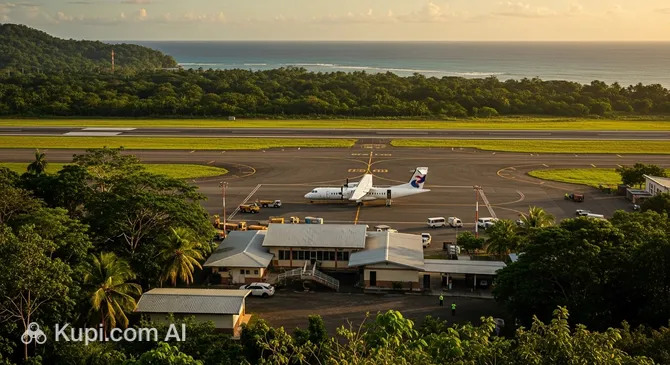
Source: Kupi.com AI
| Characteristic | Value |
|---|---|
| IATA code | LIO |
| ICAO code | MRLM |
| City | Puerto Limon |
| Country | Costa Rica |
| Time zone | America/Costa_Rica |
| Schedule | Live departures board |
| Characteristic | Value |
|---|---|
| IATA code | LIO |
| ICAO code | MRLM |
| City | Puerto Limon |
| Country | Costa Rica |
| Time zone | America/Costa_Rica |
| Schedule | Live departures board |
Getting to Limon International Airport (IATA: LIO) from the city centre of Puerto Limón in Costa Rica is effortless, as it is located just a few kilometres away. A trip by car usually takes 10–15 minutes, although time may vary depending on the traffic situation. Travellers have several transport options available to suit any taste and budget.
Taxi and Private Transfer — the fastest and most convenient method. Official red taxis with a yellow triangle on the door are easy to find throughout the city. The cost of a trip is typically around 5–10 USD. It is strongly recommended to agree on the price with the driver before starting the trip or ensure that the taximeter is switched on. Booking a transfer through your hotel is also a reliable option, especially for groups and travellers with large luggage.
Public Transport — the most budget-friendly choice. There is no direct bus route entering the airport territory. However, many city buses travel along the main highway passing near the airport. From the nearest stop to the terminal, you will have to walk about 5–10 minutes, which may not be very convenient if you have heavy suitcases.
Car Rental provides maximum flexibility, which is especially valuable if you plan to explore the picturesque Caribbean coast. Rental agency offices are located in Puerto Limón itself. You can rent a car in the city and drive to the airport without issues. There is parking on the airport territory, but it is worth remembering that this is a small regional airport, and the number of parking spaces may be limited.
Although the airport in Puerto Limón is convenient for domestic flights, the main hub for international flights in the country is Juan Santamaría International Airport (SJO), located near the capital. If your route involves crossing the border with Panama, it is worth considering the airport in Bocas del Toro (BOC) as an alternative option.
Limon International Airport (LIO) is a small and very compact airport, making it extremely convenient for navigation. You will not have to worry about long walks and confusing layouts — here everything is intuitive and located under one roof.
The airport operates with only one terminal, which serves both domestic and the few international flights. It is a single building combining all necessary zones: check-in counters, security screening area, waiting lounge, and baggage claim. Due to the modest size of the airport, arrival and departure zones are located in close proximity to each other, eliminating the need for any transfers or long movements.
Check-in and security procedures at Limon Airport are generally very fast thanks to the low passenger flow. Long queues are rare here, so the entire process from entering the building to arriving at the gate takes minimal time. Nevertheless, it is recommended to arrive at the airport approximately 1.5–2 hours before an international flight and 1 hour before a domestic one to complete all formalities without rushing.
Orienting yourself in the terminal is extremely simple. Signs are clear, and the small space allows you to easily find everything you need. Essentially, getting lost here is practically impossible. This makes Limon Airport ideal for those who dislike the bustle and complexity of major aviation hubs and appreciate a calm start or end to their journey along the Caribbean coast of Costa Rica.
The history of Limon International Airport (LIO) is closely linked to Costa Rica's aspiration to integrate its Caribbean region into the country's economic and tourism life. Although it is difficult to establish the exact founding date of a small airstrip at this location, the airport in its modern sense began to form in the second half of the 20th century. Its main task was and remains ensuring reliable and rapid communication between the capital and the city of Puerto Limón — a key port and administrative centre of the province.
The main stages of the airport's development were aimed at its gradual modernisation. Initially, it was a simple airfield, but over time the runway was paved, and a small passenger terminal was built to serve the growing flow of passengers. In different years, the government announced projects to expand the airport: plans included lengthening the runway to accommodate larger aircraft and reconstructing the terminal. Although many of these plans were implemented slowly, the airport was constantly maintained in working condition, allowing it to serve domestic flights.
Limon Airport played an important role not only in tourism development but also in logistics. It served as a vital node for business trips related to the activities of the major ports of Limón and Moín. During periods of natural disasters, such as floods that sometimes isolate the Caribbean coast, the airport became a critically important facility for delivering humanitarian aid and evacuation. Its "international" status largely reflects the region's ambitions to receive charter and scheduled flights from neighbouring countries, although currently, its main load is domestic transport.
Among the interesting facts from the airport's history is its resilience and ability to adapt to changing conditions in the domestic aviation market. The airport has never set records for passenger traffic on a national scale, but its main achievement is decades of stable operation as the main aerial artery nourishing the life and development of the entire Caribbean coast of the country.
Limon International Airport (LIO) is a small regional airport offering a basic set of services for a comfortable wait for your flight. It is important to consider that the infrastructure here is more modest than in major international hubs and is oriented mainly towards serving domestic flights. Passengers can have a snack in a small café or purchase souvenirs as a memento of the trip at a local shop.
For those who need to stay connected, Wi-Fi may be available at the airport, however, its speed and stability may be limited. The number of outlets for charging devices is also small, so it is recommended to have a portable charger with you. There is usually an ATM in the terminal building, but full-fledged bank branches and currency exchange points are absent. It is better to perform all financial operations in advance in the city of Puerto Limón.
The airport has a standard waiting hall. Specialised VIP halls or business lounges are not provided. There are also no playrooms for children, however, standard amenities in restrooms are available for passengers with infants. Passengers with reduced mobility are advised to contact the airline in advance to organise assistance and accompaniment, as special services at the airport may be limited.
There are no hotels, business centres, or conference halls on the territory of Limon Airport. The nearest hotels and all necessary business services can be found in the city of Puerto Limón, which is located a few minutes' drive from the terminal. Regarding medical assistance, in emergency cases, airport staff will call the necessary services, but there is no permanent medical post in the terminal.
When planning a trip through Limon International Airport (LIO), it is important to consider that this is a small regional airport, and the choice of catering establishments here is quite limited. Unlike major international hubs, you will not find a wide variety of restaurants and cafés here, however, it is still possible to have a snack before departure.
The main and, typically, the only place to buy food and beverages at the airport is a small café or snack bar located in the main hall of the terminal, in the public access zone (before passing security control). The assortment usually includes basic options for a quick bite:
Specialised menus, such as vegetarian, gluten-free, or halal options, are unlikely to be widely available here. The café's opening hours depend directly on the flight schedule; it usually opens a couple of hours before departure and closes after the last plane leaves. If you require a full lunch or dinner, it is recommended to eat at one of the restaurants in the city of Puerto Limón before arriving at the airport.
Travelling through Limon International Airport, the gateway to the Caribbean region of Costa Rica, can be simple and convenient if you know a few nuances. Here are several tips that will help you save time, nerves, and money during your trip to or from Puerto Limón.
Arrival Time and Check-in. Limon Airport is not as large as the capital's airport, so queues here are usually shorter. Nevertheless, for international flights, it is recommended to arrive 1.5–2 hours before departure, and for domestic ones — approximately 1 hour. This time will be sufficient to calmly pass flight check-in and security control. If possible, check in online — this will save you precious time.
Security Checks. Security procedures are standard. Prepare liquids in advance (in containers up to 100 ml, packed in a transparent bag), laptops, and other large electronics so you can quickly remove them from your hand luggage. At customs control upon arrival, have your passport and completed declaration ready if required. Honestly declare all goods subject to duty to avoid fines.
Seat Selection on the Plane. If you are flying out of Limon, window seats will gift you stunning views of the Caribbean coast. An aisle seat will be more convenient if you plan to get up often during the flight. A small life hack: when departing on flights heading north or inland, the best ocean views often open up from the right side of the aircraft.
Hand Luggage. Be sure to put all valuables in your hand luggage: documents, money, electronics, as well as necessary prescription medicines. A change of clothes in case of luggage delay would not go amiss. It is prohibited to bring sharp objects, flammable liquids, and other dangerous substances. Always check your airline's rules before leaving.
Connections and Flight Delays. If you have a connecting flight, ensure your luggage is checked through to the final destination. In case of a flight delay, first contact your airline representative for information about the new departure time and possible compensation. The airport has basic amenities, but for long waits, it is better to have a book, a charged power bank, or downloaded films with you.
Saving Time and Money. To save money, book a taxi or transfer from the airport online in advance. Prices for food and drinks at airports are always higher, so you can have a snack before leaving or bring an empty water bottle with you to fill it after passing security control. Quick preparation of documents and compliance with luggage rules is the best way to save time and avoid stress.

Reached the bottom of the page?
Looks like you know this route inside out
We use cookies and services to collect user information. This is essential for the functioning of the site and for marketing purposes. You can find out more in .
Where travelers fly most — pick a route and check prices