Support

Tambor Airport

About the Airport

Imagine a runway that practically touches the azure waters of the Pacific Ocean, and a terminal that looks more like a cosy bungalow in a tropical garden. This is not a scene from an adventure movie, but the everyday reality of Tambor Airport (Tambor Airport). This small air harbour is a key transport hub for travellers seeking to reach the southern tip of the picturesque Nicoya Peninsula in Costa Rica. Landing here is, in itself, the beginning of an unforgettable holiday filled with the "Pura Vida" spirit.
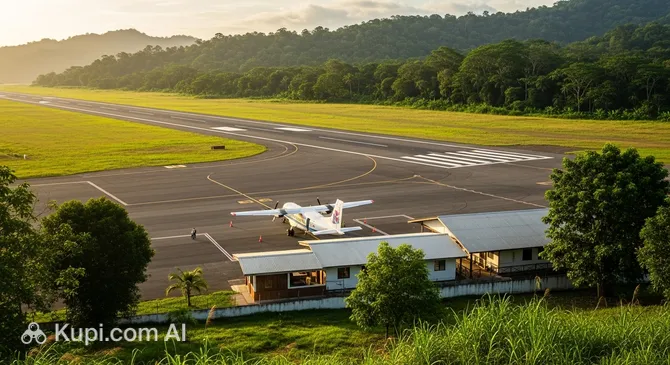
Tambor Airport. Source: Kupi.com Binoculars
IATA Code TMU
ICAO Code MRTR
City Tambor
Distance to centre approx. 1 km
Status Domestic
Annual Passengers over 20,000
Popular Airlines Sansa Airlines, Costa Rica Green Airways

The main feature of Tambor Airport is its intimacy and incredible scenery. There is no hustle and bustle of large aviation hubs here, and flight check-in and baggage claim take mere minutes. The airport mainly serves small propeller aircraft, turning the flight from San José into a thrilling aerial safari with stunning views of the mountains and the coastline.

The airport's main advantage is its strategic location. It is situated in close proximity to popular resort towns such as Montezuma, Santa Teresa, and Malpais, which can be reached by taxi or shuttle in 30-60 minutes. This is the fastest and most convenient way to reach this paradise for surfers and eco-tourism enthusiasts, bypassing the long journey by ferry and car. Tambor Airport is the ideal starting point for exploring the wild beaches, waterfalls, and national parks of the southern part of the Nicoya Peninsula.

Contact Information

  • Official Airport Website: www.dgac.go.cr (Website of the Directorate General of Civil Aviation of Costa Rica, which manages the airport)
  • Help Desk Phone: +506 2242-8000 (General aviation authority contact)
  • Airport Address: Aeropuerto de Tambor, Provincia de Puntarenas, Tambor, Costa Rica
  • Email: contralor.servicios@dgac.go.cr (For general inquiries to the administration)
  • Social Media: Facebook (Directorate General of Civil Aviation)
  • Lost Luggage Information: Since the terminal is small, baggage tracing services are managed directly by the airlines. It is recommended to contact the carrier you flew with (Sansa or Costa Rica Green Airways).
  • Passenger Support Contacts:
    • Sansa Airlines: +506 2290-4100
    • Costa Rica Green Airways: +506 4070-0771

How to Get to the Airport

Tambor Airport (TMU) is located in close proximity to the resort town of Tambor on the picturesque Nicoya Peninsula. Thanks to the compact size of the region, getting to the terminal from hotels and the central part of the village is quick and hassle-free. Travellers have several convenient options available, suitable for any budget and travel style.

Taxi and Transfer — the most common and convenient option. A trip from the centre of Tambor or from nearby beach hotels will take no more than 5-15 minutes. You can easily find a taxi in town or ask hotel staff to call a car for you. The cost of the trip is low, but it is recommended to agree on the price with the driver in advance. For greater convenience, especially if you are travelling with family or large luggage, it is worth booking a private or group transfer. Many hotels and travel agencies provide this service.

If you have been travelling around Costa Rica in a rental car, getting to the airport will be extremely simple. The route from the main road is well marked with signs. Most rental agencies operating in the region offer the option to drop off the car directly at the airport before departure, which is very convenient. There is parking on the airport territory where you can leave a car for a short time if someone is seeing you off.

As for public transport, this is the least predictable but most budget-friendly method. There is no direct bus route to the terminal. However, regional buses run along the main road that passes near the airport. You will need to get off at the stop nearest to the airport and walk the remaining distance. This option is suitable for travellers with light luggage and a flexible schedule, for whom saving money is more important than comfort.

Terminals and Map

Tambor Airport (TMU) is a small regional airport, and its layout is extremely simple, making navigation intuitively clear. If you are accustomed to large international hubs, you will be pleasantly surprised by its compactness and informal atmosphere.

The airport operates one small terminal, which serves both arriving and departing flights. This is the only building where all necessary services are concentrated. There is no separation into terminals for domestic and international lines, as the airport receives only local flights, mainly from San José. Accordingly, the issue of transferring between terminals is irrelevant here — everything is in one place.

The airport layout is very simple. The terminal is more of an open-air pavilion than a full-fledged building. The departure and arrival zones are effectively combined into one common space. Upon arrival, passengers exit the aircraft and walk to the building where baggage is handed out. The departure zone consists of several airline check-in counters (such as Sansa or Green Airways) and a small waiting area. There are no complex corridors or multi-level transitions here.

Check-in and security procedures take place very quickly thanks to the low passenger flow and the domestic nature of the flights. As a rule, all formalities take no more than 15-20 minutes. It is recommended to arrive at the airport 45-60 minutes before departure — this time will be more than sufficient. The main advice for navigation: do not worry, it is physically impossible to get lost here. Everything you need — check-in counters, waiting area, and boarding gate — is within sight and a few steps away from each other.

Airport History

The history of Tambor Airport (TMU) is not a tale of a giant international hub, but rather a story of how a small airstrip became a vital gateway to one of the most picturesque corners of Costa Rica. The airport developed hand in hand with the growing popularity of the Nicoya Peninsula as a tourist destination. It does not have a precise founding date like major capital airports; it grew organically from a simple landing strip responding to the growing demand from travellers wishing to reach secluded beaches and eco-resorts faster.

The main stage of its development was the transformation from a private or semi-private strip into a full-fledged domestic airport capable of receiving regular flights from local airlines. Instead of massive reconstructions, gradual improvements were made here to ensure passenger safety and comfort. The main task of Tambor Airport has always been pragmatic — to reduce the multi-hour journey by ferry and car to a short and scenic 25-30 minute flight from San José.

Today, Tambor Airport is a key transport asset for the entire region. It cannot boast records for passenger traffic or architectural refinements, but its true achievement is the accessibility it has gifted to places such as Montezuma, Santa Teresa, and, of course, Tambor itself. Its history is an example of how infrastructure follows tourism, bringing remote paradises closer to travellers from all over the world.

Services and Facilities

Tambor Airport (TMU) is a small regional airport serving mainly domestic flights and private aircraft on the Nicoya Peninsula. Due to its size and purpose, the range of services here is basic and oriented towards meeting the essential needs of passengers before departure or upon arrival.

Dining and Shops: The airport infrastructure is very modest. Typically, there is a small café or kiosk here where you can buy light snacks, sandwiches, refreshing drinks, and coffee. Do not expect a large selection of restaurants. Duty-free shops or large souvenir stores are absent, although there may be a small counter with local goods.

Waiting Areas and Wi-Fi: There are no VIP lounges or business lounges at the airport. The waiting area is common for all passengers and offers basic comfort. Access to Wi-Fi may be limited or absent, and its stability is not always guaranteed. Opportunities for charging electronic devices are also minimal, so it is recommended to have a portable power bank with you.

Financial and Medical Services: There are no bank branches or currency exchange points in the terminal. The nearest ATM is likely located in the town of Tambor itself. Passengers are advised to take care of currency exchange in advance. There is no medical centre as such, but airport staff can provide first aid in an emergency.

Facilities for Passengers and Hotels: Special rooms for mothers and children are not provided. Passengers with reduced mobility should contact their airline in advance to organise necessary assistance during boarding and disembarking. There are no hotels on the airport territory, however, in the immediate vicinity, in the resort zone of Tambor, there are many hotels and lodges to suit any taste and budget, which can be easily reached by taxi. Business centres and conference halls are absent at the airport.

Where to Eat

Tambor Airport (TMU) is a very small regional air station serving domestic flights. It is important to understand that its infrastructure is extremely simple, so the choice of catering establishments here is severely limited. There is no separation into terminals or large duty-free zones, and all services are concentrated in one small building.

Typically, one small cafeteria or kiosk operates on the airport grounds. This is not a full-fledged restaurant, but rather a spot for a quick snack before departure. It is located in the main waiting hall, so you definitely won't miss it. Its opening hours are usually tied to the flight schedule: it opens shortly before the arrival or departure of an aircraft and closes shortly after.

In the menu, you can find basic snacks: sandwiches, crisps, pastries (sometimes these may be local empanadas), and sweets. Beverages available include bottled water, fizzy drinks, and, of course, famous Costa Rican coffee. Sometimes you can find fresh juices (refrescos naturales), which are excellent for refreshing yourself. Prices may be slightly higher than in the town.

Specialised options, such as vegetarian, vegan, Halal, or gluten-free dishes, are unlikely to be found here. If you have strict dietary requirements, it is strongly recommended to eat beforehand or bring food with you. For a full lunch or dinner, it is better to visit one of the restaurants in the town of Tambor itself or at your hotel before travelling to the airport.

Travel Tips

Travelling through Tambor Airport (TMU) is an experience vastly different from the hustle of major international hubs. It is a small, almost home-like air harbour serving the picturesque Nicoya Peninsula in Costa Rica. To ensure your trip goes smoothly, make use of our tips.

Arrival Time and Check-in. Unlike large airports, there is no need to arrive 3-4 hours before departure. For domestic flights from Tambor, it is quite sufficient to arrive 1–1.5 hours before departure. Check-in and security control procedures here are very quick, as the airport serves a small number of passengers. The check-in counter often consists of a single window.

Luggage and Seat Selection. A key point for those departing from Tambor is luggage. Local airlines (for example, Sansa Airlines) use small propeller aircraft where strict weight restrictions apply for both checked luggage and hand luggage. Be sure to check the baggage allowance with your airline in advance to avoid extra charges on the spot. When choosing a seat on the plane, try to get a window seat — the views of the coast and jungle during takeoff and landing are simply magnificent.

Hand Luggage and Customs. Standard security rules apply here as well: liquids in containers up to 100 ml, and no sharp objects. However, due to the small size of the aircraft, hand luggage dimensions may also be smaller than standard. It is important to remember that Tambor Airport serves only domestic flights. This means that customs and passport control are absent here. You will go through all international formalities at your arrival airport in Costa Rica, for example, in San José.

Transfers and Flight Delays. If you plan to transfer to an international flight in San José (SJO), allow sufficient time for it — at least 3-4 hours. Domestic flights in Costa Rica, especially during the rainy season, may be delayed or cancelled due to weather conditions. In case of a delay, remain calm. The airport itself offers minimal amenities, so bring a book, a charged power bank, and some drinking water. Airline staff will provide you with all necessary information regarding the status of your flight.

How to Save Money. To save money, book flight tickets in advance, especially during the high tourist season (from December to April). Travelling light will not only save you time at the airport but also protect you from possible surcharges for excess weight. You can get from the airport to the hotel by taxi or book a more budget-friendly group transfer.

Reached the end of the page?

That means the route is fully explored