Support

Cayo Largo Del Sur Airport

About the Airport

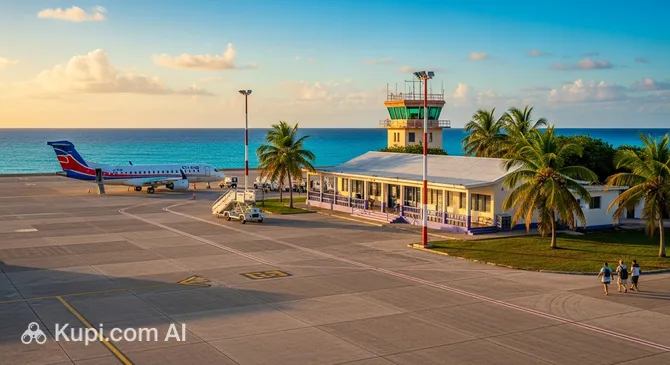
Cayo Largo Del Sur Airport. Source: Kupi.com Binoculars

Vilo Acuña International Airport is not just a transport hub, but a true portal to a world of serene Caribbean relaxation. As soon as the aircraft wheels touch the runway, passengers find themselves surrounded by turquoise waters and tropical greenery, as the air harbour is located right in the middle of the resort island. There is no hustle of huge metropolises here; the atmosphere of this place tunes you into relaxation from the first minutes of arrival. It is a compact and cosy airport where the journey begins with a warm breeze and the anticipation of an unforgettable holiday.

IATA Code CYO
ICAO Code MUCL
City Cayo Largo
Distance to centre 2–5 km (to the hotel zone)
Status International
Passengers per year ~150,000 (seasonal flow)
Schedule Current board available in the terminal

Features and Advantages of the Airport

The main advantage of Vilo Acuña Airport is its unique location and compactness. Unlike large hubs, everything here is within walking distance: very little time passes from the aircraft stairs to the terminal exit. Thanks to the small size of the island, the transfer to any hotel takes literally 10–15 minutes, allowing tourists to be on the beach almost immediately after landing.

Despite its modest size, the airport is equipped with an impressive runway about 3,000 metres long. This allows it to receive wide-body liners from Europe, Canada, and South America, ensuring a direct connection of the resort with the outside world without the need for transfers in Havana. The airport is fully adapted to the tourist flow, offering travellers the simple and clear service necessary for a comfortable start and end to their holiday.

Contact Information

For your convenience, we have collected the main contact information for Cayo Largo del Sur Airport (CYO). Please note that data may change, and for the most accurate and up-to-date information, it is recommended to contact airport representatives or your airline directly.

  • Official Website: The airport does not have a separate website. It is managed by the Cuban company ECASA. General information can be found on their web resource: www.ecasa.cu.
  • Inquiry Service Phone: +53 45 248 141.
  • Address: Cayo Largo del Sur, Isla de la Juventud, Cuba.
  • Email: There is no specialized email for passenger inquiries publicly available. It is recommended to use the phone for communication.
  • Social Media: The airport does not have official social media accounts.
  • Lost Luggage Information: If problems with luggage arise (loss, damage), you must immediately contact the Lost & Found counter or your airline representative at the airport.
  • Passenger Support Contacts: To resolve issues on the spot, contact the information desk in the terminal building or call the inquiry service.

How to Get to the Airport

Getting to Cayo Largo del Sur Airport (CYO), which serves the resort island of Cayo Largo, is effortless thanks to its compact size. The distance from most hotels to the terminal is minimal, and the trip rarely takes more than 10–15 minutes. The most popular and convenient method is a taxi or pre-booked transfer. Transfers are often organised by hotels or tour operators and may be included in the cost of your holiday in this paradise corner of Cuba. If you decide to take a taxi, it can easily be found at any hotel. The cost of the trip is usually fixed and low, but it is always better to check the price with the driver before departure.

There is no public transport in the classic sense (city buses or metro) on the island. Its role is played by tourist shuttles and "trencitos" (small road trains) that run between the main hotels, beaches, and the marina. Some of these routes may pass by the airport, but this is not the most reliable way to get to a flight. A much more predictable option is specialised hotel shuttle buses that deliver groups of tourists to the airport for specific flights. We recommend checking the schedule and availability of such a transfer at your hotel reception.

For those who value independence, transport rental is available on Cayo Largo. However, consider the local specifics: most often, it is not cars that are rented out, but scooters, quad bikes, or small jeeps. This is a great way not only to independently explore the secluded beaches of the island but also to drive to the airport without haste on the day of departure. Rental points are usually located in large hotels. Given the high demand during the tourist season, it is better to book transport in advance.

Cayo Largo del Sur Airport is small and serves mainly charter and domestic flights, so parking problems do not arise here. There is a small parking zone near the terminal building where you can leave a rented scooter or car while waiting or seeing someone off. Parking conditions are as simple as possible, and the fee is usually symbolic or non-existent. Nevertheless, the most carefree option for most travellers remains an organised transfer, allowing you not to worry about details on the day of departure.

Terminals and Map

Cayo Largo del Sur Airport (CYO) is a small and cosy aviation hub that fully corresponds to the relaxed atmosphere of the resort island. Its structure is as simple as possible, making navigation intuitive even for those visiting for the first time.

In fact, the airport consists of one terminal that serves both international and domestic flights. The building is very compact, and all key zones are located within walking distance of each other. There are no complex transitions, multi-level schemes, or need for shuttles — it is practically impossible to get lost. Immediately after entering, you find yourself in the general area with check-in counters.

Departure and arrival zones are separated but located in the same building. After checking in for the flight, passengers pass through pre-flight security and enter a small waiting hall. There is a minimal set of amenities here: several shops with souvenirs and local products, a small bar, and a sufficient number of seats. The arrival zone is even more concise: after leaving the aircraft, passengers immediately head to the hall for passport control, and then to the luggage claim belt.

Check-in and security procedures usually go quite quickly, as the airport is not designed for a large passenger flow. Nevertheless, it is recommended to arrive 2–2.5 hours before the departure of an international flight to complete all formalities without haste. For navigation, it is enough to follow the few signs or simply move along with the flow of other passengers — the entire path from the entrance to the boarding gate is extremely clear.

Airport History

Cayo Largo del Sur Airport (CYO) is not just an air gateway, but the heart of the tourist life of Cayo Largo island. Its history is inextricably linked with the transformation of a secluded corner of Cuba into a popular international resort. The airport was built and opened in the early 1980s specifically to receive tourists from all over the world wishing to enjoy the paradise beaches and crystal-clear waters of the Caribbean Sea. From the very beginning, it was a key element in the island's development plan.

As the popularity of the resort grew, so did the airport itself. Initially designed to serve a small flow of charter flights, it eventually required expansion. The most significant modernisation took place at the turn of the 20th and 21st centuries. During the reconstruction, the passenger terminal was updated, and the runway was extended, which allowed for the reception of larger long-haul aircraft from Canada and Europe. This became an important stage that took the island's tourist infrastructure to a new level.

The history of the airport is also a history of resilience. Located in a zone prone to hurricanes, it has repeatedly faced the challenges of the elements but has been restored every time, becoming only more reliable. An interesting fact: for such a small island, the airport has a surprisingly long runway — about 3,000 metres. This allows it to easily receive direct flights from distant countries, making the journey to this secluded island as comfortable as possible. Today, Cayo Largo del Sur Airport remains a vital artery connecting this Caribbean paradise with the rest of the world.

Services and Amenities

Cayo Largo del Sur Airport (CYO) is a small international airport serving mainly tourist charter flights. The infrastructure here is compact and provides a basic set of services necessary for travellers upon arrival at the resort or before flying home. In the terminal building, you will find several small shops where you can buy souvenirs and local goods, as well as a small duty-free shop. You can have a snack and drink refreshing beverages in the bar or café.

For a more comfortable wait for the flight, passengers are offered a VIP lounge, access to which can be paid for on the spot or obtained as part of the service package of some airlines. Conditions of stay should be clarified in advance. Access to Wi-Fi at the airport is usually paid and carried out via access cards that can be purchased right there. The number of sockets for charging devices is limited, so it is recommended to have a portable charger with you.

A currency exchange point (CADECA) operates at the airport, where tourists can exchange foreign currency for local money. This is especially convenient, as you will need cash upon arrival on the island. Also, a first aid post is located within the terminal, where basic medical assistance will be provided if necessary.

Services for passengers with children and people with disabilities are quite basic. There are no special play areas, but there is a mother and child room. Passengers with special needs are recommended to notify their airline in advance about the need for accompaniment or assistance for comfortable movement around the airport. The staff is always ready to help.

There are no hotels directly on the territory of Cayo Largo del Sur Airport. All hotel complexes and villas are located a few minutes' drive from the terminal, and transfer to them is usually organised by tour operators or hotels. Specialised business centres or conference halls are absent at the airport, which corresponds to its resort focus.

Where to Eat

Cayo Largo del Sur Airport (CYO) is a small tourist airport serving a resort island. In this regard, the choice of catering establishments here is quite limited and designed primarily so that passengers can have a snack before departure. Do not expect a large variety of restaurants here, as in major international hubs.

The main dining point at the airport is a small café or snack bar, usually located in the general hall before security control (landside). Another small bar may be located in the departure zone (airside). Their opening hours depend directly on the flight schedule — usually, they open a few hours before departure and close after the last plane leaves.

The menu usually features:

  • Quick snacks: sandwiches (most often with ham and cheese), pastries, crisps, and other snacks.
  • Drinks: coffee, tea, carbonated drinks, juices, and water.
  • Beverages: local options and, of course, the famous Cuban specialties.

Regarding special offers, there are no full-service restaurants with local cuisine at the airport. However, you can enjoy a cup of strong Cuban coffee or have a farewell drink before leaving the island. Vegetarian options are generally very limited (for example, a cheese sandwich), and finding specialised vegan, gluten-free, or Halal options is practically impossible. If you have strict dietary restrictions, it is strongly recommended to take food with you.

Prices at the airport are tourist-oriented, slightly higher than in hotels. Thus, Cayo Largo airport is more suitable for a light snack or buying drinks than for a full lunch. The best solution would be to eat a hearty meal at your hotel before the transfer to the airport.

Tips for Travellers

Travelling through Cayo Largo del Sur Airport is the gateway to one of the most picturesque corners of Cuba. To make your trip go smoothly, use our tips to help navigate this small but busy airport.

Arrival Time and Check-in. The airport in Cayo Largo serves mainly charter flights, so we recommend arriving at least 2-3 hours before departure. During peak hours, when passengers from several flights gather for check-in, queues may arise. Have your passport, ticket, and tourist card (tarjeta del turista) ready — this will significantly speed up the process.

Security Check and Hand Luggage. The screening procedure is standard, but due to the compact size of the airport, be prepared for possible waiting. Be sure to put all valuables, documents, necessary electronics, and medicines in your hand luggage. Don't forget to pack a swimsuit, sunscreen, and a hat — in case your luggage is delayed. Liquids are allowed in containers up to 100 ml. Famous Cuban specialties can be bought in the duty-free shop after passing control and freely taken on board the aircraft.

Seat Selection and Flight Delays. To enjoy unforgettable views of the turquoise Caribbean Sea and coral reefs, try to choose a window seat. In case of a flight delay, bear in mind that leisure opportunities at the airport are limited. Download films or books to your devices in advance and take a portable charger with you. It is better to check information about schedule changes directly with representatives of your airline.

Customs Control. When flying out of Cuba, restrictions apply to the export of certain goods. Without a special declaration and receipts, you are permitted to export up to 50 cigars and a limited amount of local beverages per person. Keep receipts for all major purchases to avoid misunderstandings at customs.

Passengers with Transfers. Cayo Largo del Sur Airport is not a transit hub, and most flights are direct charters. If you do have a transfer planned (for example, in Havana), allow enough time for it. Most likely, you will need to collect your luggage and go through check-in again for the next flight.

Saving Time and Money. If possible, complete online check-in for the flight if your airline provides such a service. Prices for food and drinks at the airport can be inflated, so it is worth taking a light snack with you. An empty water bottle can be filled after passing security. It is better to exchange currency at the airport in small amounts — only for the most necessary expenses.

Reached the end of the page?

That means the route is fully explored