Support

Brest Bretagne Airport

About the Airport

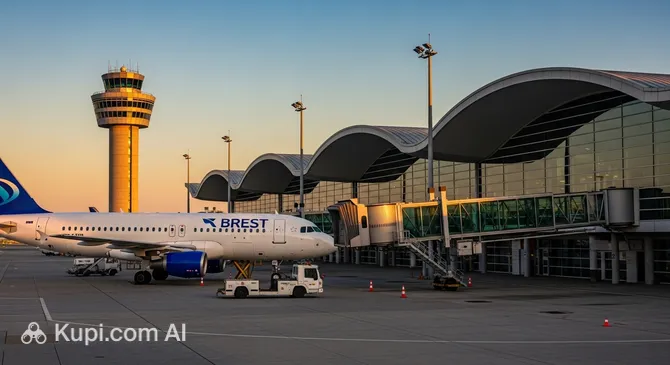
Brest Bretagne Airport. Source: Kupi.com Binoculars

Brest Bretagne Airport (Aéroport Brest Bretagne) is the main aerial gateway to the far west of France, opening the way to the picturesque shores of the Finistère department. The modern terminal building, with its unique architecture resembling a manta ray, immediately sets travellers in the mood for an encounter with the Atlantic. Thanks to its compact size and thoughtful navigation, a calm atmosphere reigns here, allowing you to begin your acquaintance with the region without unnecessary bustle.

IATA Code BES
ICAO Code LFRB
City Brest (France)
Distance to Centre ~10 km
Status International
Annual Passengers ~811,000 (2023)
Schedule Available on the official website

Features and Advantages of the Airport

The Brest Bretagne Airport terminal is not just a functional building, but a true architectural object that blends harmoniously into the landscape. Panoramic windows provide plenty of natural light, and the intuitive layout allows you to complete all formalities in a matter of minutes.

For the convenience of passengers, excellent transport links with the city have been established: a special shuttle takes tourists to Tram Line A, which leads directly to the centre of Brest and the railway station. The airport also offers a wide range of services, including car rental, which is particularly relevant for those wishing to independently explore the unspoiled beaches and lighthouses of Brittany.

Contact Information

Below is the essential contact information for passengers departing from or arriving at Brest Bretagne Airport (BES).

  • Official Website: www.brest.aeroport.bzh. Here you will find flight schedules, information on parking, services, and the latest news.
  • Information Desk Phone: +33 2 98 32 86 00. You can obtain general information about the airport's operations at this number.
  • Airport Address: Aéroport Brest Bretagne, 29490 Guipavas, France.
  • Email: To contact various airport departments, it is recommended to use the contact forms available on the official website in the "Contacts" section.
  • Social Media: You can follow airport updates on its official pages on Facebook and Instagram.
  • Lost Luggage Information: If your luggage has been lost or damaged, please contact your airline's baggage tracing service (Service Litiges Bagages). Contacts for the Lost and Found office (objets trouvés) at the airport can be found on the official website.
  • Passenger Support Contacts: For general questions and support, please use the main information desk phone number or the feedback forms on the website.

How to Get to the Airport

Reaching Brest Bretagne Airport (BES), located approximately 10 km northeast of the centre of Brest, is possible via several convenient methods. The choice depends on your budget, time, and comfort preferences while travelling through this picturesque region of France.

Public Transport: The most economical way is to use the shuttle bus (Navette Aéroport). It runs between the airport and the Porte de Guipavas tram stop (Line A). The shuttle ride takes only about 10 minutes. From there, you can easily reach the city centre and the railway station by tram. The total travel time from the city centre is approximately 30-40 minutes. The fare is equal to the price of a standard ticket for the Bibus city transport network, making this option very affordable.

Taxi and Transfer: For maximum convenience, you can take a taxi. The rank is located right outside the arrivals terminal exit. A trip to the centre of Brest will take about 15-20 minutes depending on traffic conditions. The estimated cost during the day is €25-€35. This is an excellent option if you are travelling with heavy luggage or a small group. You can also pre-book a private transfer so that a driver meets you with a name sign, ensuring a fixed price.

Car Rental: If you plan to explore the beauties of Brittany, car rental will be the ideal solution. Offices of leading international and local rental companies (Avis, Europcar, Sixt, and others) are represented at Brest Airport. The counters are located within the terminal building, allowing you to process all documents and collect keys immediately upon arrival. The airport is conveniently connected to the main road network via the N12/E50 highway.

Airport Parking: For those arriving in their own or rented vehicle, several parking lots are provided at the airport. There are options for short-term parking (P1 Proximité) directly opposite the terminal and for long-term stays (P2, P3 Éco) with more favourable rates. It is recommended to book a parking space online in advance — this often allows you to receive a discount.

When planning your journey, you may also consider other airports in the region that might be convenient depending on your route. Among them are Quimper–Bretagne Airport in Quimper, Lannion – Côte de Granit Airport in Lannion, and Lorient South Brittany Airport in Lorient. For trips further along the coast, you might consider Dinard–Pleurtuit–Saint-Malo Airport or even the international Guernsey Airport in the Channel Islands.

Terminals and Map

Brest Bretagne Airport (BES) is a modern and compact airport serving the city of the same name in the west of France. Its structure is designed for maximum passenger convenience, so navigation here will not cause difficulties even for first-time visitors.

Structure and Navigation

The airport consists of one passenger terminal that serves both domestic and international flights. Thanks to this, there is no need for long walks or shuttle transfers — all zones are located in one building and within walking distance of each other. The terminal layout is intuitive: check-in counters and the arrivals area are located on the ground floor, while the departures area with security control and boarding gates is on the first floor.

Departure and Arrival Zones

The Departure Zone (Départs) is located on the first floor. After checking in on the ground floor (or online), passengers proceed upstairs to pass through security control. Security procedures at Brest Airport are usually quick, but during peak hours, it is recommended to allow extra time. On average, you should allocate about 1.5-2 hours before an international flight and about 1-1.5 hours for a domestic one for check-in and security. After screening, you will enter the secure area with several shops, cafes, and comfortable waiting lounges before the boarding gates.

The Arrival Zone (Arrivées) is located on the ground floor. Immediately after disembarking the aircraft, passengers proceed to the baggage claim hall. The baggage carousels are located next to the exit into the public hall. Here you will also find car rental offices, a tourist information desk, and the exit to taxi and bus stops.

Navigation Recommendations

Due to the airport's compactness, it is practically impossible to get lost here. Clear signs in French and English are present everywhere. Since there is only one terminal, you do not have to worry about finding the right building. The main advice is simply to follow the standard flow: check-in, security, boarding gate. This makes Brest Bretagne Airport one of the most convenient and least stressful regional airports in the country.

Airport History

The history of Brest Bretagne Airport (BES) began long before it became the region's main air hub. Its foundation dates back to 1937, when a French Navy airbase was opened in the commune of Guipavas. During the Second World War, the airfield held strategic importance and was used by various forces, leading to significant destruction.

Post-war reconstruction opened a new, civil chapter in the airport's history. The first commercial flights began in the 1950s, and in 1961, the first terminal building was constructed, marking the official start of passenger services. From that moment, the airport, then known as Brest-Guipavas, began to develop systematically, gradually increasing the number of destinations and passenger traffic.

A key stage of growth was a large-scale modernization. In 1990, a new, more spacious terminal was opened, but the real breakthrough occurred in 2007. It was then that the modern airport complex, which is used today, was put into operation. This allowed the airport to significantly increase its capacity, exceeding the mark of one million passengers per year, and to secure its status as the largest airport in Brittany. Along with the new terminal, the airport received a new name — Brest Bretagne, emphasizing its regional significance.

Today, Brest Bretagne Airport is not just a transport hub, but an important element of the economic and tourism infrastructure of the entire region. Its history is a journey from a military base to a modern aerial gateway connecting the western tip of France with the rest of Europe and the world, whilst preserving the memory of its rich past.

Services and Facilities

Brest Bretagne Airport (BES) offers passengers all necessary services for a comfortable wait before their flight. Within the terminal, you will find several cafes and restaurants where you can have a snack or a full meal, enjoying dishes of local and European cuisine. For shopping enthusiasts, stores are open, including Duty Free with a wide assortment of perfumes, cosmetics, and souvenirs.

For those who wish to stay connected or work, free Wi-Fi is available at the airport, as well as numerous charging stations for electronic devices. Passengers preferring enhanced comfort can utilize the services of the VIP lounge, offering a quiet atmosphere, beverages, and snacks away from the general bustle.

The terminal provides all basic amenities: there are ATMs and currency exchange points for handling financial matters. In case of need, the airport has a medical point where first aid can be provided. For business travellers, a business centre is equipped with conference rooms suitable for meetings and negotiations.

The airport cares for all categories of travellers. For passengers with children, mother and child rooms and play areas are provided. Passengers with reduced mobility are offered special assistance (it is recommended to book this service in advance), and the terminal infrastructure is fully adapted to their needs.

If you need to stay overnight before or after your flight, several hotels of various price categories are located in the immediate vicinity of the airport, making it a convenient starting point for travelling around the Brittany region and the city of Brest, one of the most important ports in the west of France.

Where to Eat

Brest Bretagne Airport (BES) offers travellers several options for a snack or a full meal, reflecting the culinary traditions of the Brittany region and all of France. Regardless of how much time you have before your flight, you will be able to find a suitable place to refresh yourself.

The main establishment for those wishing to have a leisurely lunch or dinner is located in the public zone (landside), on the first floor of the terminal. Here sits a restaurant where you can order dishes of traditional French and Breton cuisine. This is an excellent opportunity to try local specialities, for example, galettes (buckwheat pancakes with hearty fillings) or dishes made from fresh seafood. This place is ideal for meeting with those seeing you off or for those who have arrived at the airport early and wish to enjoy a ``real French lunch``.

If you need a ``quick snack`` after passing through security control, a cafe-bar operates in the departure zone (airside). Here you will find a wide selection of sandwiches, salads, pastries (croissants, pain au chocolat), as well as hot and cold beverages. This is an ideal option to grab a coffee and something light to take on board or to quickly refresh yourself while waiting for boarding.

Regarding special dietary needs, vegetarian options such as salads or sandwiches with vegetables are usually present on the menu. For information on ``gluten-free`` or specific dietary dishes, it is best to speak directly to the cafe or restaurant staff. Travellers looking for Halal-friendly options may prefer the seafood or vegetarian selections available. The price range at the airport is average: the cost of a full meal in the restaurant will be higher than the price of a sandwich or pastry in the cafe. Opening hours of catering establishments are generally ``tied to the flight schedule`` — they open with the first morning departures and close after the last evening planes leave.

Tips for Travellers

To ensure your journey through the airport of Brest in beautiful France goes smoothly and without stress, take advantage of our tips. Brest Bretagne Airport (BES) is modern and fairly compact, but proper preparation is never superfluous. We recommend arriving at the airport at least 2 hours before domestic or Schengen flights and 3 hours before international ones. This time is sufficient to calmly complete all formalities, even during peak seasons.

To save time, use online check-in, which is offered by most airlines. This will allow you to avoid queues at the check-in counter if you are travelling only with hand luggage. Security screening here is standard for EU countries. Prepare documents in advance, remove metal objects from your pockets, and pack liquids up to 100 ml in a transparent bag. Laptops and other large electronics are usually required to be taken out of your bag.

When choosing a seat on the plane, be guided by your preferences: a window seat will give you picturesque views of the Brittany coast, while an aisle seat ensures more legroom and the freedom to stand up. Regarding hand luggage, remember the strict rules: any sharp objects, flammable substances, and liquids in containers larger than 100 ml are prohibited. Always check the carry-on and baggage allowances on your airline's website, as they may differ.

If you have a transfer at Brest Airport, clarify whether you need to collect and re-check your luggage. Typically, for flights within the Schengen zone, this is not required. Customs control for those arriving from non-EU countries includes checking for goods subject to declaration. If you are travelling within the EU, customs formalities are kept to a minimum.

To save money, bring an empty water bottle with you, which can be filled after passing security control. Prices for food and drinks at the airport are traditionally higher. It is also worth booking parking or transfers in advance if you plan to use them — this is often more economical than paying on the spot.

In case of a flight delay, first contact your airline representative for information. Remain calm and clarify your rights. In accordance with EU regulation EU Regulation 261/2004, for long delays, passengers are entitled to assistance (drinks, meals), and in some cases, monetary compensation. Keep all documents related to the flight handy and do not hesitate to ask airport staff questions.

Reached the end of the page?

That means the route is fully explored