Support

musée de Cambrai

About

In the heart of the historical center, within the elegant walls of the Hôtel de Francqueville mansion, lies the Musée de Cambrai — the region's premier cultural treasure. This unique museum complex harmoniously combines majestic 18th-century architecture with bold modern additions, creating a space where time seems to stand still. In the city of Cambrai, this site is rightfully considered a must-visit for all connoisseurs of history and fine arts.
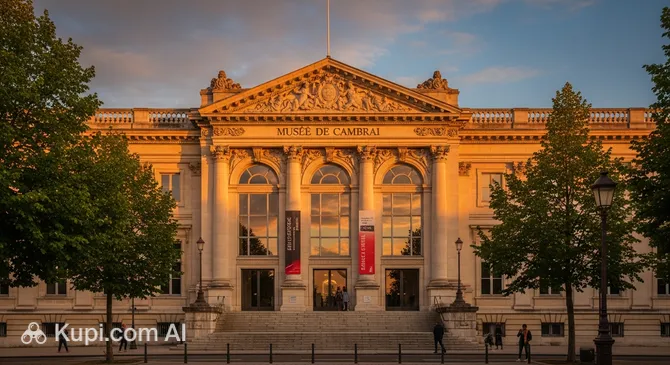
Cambrai Museum
Cambrai Museum. Иллюстрация. Источник: Kupi.com AI

The museum's collection spans an impressive time range: from ancient times to the present day. Here, in this part of France, visitors can see rare archaeological finds from the Merovingian period, an osteo-archaeology exhibition unique to the country, and canvases by great masters. The galleries feature works by Henri Matisse, Auguste Rodin, and Camille Claudel, while a special place is held by the collection of 17th-century Flemish and Dutch paintings.

The museum’s special atmosphere is enhanced by its division into thematic levels that guide guests through the ages. Besides classical art, the museum is famous for its focus on geometric abstraction and local heritage, including an amazing 18th-century processional carriage. It is not just a repository of antiquities, but a vibrant cultural hub offering a deep immersion into the unique history and aesthetics of the region.

Contacts

For more information about special exhibitions or to plan a group visit, you can use the institution's official contact details.

How to contactContact
Address15 Rue de l'Épée, 59400 Cambrai, Франция
Phone+33 3 27 82 27 90
Websitewww.villedecambrai.com

What to Do

A visit to the museum turns into a fascinating journey through millennia, organized across four levels. Starting in the underground halls, you can explore archaeological treasures, including artifacts from Merovingian burials. Special attention should be paid to the osteo-archaeological collection — a rare opportunity to see how modern scientific methods allow for the reconstruction of the lifestyles and even the health of people who lived here hundreds of years ago.

In the fine arts galleries, be sure to find works by outstanding masters: Rodin's emotional sculptures, Camille Claudel's delicate forms, and the vibrant accents in Matisse's works. Don't miss the chance to peek into the large brick salon where monumental canvases are displayed, and definitely check out the geometric abstraction collection, which is one of the museum's highlights.

For those interested specifically in the city's history, the heritage department will be a true discovery. Here you can see an old 17th-century relief map of the city and the unique processional carriage of the Canonesses of Sainte-Aldegonde — the only exhibit of its kind in the entire country. The museum also offers interactive and educational areas that will interest both adults and children, making the learning process engaging and accessible.

Getting There

Located at 15 Rue de l'Épée, the museum is situated in the heart of the historical center. Reaching it on foot from the Gare de Cambrai railway station is easy — the walk takes about 15–20 minutes (approximately 1.5 km), allowing you to admire the city's architecture along the way.

For those who prefer public transport, it is convenient to use the ARCIN city bus network. The closest stops are Hôtel de Ville or directly Rue de l'Épée. These lines connect the station and suburban areas with the central part of the city. The city also has a Vel'Ô Nord bike-sharing system, making two-wheeled travel a pleasant alternative.

If you are traveling by car, follow the A2 or A26 motorways leading to the city. You can leave your car in one of the central parking lots, such as Parking Hôtel de Ville, which is just a few minutes' walk from the museum entrance. For navigation, it is convenient to use online maps, which accurately route you to the doors of this cultural center.

Ближайший город: Cambrai

History & Facts

The history of this cultural institution began in 1847, when the need arose to house artifacts confiscated during the Revolution in the episcopal city. Initially, the collection was kept in the National Guard rooms at the town hall, but over time, the collection expanded significantly thanks to state gifts and acquisitions. One landmark event was the transfer of 43 pieces of Greek and Etruscan ceramics from the famous Giampietro Campana collection in 1863.

A significant milestone came in 1888, when local industrialist Auguste Legrand bequeathed his mansion to the city for the museum's needs. This allowed for the creation of a spacious salon to display large-format paintings. The new home for the collections became the Hôtel de Francqueville, an exquisite mansion built in 1720, which officially opened its doors to visitors in the spring of 1893. Since then, the museum has gone through several stages of renewal, including the preservation of its treasures during historical periods and a major reconstruction at the end of the 20th century.

The museum's modern appearance is the result of a bold architectural solution from 1994, when modern wings were added to the historical building. The most recent major renovation in 2018 allowed for a complete update of the exhibition, making it more accessible and interactive. Today, the museum does not just preserve art objects but tells the story of the region's evolution from the ancient settlement of Camaracum to an important textile and cultural center in the north of the country.

Time Needed

To leisurely explore all four levels of the exhibition, a typical visitor will need 2 to 3 hours. This time is quite sufficient to travel from prehistoric times in the archaeological department to the masterpieces of modern abstraction, while paying attention to details and information stands.

If you are deeply interested in the region's history or plan to study the unique osteo-archaeology collection and the rare processional carriage in detail, your visit may take longer. Art lovers should also set aside an extra half hour to view the galleries featuring works by Flemish masters and French classics such as Matisse and Rodin.

Working Hours

The museum welcomes guests on a convenient schedule during the second half of the week. You can visit the exhibition from Wednesday to Sunday. Opening hours are divided into two blocks: morning from 10:00 AM to 12:00 PM and afternoon from 2:00 PM to 6:00 PM.

Please note that on Mondays and Tuesdays, the museum is closed to visitors. It is recommended to plan your visit in advance and check the information on the city's official website, as the schedule may change on public holidays.

DayWorking hours
понедельникЗакрыто
вторникЗакрыто
среда10:00–12:00, 14:00–18:00
четверг10:00–12:00, 14:00–18:00
пятница10:00–12:00, 14:00–18:00
суббота10:00–12:00, 14:00–18:00
воскресенье10:00–12:00, 14:00–18:00

Nearby

The museum's location in the historical core of the city opens up great opportunities for further exploration. Just a few steps away, you will find many architectural monuments that will help you better experience the atmosphere of the ancient French center.

Exploring the surroundings will allow you to see preserved defensive structures, Gothic towers, and cozy squares, each holding its own legends. Here is a list of nearby points of interest:

NameDistance
Cambrai Cathedral (Cathedral of Our Lady of Grace)0.2 km
CupCoffee Burger Restaurant0.5 km
Kyoto0.7 km
Le Carré0.8 km
L'Eau à la Bouche1.1 km
Goudale Restaurant1.1 km
Shop'in Cambrai Shopping Centre2.9 km

Reached the end of the page?

That means the route is fully explored