Support

Dole-Jura Airport

About the Airport

Dole-Jura Airport is not just an air gateway, but your personal key to the treasures of eastern France. Located between the picturesque Jura mountains and the famous vineyards of Burgundy, it serves as the ideal starting point for travels across the Bourgogne-Franche-Comté region. Compact and modern, this airport eliminates the hustle of major hubs, offering a calm and comfortable start to your French adventure, whether it is a business trip or a long-awaited holiday.
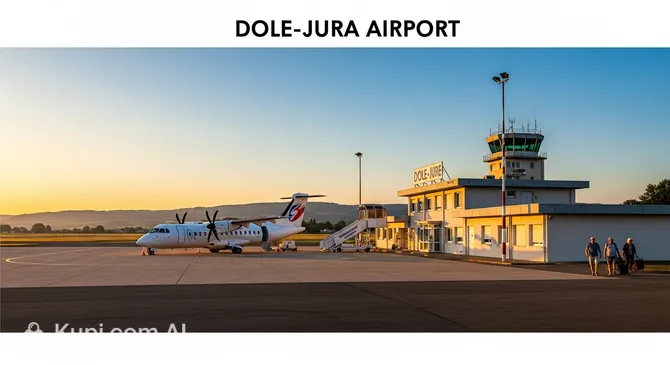
Dole-Jura Airport. Source: Kupi.com Binoculars
IATA Code DLE
ICAO Code LFGJ
City Dole
Distance to centre about 7 km
Status International
Annual passengers about 100,000
Popular Airlines Ryanair, Air Corsica

The main advantage of Dole-Jura Airport is its efficiency and convenience. Thanks to its small size, all procedures, from check-in to boarding, are completed quickly and without unnecessary stress here. You will not get lost in endless corridors or spend much time in queues, which is especially appreciated by travellers eager to start their holiday as soon as possible.

The airport has a strategic location, making it attractive for tourists. From here, it is equally easy to reach the ski resorts and nature parks of the Jura, as well as the historic cities of Dijon and Besançon. All necessary services are available in the terminal, including cafés and car rental desks — the best way to explore this picturesque and multifaceted region.

Contact Information

  • Official website: You can find the most up-to-date information on flight schedules, services, and airport rules on the official website: www.aeroport-dole-jura.com.
  • Help desk phone: For immediate information and enquiries, you can call: +33 3 84 72 04 26.
  • Airport address: The airport is located at: Route de l'Aéroport, 39500 Tavaux, France.
  • Email: For written requests and feedback, please use the e-mail: contact@aeroport-dole-jura.com.
  • Social media: Follow news, updates, and special offers from the airport on its official social media pages, such as Facebook.
  • Lost luggage information: In case of loss or damage to luggage, you should first contact your airline's baggage tracing service. Additional information can be obtained from the airport help desk.
  • Passenger support service: For general questions related to your stay and service at the airport, please contact the main help desk number.

How to get to the airport

Dole-Jura Airport (DLE) is located just a few kilometres southwest of the city of Dole, making the journey to the terminals quick and simple. You can reach the air harbour in several ways, choosing the option that best suits your budget and comfort level for travelling around France.

The most economical and popular form of public transport is the shuttle bus (navette). Its schedule is specifically coordinated with flight departure and arrival times, which is very convenient for passengers. Usually, the shuttle runs between the airport and the main railway station in Dole. The trip takes about 15–20 minutes, and the ticket costs approximately 6–8 EUR. This makes the shuttle an excellent choice for solo travellers and those wishing to save money.

If you prefer comfort and speed, your choice is a taxi or a pre-booked transfer. The trip from the city centre will take no more than 10–15 minutes. Taxi fares usually range from 25–30 EUR, but may vary depending on the time of day and the exact address. This is the ideal option if you have a lot of luggage, are travelling with family, or simply want to get to the airport without extra transfers and with maximum convenience.

For those travelling by private or rental car, the road to Dole-Jura Airport will be straightforward thanks to convenient signage and proximity to major highways. The airport features spacious parking located within walking distance of the terminal. There are zones for both short-term stops and long-term parking for the duration of your absence, making this method particularly convenient for car travellers.

Terminals and Map

Dole-Jura Airport (DLE) is a small regional airport distinguished by its compactness and passenger convenience. Its structure is extremely simple: it consists of one passenger terminal that handles all flights — both departures and arrivals. This eliminates the need for complex transfers and makes orientating yourself in the airport as simple as possible.

The terminal building has an intuitive layout. All main zones are located on one level, making navigation extremely easy. On one side of the main hall, you will find the check-in desks and baggage drop-off. Immediately behind them is the pre-flight security area, leading to a small waiting lounge with boarding gates. The arrivals area is also integrated into the general structure: after disembarking from the aircraft, passengers enter the baggage claim hall, and then the general meeting area.

One of the main advantages of Dole-Jura Airport is the fast completion of all formalities. Thanks to the low passenger traffic and efficient staff, check-in and security checks usually take no more than 20–30 minutes. Nevertheless, it is recommended to arrive at the airport the standard 1.5–2 hours before departure to go through all procedures without rushing.

To navigate the airport, simply follow the clear signs. You will not have to walk long distances to the boarding gate or search for the necessary zone, as everything is within walking distance. The absence of multiple terminals and complex corridors makes travelling through Dole-Jura Airport particularly comfortable for families with children, elderly travellers, and anyone who values their time and prefers to avoid the hustle of large aviation hubs.

Airport History

The history of Dole-Jura Airport (DLE) begins in 1939, when a military airfield was established on this site for the needs of the Air Force of France on the eve of World War II. For many years, it performed exclusively military functions, serving as a base for various aviation units.

The transition to civil use became a key stage in the airport's development. In 1970, the airfield was officially opened for commercial flights and was named Dole-Tavaux. This event marked the beginning of its transformation into a regional transport hub, although for several decades its activity remained quite modest.

A new era for the airport began in the 2000s. Large-scale infrastructure modernisation was carried out, including the reconstruction and extension of the runway to 2,230 metres, which allowed it to accommodate larger aircraft. In 2004, the airport was renamed Dole-Jura to better reflect its role in serving the entire picturesque Jura department and attracting tourists to the region.

A real breakthrough and record for the airport was the attraction of budget airlines in the early 2010s. With the arrival of low-cost carriers, passenger traffic grew significantly, turning Dole-Jura into a popular "air gateway" for travellers from all over Europe. This allowed for the establishment of regular connections with Portugal, Morocco, and other countries.

An interesting fact from the airport's history lies in its successful dual purpose. Despite active civil operations, it is still partially used for army aviation needs to this day. Thus, Dole-Jura represents a unique example of the harmonious coexistence of a military past and a dynamic civil present, playing an important role in the transport system of the Bourgogne-Franche-Comté region.

Services and Amenities

Dole-Jura Airport (DLE) is a compact regional aviation hub in eastern France, offering passengers all essential amenities for a comfortable wait for their flight. Since the airport is small, the choice of establishments here is limited but sufficient for a snack before departure. At your service is Trib’s restaurant, where you can order beverages, sandwiches, salads, and hot dishes. There is also a small shop selling travel essentials, press, and regional souvenirs.

For those who need to stay connected, free Wi-Fi is available throughout the terminal. You can also find power outlets for charging electronic devices in the waiting lounges. ATMs are installed at the airport; however, there are no specialised currency exchange bureaus, so it is recommended to arrange currency exchange in advance. Medical assistance is provided through the first aid service in emergency situations.

The airport is equipped to receive passengers with special needs. Assistance is provided for moving through the terminal, as well as boarding and disembarking from the aircraft. To receive this service, you must notify the airline of your needs at least 48 hours before departure. For travellers with small children, there are baby care rooms with changing tables. Regarding VIP lounges, due to the airport's size, separate lounges for business class passengers are not provided here.

There are no hotels directly inside the airport building, but several accommodation options can be found in the immediate vicinity, such as ibis and Campanile hotels. More hotels are located in the city of Dole itself, which is easily accessible by taxi or shuttle. There are no specialised conference rooms or business centres on the territory of Dole-Jura Airport; for business meetings, it is better to use the infrastructure of hotels in the city or its surroundings.

Where to Eat

Dole-Jura Airport (DLE) is a compact regional airport in France, so the choice of catering establishments here is designed primarily for passengers who need a quick snack before departure. Do not expect a variety of restaurants here as in major international hubs, but everything necessary for a comfortable wait for your flight is available.

The only place for a snack at the airport is Trib’s café. It is located in the general departure hall, in the so-called "landside" area, before passing security control. This makes it convenient for both departing passengers and those seeing them off. Opening hours are usually tied to the flight schedule: it opens a few hours before the first departure and closes after the last aircraft leaves.

The Trib’s café menu offers a standard set for a quick bite:

  • Beverages: Coffee, tea, hot chocolate, juices, water, and soft drinks.
  • Pastries: Croissants, chocolate rolls, and other fresh pastries — an excellent option for breakfast.
  • Snacks: Sandwiches with various fillings (meat, cheese), salads, crisps, yoghurts.

Full hot meals are generally not offered here. Prices are typical for small European airports — higher than in the city, but quite acceptable.

Regarding special dietary needs, choices are extremely limited. Vegetarians may find a cheese sandwich or a simple salad. However, specialised vegan, gluten-free, or Halal dishes are practically impossible to find here. Sometimes local products can be found in the assortment, such as Comté cheese from the Franche-Comté region, but this is rather an exception. If you have strict dietary restrictions, it is highly recommended to bring food with you.

Thus, Trib’s café at Dole-Jura Airport is ideal for a quick snack and a cup of coffee before the flight. If you are looking for a full lunch or dinner, it is better to do so in advance at one of the restaurants in the city of Dole or its surroundings.

Travel Tips

To ensure your journey through Dole-Jura Airport goes as smoothly as possible, take advantage of our tips. This is a small regional airport, so many procedures here are faster than in large hubs, but preparation is never redundant.

Arrival time and check-in. We recommend arriving at the airport approximately 1.5–2 hours before your flight departure within the Schengen zone. Although queues are usually short here, it is better to have a time buffer. To save time, complete online check-in on your airline's website and save the boarding pass on your phone.

Security checks. The procedure is standard but typically goes faster. Pack all liquids up to 100 ml in a transparent bag in advance, and be prepared to take laptops and other large electronics out of your bag for separate scanning. This will significantly speed up the screening process.

Seat selection. If the airline allows you to choose a seat, consider your preferences. Window seats (A, F) offer beautiful views during take-off and landing. Aisle seats (C, D) are convenient if you plan to get up during the flight. Seats in the front of the cabin will allow you to disembark faster after landing.

Hand luggage. Strictly observe hand luggage rules. It is prohibited to take sharp objects, weapons, flammable substances, and liquids in containers larger than 100 ml into the aircraft cabin. Always check the weight and size limits for hand luggage on your airline's website, as they may differ.

Connecting passengers. Dole-Jura Airport is not a major transit hub and mainly serves direct flights. If you do have a transfer planned, check with your airline in advance whether you will need to collect and re-check your luggage.

Customs control. For flights within the Schengen area, passport control is usually absent. If you are arriving from a country outside Schengen or flying to one, you will have to pass passport and customs control. Follow the "Green Channel" if you have nothing to declare, or the "Red Channel" if you are carrying goods subject to declaration under the laws of France.

Saving time and money. Book flight tickets and airport parking in advance. Travel light with only hand luggage to avoid waiting for baggage. Bring an empty water bottle that can be filled after passing security control — this will save money on drinks.

Flight delays. In case of a flight delay or cancellation, monitor information on the departure boards and in your airline's app. Contact the carrier's representative for information about your rights to food, drinks, or hotel accommodation in accordance with EU rules. Although Dole airport is small, there is a café here where you can spend time comfortably while waiting.

Reached the end of the page?

That means the route is fully explored