Support

Libreville Airport

About the Airport

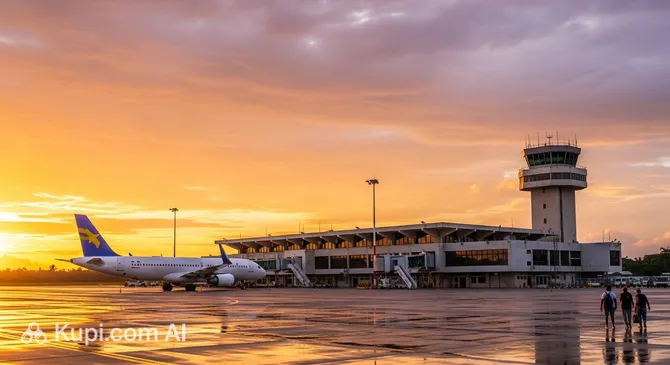
Libreville Airport. Source: Kupi.com Binoculars

Leon M'ba International Airport is the main aerial gateway to Gabon, where your journey begins with a touch of the exotic: the runway is located practically at the very edge of the Atlantic Ocean. Upon landing here, passengers can observe picturesque views of the coast and lush tropical greenery before even stepping off the plane. Despite its compact size, the airport is a key transport hub for the country, connecting Libreville with major cities in Africa and Europe.

IATA Code LBV
ICAO Code FOOL
City Libreville
Distance to Centre Approx. 7–12 km
Status International
Annual Passengers Approx. 800,000
Schedule Online Board

Features and Advantages of the Airport:

The main feature of the airport is its unique location. It is situated just a 15–20 minute drive from the city centre and in immediate proximity to the beaches: one simply needs to cross the road to reach the water. This makes waiting for a flight or meeting guests less tiring compared to large, remote hubs.

The terminal is equipped with everything necessary for a comfortable stay. Passengers have access to VIP lounges (such as the Samba Lounge), currency exchange points, and ATMs, as well as duty-free shopping areas where local souvenirs can be purchased. For the convenience of travellers, free Wi-Fi and mobile device charging stations are provided, allowing you to stay connected right up until boarding.

Contact Information

For your convenience, we have compiled the main contact information for Leon M'ba International Airport in Libreville. We recommend checking the accuracy of the data, especially phone numbers, on official resources before your trip.

  • Official Website: www.libreville-airport.com
  • Information Desk Phone: +241 011 73 82 82
  • Address: BP 2253, Libreville, Gabon (Aéroport international Léon-Mba de Libreville)
  • Email: To contact airport representatives, it is recommended to use the contact form on the official website.
  • Social Media: Current information and news can be found on the official page on Facebook.
  • Lost Luggage Information: In case of loss or damage to luggage, you must first contact your airline's Lost & Found service at the airport.
  • Passenger Support Service: For general inquiries, you can contact the main airport information desk phone number.

How to Get to the Airport

Libreville Leon M'ba International Airport (LBV) is located close to the city centre, making the journey there quite quick and simple. Depending on your chosen transport, traffic, and budget, you can reach the airport in several ways. The trip from the centre of Libreville usually takes between 15 to 30 minutes.

Taxi is the most popular and convenient way to get to the airport. You can find official taxis throughout the city. It is important to remember that meters are rarely used, so be sure to agree on the fare with the driver in advance, before getting into the car. The trip will cost several thousand CFA francs. This is a reliable and relatively fast option, especially if you have a lot of luggage.

Public Transport in Gabon is mainly represented by shared taxis (taxi-brousse) and minibuses. This is the most budget-friendly option, but it requires a certain degree of flexibility. Such transport does not have a strict schedule and departs as it fills up. It is a good way to immerse yourself in local life, but may not be the most comfortable if you are in a hurry or travelling with large suitcases.

Car Rental is an excellent choice for those planning to explore the surroundings of Libreville and other regions of the country on their own. Offices of both international and local rental companies operate at the airport and in the city. Ensure you have an international driving permit. The airport provides parking where you can leave your car for a short or long term.

Private Transfers are also an available option. Many hotels offer airport transfer services to their guests. Additionally, you can book a private car in advance through a travel agency. This is the most comfortable and predictable, albeit the most expensive, way to reach your destination without any hassle.

Terminals and Map

Libreville Airport (LBV) is distinguished by a simple and clear structure, making it convenient for passengers. You won't have to worry about complex transfers and long corridors, as all infrastructure is concentrated in one main terminal, which serves both international and domestic flights.

The terminal layout is intuitive. Arrival and departure zones are clearly separated. On the ground floor, you will find airline check-in counters and the arrivals hall, where passengers go through passport control, collect luggage, and pass through customs inspection. After checking in for a flight, passengers departing from Libreville proceed to the first floor, where security and passport control points are located, leading to the waiting area with boarding gates.

Since there is only one terminal in the airport, there is no need to transfer between buildings. All services and zones are located within a single complex, which significantly simplifies navigation. Signs and indicators are mainly in French, but their placement is logical, and figuring out the route will not be difficult.

It is recommended to allocate sufficient time for completing all formalities before departure. For international flights, it is worth arriving at the airport 2.5–3 hours before departure, and for domestic flights1.5–2 hours. Despite the airport's compactness, queues can form at check-in counters and security checks during peak hours.

The main recommendation for navigation is to follow the standard flow of passengers. After entering the building, you will immediately see the schedule board and check-in counters. After completing registration, look for signs for "Departures" and "Security Control". Thanks to the small size of the terminal, you will easily and quickly find everything you need.

Airport History

The history of the International Airport of Libreville, officially bearing the name of Leon M'ba, begins in the mid-20th century. It was founded back in the colonial era, but its key development and establishment as the country's main aviation hub occurred after Gabon gained independence in 1960. The airport received its current name in honour of the country's first president, highlighting its status as a vital national facility.

The main stimulus for the airport's development was the country's economic growth linked to oil production. During this period, its capabilities for handling international flights were significantly expanded. For a long time, it served as the base for the national carrier Air Gabon, whose history was closely intertwined with that of the air harbour. The airport has witnessed many important state visits and events, playing the role of the main gateway for diplomacy and business.

Over the decades, Libreville Airport has undergone modernization several times. One of the most significant stages was the extension and strengthening of the runway, which allowed for the reception of large long-haul aircraft, such as the Boeing 747. An interesting fact: in the past, the airport's infrastructure allowed it to service even supersonic passenger liners like the "Concorde," which performed rare but iconic flights here.

In the 21st century, work continues on improving the airport to meet modern international standards of safety and comfort. An important step in recent history was the commencement of a large-scale project to build a new passenger terminal. This initiative aims to increase capacity and further strengthen Libreville's position as an important transport hub in Central Africa.

Services and Amenities

Libreville Leon M'ba International Airport (LBV) offers travellers a set of essential services and amenities to make waiting for a flight more comfortable. Although the airport is not very large, everything necessary for passenger convenience is available here.

Dining and Shopping. In the terminal, you will find several cafes and coffee shops where you can have a snack, drink coffee, or enjoy refreshments. A Duty-Free shop is also in operation, offering a standard range of goods: perfumes, tobacco products, and souvenirs. The selection may not be as extensive as in major international hubs, but the essential items are present.

Lounges and Wi-Fi. For passengers preferring enhanced comfort, there are VIP lounges at the airport. Here you can relax in a quiet atmosphere and enjoy complimentary snacks and beverages. Wi-Fi is available throughout the terminal, and there are charging stations for electronic devices so you can always stay connected.

Financial and Medical Services. The airport has currency exchange points and ATMs where you can withdraw cash. A medical centre is provided in case of illness or the need for first aid.

Services for Passengers with Special Needs. The airport is equipped to serve passengers with reduced mobility: wheelchairs and staff assistance for boarding are provided. Families with small children can use mother and child rooms for infant care.

Accommodation and Business Services. There are no hotels directly on the airport premises, but several hotels are located in the immediate vicinity, offering convenient accommodation for transit passengers. There are no specialized conference halls within the terminal itself, but such services are often provided in nearby hotels.

Where to Eat

Libreville Airport (LBV) offers passengers several options for a snack or a full meal before departure. Although the choice of establishments here is not as large as in major international hubs, you will be able to find a cosy place to refresh yourself and relax.

The main cafes and coffee shops are located in the public area of the airport, before passing passport control and security (landside). Here you can usually find establishments with seating that serve sandwiches, pastries, salads, as well as hot and cold drinks. This is the best option if you have enough time before your flight and want a proper lunch. In the departure zone (airside), after all formalities, the selection is generally more modest and limited to small kiosks where you can buy water, juice, snacks, and coffee.

In the menus of local establishments, you can find both standard European snacks and some elements of local cuisine. While you are unlikely to find complex traditional dishes of Gabon, it is worth trying local juices or pastries. Sandwiches or croissants are perfect for a quick snack, while set meal offers in the main hall cafes are suitable for a more substantial lunch.

Travellers with specific dietary needs (vegetarians, vegans, or those adhering to a gluten-free or Halal diet) should note that specialized dishes may be unavailable. It is recommended to bring necessary snacks with you to avoid inconvenience. Prices in airport establishments are traditionally higher than in the city of Libreville itself.

The opening hours of most cafes are tied to the flight schedule, especially international ones. During the day and evening, establishments are open; however, early in the morning or late at night, some of them may be closed. Plan your time to have a snack without rushing.

Travel Tips

To ensure your journey through the main airport of Gabon goes smoothly, take advantage of these useful tips. A thoughtful approach will help save time, stress, and money, making the start or end of your trip as comfortable as possible.

Arrival Time at the Airport
For international flights, it is recommended to arrive at Libreville airport at least 3 hours before departure, and for domestic flights — 1.5–2 hours. This will give you enough time to complete all formalities without haste, even if queues arise.

Check-in and Security Control
Keep your passport, visa, and e-ticket handy. The check-in and screening process may not be as fast as in major global hubs. Be patient and follow the staff's instructions. Ensure your carry-on luggage complies with safety requirements.

Seat Selection
If it is possible to choose a seat during online check-in, consider your preferences. A window seat will offer you breathtaking views of the Atlantic coast during takeoff or landing. An aisle seat provides greater convenience if you need to get up during the flight.

Hand Luggage
Standard rules apply here: liquids in containers no larger than 100 ml (packed in a transparent bag), and no sharp objects. Always carry valuable electronics, documents, and power banks in your hand luggage, not in checked baggage. Be sure to check the baggage allowance with your airline.

Transfer Passengers
If you have a connecting flight, find out in advance whether you need to collect your luggage and check in again. The airport's transit zone may be small, so do not count on a large selection of shops and cafes.

Customs Control
Upon arrival, be prepared for questions about the purpose of your visit, place of accommodation, and possession of a return ticket. If you are bringing in valuable goods or large sums of cash, they must be declared to avoid misunderstandings.

Saving Time and Money
Book a transfer from the airport to the city in advance — this is often cheaper than taking a taxi on the spot. Prices for food and drinks at the airport are usually inflated, so bring an empty water bottle (which can be filled after security) and light snacks.

Flight Delays
In case of a flight delay or cancellation, contact your airline representative immediately. Clarify your rights to receive meals, drinks, or hotel accommodation. A charged phone, power bank, and an interesting book or movie will help pass the waiting time.

Reached the end of the page?

That means the route is fully explored