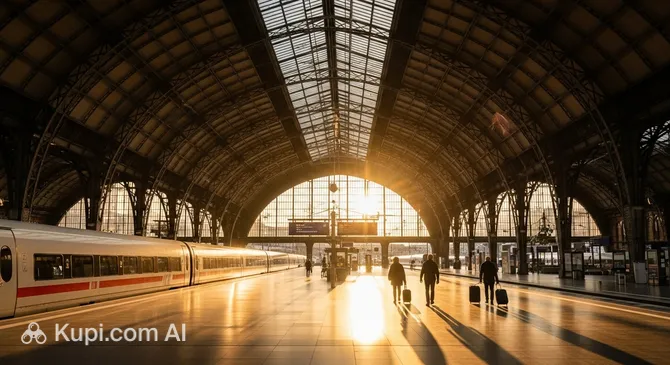
Frankfurt (Main) Central Station (Frankfurt am Main Hauptbahnhof) is not only Germany's largest railway hub but also one of the busiest passenger terminals in Europe. The majestic Neo-Renaissance building, crowned with a statue of Atlas, welcomes hundreds of thousands of travelers daily, connecting Frankfurt with every corner of the continent. Thanks to its unique architecture and well-planned infrastructure, the station is a true landmark of the city.
It is important for passengers to know that this is a terminus station (Kopfbahnhof), where trains do not pass through but stop before the main hall. This makes transferring significantly easier, as there is no need to cross over the tracks via bridges—you simply walk around them at the head of the platform. The main tracks (1 to 24) are on the ground level, while the suburban S-Bahn and metro U-Bahn stations are located on the underground levels.
Official website: bahnhof.de (Frankfurt Hbf section)
DB Information Service Phone: +49 30 2970 (General Deutsche Bahn hotline)
Address: Am Hauptbahnhof, 60329 Frankfurt am Main, Germany
Opening Hours: The station is open around the clock (24/7); however, ticket counters and shops have individual operating schedules.
Luggage Storage: Automated lockers are available 24/7.
Accessibility: The station is equipped with elevators to underground levels, tactile guidance systems, and a Mobility Service Central for passengers with reduced mobility.
Getting There
Getting to Frankfurt Central Station is very simple, as it is the hub of the city's transport system. The most popular method is the suburban train, the S-Bahn. Almost all lines (S1–S6, S8, S9) arrive here. A trip from Frankfurt Airport on lines S8 or S9 takes only about 10–15 minutes, with trains departing every 15 minutes.
The station is also served by the U-Bahn metro (lines U4 and U5) and an extensive tram network (lines 11, 12, 14, 16, 17, 20, 21), with stops located right in front of the main entrance. If you are in the city centre, for example near the Römer square, a walk along Kaiserstraße takes about 15–20 minutes. Taxi stands are located at the northern and southern exits of the main building.
Services and Amenities
Within the Frankfurt (Main) station, passengers have access to a wide range of services for a comfortable wait. The DB Information centre is located in the main hall, where you can get schedule details. For ticket purchases, there are both automated terminals (available in multiple languages) and a full-service traveler centre, the Reisezentrum.
The station is equipped with free Wi-Fi (network WIFI@DB) and waiting areas. For first-class passengers and status customers, the comfortable DB Lounge is available. For luggage storage, automated lockers (Schließfächer) of various sizes are provided. There are also paid restrooms (usually the McClean system), shower cabins, and Bahnhofsmission aid points. Elevators and special escort services are available for citizens with reduced mobility.
Where to Eat
The station's gastronomic zone offers a huge selection of places to have a bite. The majority of establishments are concentrated in the Markt im Bahnhof area and the transverse hall. Here you will find popular international fast-food chains (McDonald’s, Burger King, KFC) and coffee shops (Starbucks, Coffee Fellows), operating from early morning until late at night.
For a quick and budget-friendly snack, the numerous German bakeries (such as Le Crobag or Kamps) are excellent options, offering fresh pastries and sandwiches. The average cost for a coffee and a bun is around 5–7 Euros. If you need to buy groceries for your journey, there are supermarkets and To Go format stores located within the station and in the underground passage.
Station History
The history of Frankfurt Central Station began in 1888 when it was grandly opened, replacing three outdated western stations of the city. At the time of construction, it was the largest station building in Europe. The architectural design in the Neo-Renaissance style with Neo-Classical elements was intended to emphasize the economic power of Germany.
During the Second World War, the building suffered serious damage but was carefully restored, preserving its historical appearance. An important stage of development was the construction of underground levels for the S-Bahn and U-Bahn systems in the 1970s, which turned the station into a multi-level hub. Today, it is considered a monument of technical architecture and a key link in the European railway network.
Passenger Tips
When planning a trip through Frankfurt (Main), try to arrive 20–30 minutes before your train departs, as the station is immense and moving between platforms may take time. Keep a close watch on the large display board in the main hall: sometimes the departure platform may change at the last moment.
Please be attentive to your belongings: as at any major station in the world, pickpockets may operate here. The area around the station (Bahnhofsviertel) is known for its active nightlife, so during dark hours, it is advisable to stick to the well-lit main streets. If you have a long overnight transfer, the waiting hall may be closed for cleaning, but the main zones remain accessible.