Support

Strausberg Airport

About the Airport

Strausberg Airport
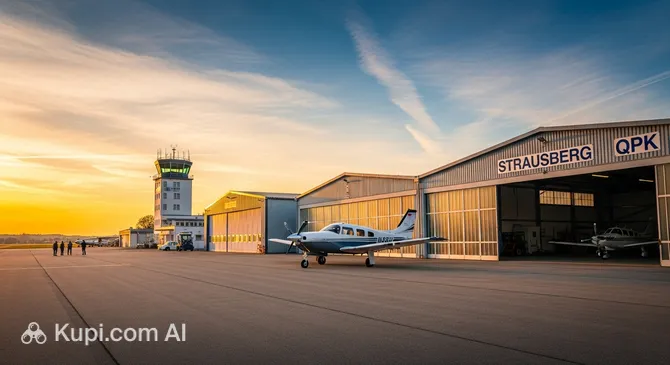
Strausberg Airport. Source: Kupi.com AI

Strausberg Airport (Flugplatz Strausberg) is not a bustling international hub with endless queues, but a true "green haven" for aviation located east of Berlin. Here, instead of the roar of turbines from huge airliners, you will hear the hum of private plane engines and the rustle of glider wings soaring over the picturesque landscapes of Brandenburg. This place is steeped in the spirit of history and aviation romance, perfect for those who want to see Germany from a bird's-eye view or begin their journey on a business jet in an atmosphere of privacy and comfort.

AirportStrausberg Airport
IATAQPK
ICAOEDAY
CityStrausberg
TimezoneEurope/Berlin
ScheduleOnline board

The airfield boasts several unique features that make it attractive not only for pilots but also for tourists:

  • Living History: The grounds host the Flugplatzmuseum Strausberg — an aviation museum where you can see rare exhibits and learn about the rich past of this site, dating back to the 1920s.
  • Gastronomy with a Runway View: The popular restaurant "Doppeldecker" ("Biplane") offers excellent Greek cuisine and a terrace from which you can comfortably watch planes taking off and landing.
  • Convenience for Business Aviation: The airport is certified for instrument flight rules (IFR) and can accommodate business jets weighing up to 14 tons, providing quick access to Berlin without the capital's traffic jams.
  • Training and Leisure: Several flight schools are based here, and introductory flights on airplanes and gliders are offered for everyone interested.

Contact Information

  • Official Airport Website: www.flugplatz-strausberg.de
  • Information Desk Phone: +49 3341 345 370 (Flight Information Bureau / Flugleitung)
  • Airport Address: Flugplatzstraße F1, 15344 Strausberg, Germany
  • Email: info@sfg-strausberg.de
  • Airport Social Media: Current news is published on the official Facebook page (link available via the airport website).
  • Lost & Found Information: There is no specialized Lost & Found department. In case of lost items on the airfield territory or in the terminal, please contact the duty dispatcher directly via the main phone number or email.
  • Customer Support Contacts: All questions regarding passenger and pilot services are handled through the central administration (Flugleitung) at +49 3341 345 370.

How to Get to the Airport

Getting to Strausberg Airport is quite simple, as it is conveniently located relative to the city's transport infrastructure and is just a few kilometers from the terminus of Berlin's suburban trains. Since this is a general aviation airfield, there is no mass flow of passengers, and the journey to the terminal is usually stress-free and without traffic congestion.

Public Transport

The most convenient way to reach the airport from Berlin or the center of Strausberg is to use the city railway (S-Bahn). You will need the S5 line.

  • Train (S-Bahn): Take the train to the final station, Strausberg Nord. The trip from the center of Berlin (e.g., from Alexanderplatz) will take about 50–60 minutes. The service interval is 20 minutes.
  • On Foot: From the Strausberg Nord station to the airfield entrance is only about 1.2 km. The walk will take approximately 15 minutes. The path is over flat terrain, which is convenient even with small hand luggage.
  • Bus: If you prefer not to walk, you can take a local bus (route 926 or 931) from the station, which stops near the airfield. However, due to the short distance, a taxi or walking is often faster than waiting for the bus.

By Car and Taxi

Traveling by car is the most comfortable option for pilots and restaurant visitors. The airport is located near federal highways leading to the capital.

  • Route: From Berlin, follow the B1/B5 highway in an easterly direction, then turn onto the L33 or L23 towards Strausberg. Travel time from central Berlin is about 45–60 minutes depending on traffic. From the center of Strausberg itself, it is only a 5–7 minute drive.
  • Taxi: A taxi stand is located at the Strausberg Nord railway station. The ride to the terminal will cost approximately 8–12 Euros.
  • Car Rental: There are no rental desks for major international brands directly in the airfield building. It is recommended to rent a car in advance in Berlin or use rental points in the center of Strausberg.

Parking

Unlike major international hubs, parking here is not a problem. Directly in front of the main building and the "Doppeldecker" restaurant, there is free parking for visitors, clients, and pilots. Spaces are usually always available.

Alternative Airports Nearby

If your goal is scheduled international flights with major airlines, you should consider neighboring aviation hubs. The nearest and primary one is Berlin Brandenburg (BER), located just 37 km to the south; this is the region's main air gateway with a passenger flow of over 25 million people.

For travelers considering a wider geography or connecting flights, other options are available, although they are significantly further away:

Terminals and Map

The structure of Strausberg Airport (QPK) differs fundamentally from familiar international aviation hubs. You will not find confusing mazes, endless corridors, or multiple terminals marked with letters and numbers here. The entire airport complex is designed on the principle of maximum efficiency and convenience for private and business aviation.

Number of Terminals and Their Purpose

The airport features one main multifunctional building (Hauptgebäude), which serves as the sole terminal. This compact two-story structure combines all necessary services for pilots and passengers:

  • Administration and Control Tower (Flugleitung): The "heart" of the airfield, located in the tower, from where flight operations are managed.
  • Crew Service Area: Here you will find a briefing room for flight preparation and meteorological services.
  • Passenger Zone: A small waiting area and direct access to the apron.
  • Restaurant: The "Doppeldecker" establishment is integrated into the building and serves simultaneously as a relaxation area and an observation deck.

Airport Map and Navigation

Navigation around the territory is extremely simple and intuitive. It is impossible to get lost here, as all key facilities are in direct line of sight of each other.

  • Entrance Area: The main entrance to the building is located immediately behind the car park. The distance from your car door to the administration desk is literally a few dozen meters.
  • Access to Aircraft: Passage to the airfield (Vorfeld) is through a special controlled exit in the central part of the building. Access there is permitted only when accompanied by staff or a pilot.
  • Transfers: Since there is only one terminal, there is no need for shuttles or moving walkways. All movement is done on foot.

Departure and Arrival Zones

In Strausberg, there is no strict separation into "Departure" and "Arrival" levels typical of large hubs. All operations take place on the ground floor in a single flow, which is regulated depending on current flights.

  • Departure Zone: Consists of a flight registration desk (for pilots) and a cozy hall where passengers can wait for the aircraft to be ready. Boarding takes place directly on the apron, where the aircraft taxis as close as possible to the building.
  • Arrival Zone: After landing, passengers immediately enter the main building or, in the case of a private transfer, can proceed to a car through a side exit (upon agreement with security).

Processing Time

The main advantage of Strausberg Airport is speed. There are no long queues for security checks and registration.

  • Check-in: For passengers of business jets and private flights, formalities are kept to a minimum. Usually, it is sufficient to arrive 15–20 minutes before departure.
  • Security: Security procedures are conducted individually and take mere minutes. There is no need to remove shoes or take out liquids unless specified by the special rules of a specific flight.
  • Passport Control: The airport mainly serves intra-Schengen flights. If your flight requires customs or passport control (non-Schengen flights), this must be requested in advance, and the procedure will be organized personally for you upon the arrival of officers.

Navigation Recommendations

If you are in Strausberg for the first time, look for the control tower — it is visible from afar. The entrance to the restaurant and the entrance to the administrative wing are next to each other. If you have a meeting with a pilot or instructor, the best place to wait is the restaurant terrace: it offers a full view of the aircraft parking area, and you definitely won't miss your plane.

Airport History

The history of Strausberg Airport mirrors the turbulent 20th century. Over nearly a century of existence, this site has evolved from a simple glider field to a strategic military facility, and then transformed into a modern center for business aviation. For history buffs, this place is of special interest, as every stage of the airfield's development has left its unique mark here.

Birth and Pre-War Years

The official birth date of the airfield is considered to be 1927. At that time, aviation was experiencing a real boom, and Strausberg, with its open spaces near Berlin, became an ideal place for enthusiasts. Initially, a glider club was based here, attracting young people dreaming of the sky. However, the peaceful period did not last long: by the mid-1930s, the infrastructure began to be rebuilt for the needs of the Luftwaffe, turning into a testing ground and repair base.

The GDR Era: Closed Zone

After World War II and a short period of use by the Soviet Air Force, the airfield acquired key importance for East Germany. From the 1950s, Strausberg became the "heart" of the GDR's military aviation. It was here that the command of the Air Force and Air Defense of the National People's Army (NVA) was located. The airfield was used for government flights, liaison flights, and the basing of transport squadrons.

During this period, the territory was strictly guarded and closed to civilians. Aircraft such as the An-2, Il-14, and Mi-8 helicopters landed here, transporting the country's top leadership and military officials. An atmosphere of strict secrecy reigned here right up until the fall of the Berlin Wall.

New Life and Modernization

A turning point was 1992, when, following the reunification of Germany, the demilitarization of the facility began. Management passed to the civil company Flugplatz Strausberg GmbH, and the airfield opened its gates to private pilots and flying clubs. A large-scale transformation began from a closed military base into a welcoming air harbor.

A key stage of modernization was 1999. A major reconstruction of the runway was carried out: the old surface was replaced with modern asphalt and the runway was extended to 1,200 meters. This allowed for the reception of heavier business-class aircraft. Shortly thereafter, a modern Instrument Landing System (ILS) was installed, making Strausberg an all-weather airfield — a rare achievement for regional airports of this size.

Interesting Facts and Achievements

  • Space Trace: Due to Strausberg being the headquarters of the GDR Air Force, the airfield's history is closely intertwined with the name of Sigmund Jähn — the first German cosmonaut. He often visited here on duty as part of his activities in the Air Force leadership.
  • Living Museum: A museum operates on the airport grounds where enthusiasts restore historical equipment. Many aircraft that can be seen in the exhibition were once actually operated on this runway.
  • Record Silence: Despite its proximity to residential areas, the airport is considered one of the "quietest" thanks to strict noise regulations and a ban on night flights for loud aircraft, representing a compromise between aviation development and the comfort of residents.
  • Unique Geography: This is one of the few airfields in Germany that, having started as a dirt field for gliders, was able to evolve into a certified IFR airport (for instrument flights) without losing its "club" charm.
Services and Facilities

The infrastructure of Strausberg Airport (QPK) fully corresponds to its status as a hub for business and private aviation. Here you will not find noisy shopping galleries or overcrowded waiting halls typical of giant hubs. Instead, passengers are offered a cozy atmosphere, personalized service, and a set of services necessary for a comfortable and quick departure or arrival.

Dining and Shopping

The gastronomic gem of the airport is the restaurant "Doppeldecker" ("Biplane"). It is not just a food outlet, but a proper establishment serving Greek and international cuisine, popular not only with travelers but also with locals.

  • Atmosphere: The main feature of the restaurant is the open terrace with a panoramic view of the runway. This is an ideal place for lunch or a cup of coffee while waiting for a flight.
  • Shops: There are no Duty Free zones or souvenir kiosks on the premises. However, small commemorative souvenirs related to aviation or the airfield's history can often be purchased at the restaurant or the administration desk. It is recommended to buy necessities in the city beforehand.

Lounges and Business Services

Due to the specific nature of the airport's operations, the need for separate closed VIP lounges is practically absent here. The entire compact terminal essentially functions as a single business lounge.

  • Waiting Comfort: Passenger flow here is minimal, so the general hall is always quiet, calm, and has plenty of available seats. Soft armchairs and the absence of bustle create a private environment.
  • Conference Facilities: For business meetings or pre-flight briefings, special rooms (Briefing Room) located in the administrative wing can be used. Their use must be coordinated with the administration in advance.
  • Connectivity: Free Wi-Fi is available throughout the terminal and restaurant. There are sufficient power outlets for charging gadgets in the waiting area, so you can always stay connected.

Financial and Medical Services

Given the compactness of the airfield, the range of additional services here is limited to basic needs:

  • Banks and ATMs: There are no ATMs or currency exchange points directly in the terminal building. The restaurant and administration accept bank cards, but if you need cash Euros, it is recommended to withdraw them in the center of Strausberg (about 2 km from the airport) or at the Strausberg Nord railway station.
  • Medical Assistance: There is no specialized medical center. Airport staff are trained in first aid and have necessary first aid kits. In case of serious ailments, the nearest hospital is located in the city of Strausberg, just a few minutes away by car.

Facilities for Passengers with Children and Special Needs

Strausberg Airport is distinguished by a high degree of accessibility and friendliness to guests.

  • Accessible Environment: The terminal building is single-story (in the passenger zone) and designed on the principle of a barrier-free environment. The absence of stairs and thresholds on the way from the parking lot to the aircraft makes movement maximally convenient for passengers in wheelchairs. Staff are always ready to provide individual assistance with boarding.
  • For Children: There is no special playroom, but the airfield itself serves as the best entertainment. Children can watch planes from the terrace or visit the aviation museum located on the premises, turning the wait for a flight into an educational excursion.

Hotels Nearby

There is no hotel on the airfield territory itself, but thanks to the proximity to the city and nature, travelers can choose one of the excellent accommodation options within a 5–10 minute drive:

  • The Lakeside Burghotel: A luxurious castle-style hotel with a wellness center, located near the airport. Popular among business jet crews and discerning tourists.
  • Gasthof Strausberg Nord: A more budget-friendly and cozy option located in the immediate vicinity of the railway station and the airport.

Where to Eat

The gastronomic map of Strausberg Airport (QPK) differs from the usual layout of large international hubs. Here you will not find chain coffee shops, fast-food courts, or numerous bars in the "secure" zone. Since the airport primarily serves private and business aviation, dining here is organized on the principle of "one, but high-quality place," where lunch becomes part of a pleasant pastime, rather than just a way to satisfy hunger before departure.

"Doppeldecker" Restaurant (Biplane)

The sole and main establishment on the territory is the "Doppeldecker" restaurant. It is located in the public zone (landside) of the main terminal, so it can be visited not only by passengers and pilots but also by meet-and-greeters, as well as guests of the airfield. The entrance is located next to the administrative desk.

  • Cuisine: The establishment specializes in classic Greek cuisine. This is an excellent place for a full lunch or dinner in a Mediterranean style.
  • Signature Offerings: It is definitely worth trying traditional grilled meat dishes — souvlaki or bifteki. Portions here are generally generous. An assortment of Greek dips (tzatziki, taramasalata) with warm bread is popular as an appetizer.
  • Atmosphere: The main "highlight" of the restaurant is the open terrace overlooking the airfield. In warm weather, this is the best spot to observe take-offs and landings while enjoying a refreshing beverage or a cup of coffee.

Dietary Needs and Special Requests

Despite the meat specialization of Greek cuisine, the restaurant menu is flexible enough to satisfy various needs:

  • For Vegetarians: A wide selection of meat-free dishes is available: Greek salad with feta, grilled halloumi cheese, grilled vegetables, eggplant casseroles, and various appetizers (meze).
  • For Vegans and Gluten-Free Diets: There is no specialized menu, but many salads and side dishes (rice, vegetables) are suitable for vegans. Staff are generally accommodating and can advise on dish composition or remove certain ingredients (e.g., cheese) upon request.
  • Halal: Official Halal certification is usually not stated on the menu. Given the nature of Greek cuisine, guests observing strict dietary laws are advised to clarify the ingredients of meat dishes with the waiter or choose fish and vegetarian options.

Prices and Opening Hours

The restaurant belongs to the mid-price range. A full lunch with a drink will cost approximately 20–30 Euros per person, which is quite reasonable for Germany and such a unique location.

  • Operating Hours: The establishment usually opens around 11:00–11:30 and works until late evening (until 22:00 or 23:00), serving both daytime flights and evening visitors.
  • Payment: Both cash and bank cards are accepted.

Recommendations for Passengers

It is important to note that in the sterile zone (airside) — directly before boarding the plane or on board private vessels — there are no stationary food outlets. Catering for the flight is ordered in advance through the flight operator.

  • For a Full Meal: Plan to arrive at the airport with a margin of 1–1.5 hours to eat calmly at the "Doppeldecker" restaurant before going through pre-flight formalities.
  • For a Quick Snack: If you are short on time, opportunities for "fast food" are limited. You can order coffee and dessert in the restaurant, but there is no "Grab & Go" concept (sandwiches to take away) here. If you are in a hurry, it is recommended to bring a light snack with you in advance, having bought it in the city of Strausberg.

Travel Tips

Traveling through Strausberg Airport differs significantly from the experience of flying through giant international hubs. The atmosphere here is that of a club for enthusiasts rather than a transport conveyor belt. To make your flight as comfortable as possible, we have prepared a list of practical tips that take into account the specifics of private and business aviation.

Optimal Arrival Time

Forget the rule of "arriving 2–3 hours early." In Strausberg, everything happens much faster.

  • For Domestic and Intra-Schengen Flights: It is sufficient to arrive 20–30 minutes before the scheduled departure time. This is enough time to meet the pilot, discuss the route, and load luggage.
  • For International Flights (Non-Schengen): If your flight requires passport control, it is better to arrive 45–60 minutes early, as border control officers arrive on call, and the procedure may take a little longer.

Check-in and Security: Stress-Free

There are no endless queues or metal detector gates where you need to remove your belt here.

  • Documents: Always keep your passport with you, even if flying within Germany. The pilot is obliged to check the identity of passengers before departure.
  • Liquids and Gadgets: Rules for carrying liquids here are softer than on commercial flights, as you are flying on a private aircraft. Usually, water and drinks can be brought with you, but it is better to clarify this point with the aircraft commander in advance.

Luggage and Hand Luggage: The "Soft Bag" Rule

This is perhaps the most important tip for passengers of small aviation. Business-class jets and light aircraft have compact luggage compartments of non-standard shapes.

  • What to Choose: Opt out of hard plastic suitcases (especially XL size) in favor of soft travel bags or backpacks. They are easier to stow in the cargo hold.
  • Weight: In small aviation, every kilogram matters for the balance of the aircraft. Strictly observe the weight limit agreed with the operator.
  • Dangerous Items: Standard safety rules (ban on explosives, flammable items) apply here too. Weapons (e.g., hunting gear) require prior coordination and documentation.

Choosing a Seat on the Plane

Online check-in with seat selection does not exist here, but that is for the best.

  • How to Sit by the Window: On small planes, almost every seat is a Window Seat. The view will be excellent for all passengers.
  • Balancing: Often the seating arrangement is determined by the pilot based on passenger weight for the correct centering of the vessel. Please treat this with understanding — it is a matter of your safety.
  • Next to the Pilot: If you are flying on a light four-seater plane (e.g., Cessna), there is a chance to take the co-pilot's seat (front right). Ask about this in advance — the impressions from the flight will be unforgettable.

Tips for Connecting Passengers

Strausberg does not offer direct connections, as it does not work with scheduled airlines.

  • Transfer to BER: If your route is combined (private jet to Strausberg + scheduled flight from Berlin), allow at least 1.5 hours for the transfer to Berlin Brandenburg Airport. Although the distance is short, road traffic or waiting for a taxi can cause adjustments.
  • Ordering a Taxi: Uber or FreeNow cars may be scarce in this zone. It is more reliable to book a local taxi in advance for your arrival time.

Customs Nuances

Strausberg Airport does not have a permanent customs post. Customs control is carried out upon request (Prior Notice mode).

  • Important: If you plan to fly to a country outside the Schengen zone (or arrive from one), ensure that your aviation broker or pilot has notified the airport services about this at least 24 hours in advance. Otherwise, departure may be delayed or canceled.

How to Save Time and Money

  • Use the S-Bahn: A taxi from central Berlin to the airfield can cost around 80–100 Euros. A trip on the S5 train will cost significantly less and take a predictable amount of time (about an hour), saving you from traffic jams.
  • Dining: Prices at the "Doppeldecker" restaurant at the airfield are significantly more democratic than at food outlets in major airports. Having lunch here is more economical and tastier than buying food for the road at gas stations.

If the Flight is Delayed

In small aviation, weather plays a big role, and delays due to meteorological conditions happen more often than with large airliners. But in Strausberg, waiting is not a punishment.

  • Visit the Museum: Instead of sitting in a chair, head to the Flugplatzmuseum on the premises. This is a great way to pass an hour or two studying rare aircraft.
  • Terrace: In warm weather, waiting on the restaurant terrace with a view of the airfield is calming and sets a relaxing atmosphere.
  • Wi-Fi: Use the free internet in the restaurant for work, as there are no special business lounges in the airfield building itself.

Reached the end of the page?

That means the route is fully explored