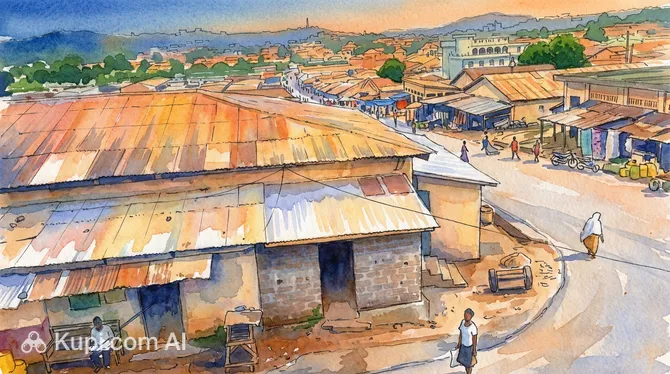
Located in the picturesque south of Guinea, the city of Guéckédou is a unique cultural and geographical crossroads. Situated in the Nzérékoré Region, the city occupies a strategic position near the borders of Sierra Leone and Liberia, which leaves a distinct mark on its daily life and atmosphere. Here, at an altitude of about 392 meters above sea level, you can feel the true rhythm of provincial West Africa.
Gueckedou. Illustration.
Source: Kupi.com AI
While Guéckédou is primarily an important administrative and transit hub, its population of over 220,000 creates a vibrant and dynamic urban landscape. You can learn about the history of Guéckédou through its landmark sites, such as the Roman Catholic mission founded in the mid-20th century, which remains an important spiritual beacon for locals today.
The city's economic life is closely tied to the processing of the region's natural resources: palm oil and soap factories operate here, and local markets are always brimming with fresh produce. Guéckédou invites travelers seeking to experience the authentic life of Guinea, far from the well-trodden tourist paths, offering genuine hospitality and a chance to witness the intersection of a whole region's trade routes.
Weather Overview
The city of Guéckédou is dominated by a typical tropical climate, characteristic of the southern regions of Guinea. There are two main seasons: dry and wet. The hottest period is traditionally the beginning of the year—February and March—when average high temperatures reach 34-35°C. During this time, humidity is lower, but the sun can be very intense.
The rainy season comes into full force by June and lasts until October. Peak rainfall occurs in August and September, when the amount can exceed 300-400 mm per month. During this period, the sky is often overcast, bringing long-awaited relief: daytime temperatures drop to a comfortable 24-26°C. The detailed city climate should be considered when planning a trip to avoid washed-out roads during the peak of the downpours.
The optimal time for travelers to visit is from December to February. During these months, rainfall is minimal, and nights bring a pleasant coolness (temperatures can drop to 19-20°C). The forest terrain and abundant vegetation around Guéckédou help ensure that even in extreme heat, the air here feels more alive and fresh than in coastal metropolises.
Average monthly temperature
Average monthly precipitation
Interesting Facts
Guéckédou is a vital transport hub connecting Guinea with roads to Kailahun (Sierra Leone) and key Guinean cities like Kissidougou and Macenta.
The city has shown impressive demographic growth: since the mid-90s, its population has increased several times over, turning a small settlement into a major regional center.
The central part of the city, known as Guéckédou-Centre, covers an area of only about 3 square kilometers, making it very dense and lively.
A major milestone in the city's history was the founding of the Roman Catholic mission in 1951, which remains active today.
The city is situated at an elevation of 392 meters above sea level, providing a slightly milder microclimate compared to the coastal lowlands.
How to Get There
The accessibility of Guéckédou is defined by its role as a major hub on the border of three countries. Most travelers arrive here via the roads connecting it to other regions of the country and neighboring Sierra Leone. You can find more details about ways to get to the city when planning your route in advance, as road conditions can change significantly depending on the season.
There is currently no direct air service to the city. The nearest airfields capable of receiving flights are located in the cities of Macenta and Nzérékoré, though they are used irregularly. Most tourists prefer to travel from the capital, Conakry, by intercity bus or taxi, which takes about 10–12 hours due to the significant distance of 600 km and the local terrain.
Railway service is also not developed in this region of Guinea, so ground transport remains the only practical option. It is important to note that during the rainy season, travel times can increase significantly due to washed-out unpaved road sections, so it is recommended to allow extra time for your journey.
Main Attractions
Guéckédou is a city where the main attractions lie not in monumental landmarks, but in its functional architecture and the lively atmosphere of a transit hub. One of the most significant sites is the Roman Catholic mission, founded in 1951. It serves not only as a religious center but also as an important historical site that preserves the spirit of the colonial era and acts as a cultural anchor for the southern region.
The industrial heart of the city can be explored by visiting a local palm oil and soap factory. For a traveler, this is a rare opportunity to observe the processing of one of Africa's most valuable resources. The city's energy is best felt in the central markets and squares, which turn into a bustling melting pot of people, goods, and sounds when traders from three neighboring countries meet here.
While the city lacks classical museums, the transit crossroads itself, connecting roads to Kissidougou, Macenta, and Kailahun, serves as a symbol of Guéckédou. Observing the endless flow of transport and goods provides insight into how logistics and trade work in this part of the world, making a visit to the city an educational experience for those interested in the region's anthropology and economy.
Local Cuisine
The gastronomic character of Guéckédou is deeply rooted in the traditions of forest Guinea, where the main ingredients are products gifted by the local land. The diet is based on rice and cassava, used to prepare the famous fufu—a thick paste served as a side dish to hearty soups and stews. Palm oil, produced right here in the city's factories, holds special importance in the local cuisine, giving dishes a characteristic golden hue and deep flavor.
Meat dishes are dominated by chicken and fish, often prepared with peanut sauce or spicy seasonings. Street food lovers should visit the city markets to try freshly made jollof rice or fried plantains (large savory bananas). This is a great way to get to know the culinary preferences of the locals in a very relaxed setting.
As for drinks, fresh palm wine, harvested from the surrounding forests, is popular in Guéckédou. Natural juices made from tropical fruits—mangoes, pineapples, and citrus—are also widely available. Despite the lack of fine dining restaurants, the food in local eateries features honest flavors and generous portions, allowing you to fully experience the color of West Africa.
Travel Tips
A trip to Guéckédou is an immersion into the real life of Guinea. To ensure your visit goes smoothly, we have prepared some important tips to help you find your way around.
Clothing and Essentials: Choose light clothing made from natural fabrics, as humidity in the region is high. Be sure to bring sturdy closed shoes for walking on unpaved roads and insect repellent.
Transport: The fastest way to move around the city is by moto-taxi. Always agree on the price in advance, before getting on the bike. For intercity travel, use bush taxis, but be prepared for cramped conditions.
Finances: Use cash only (Guinean francs). ATMs in the city are very rare, and international cards are practically not accepted anywhere. It is better to exchange currency in advance in Conakry or Nzérékoré.
Health: A yellow fever vaccination certificate is mandatory. Drink only bottled or boiled water and avoid ice in drinks.
Communication: The official language is French, but many speak local dialects. English is very limited, so learn a few basic phrases in French or use an offline translator.
Local Etiquette: Guineans are very friendly. Always greet people before asking for anything. The right hand is considered clean, so use it for handshakes and eating.
What to Avoid: Do not take photos of government buildings, police, or military sites—this can lead to serious legal problems. Always ask for permission before photographing local residents.
Additional Tip: The best time to visit is the dry season from November to May. At other times, heavy rains can paralyze road traffic.
By following these simple recommendations, you can fully enjoy the hospitality of Guéckédou and discover the authentic atmosphere of this unique region of Guinea.
Entertainment & Nightlife
The entertainment scene in Guéckédou reflects its quiet provincial status, so do not expect loud nightclubs or large entertainment centers. The city's evening life revolves around informal gatherings. Locals often spend time in small tea houses or cozy street cafes, where the day's news is discussed over a cup of a traditional beverage to the rhythms of African music.
The central market squares remain the primary places for strolling during the day and evening. Here, you can immerse yourself in an authentic environment, chat with vendors, and witness spontaneous performances by local musicians. For those seeking more organized leisure, the Roman Catholic mission grounds often serve as a center for community events.
For more active entertainment and a typical nightlife scene, travelers usually head to the regional center of Nzérékoré or the national capital. In Guéckédou itself, the value lies in the opportunity to slow down and enjoy life's simple pleasures: long conversations, traditional food, and the unique rhythm of a border town that goes to sleep quite early, preparing for a new workday at the crossroads.
Parks & Museums
In Guéckédou, you won't find classic art galleries or historical museums in the Western sense. The city's cultural life takes place directly on its streets and in public spaces. Nevertheless, the Roman Catholic mission grounds often serve as an open-air museum, where you can see architecture from the middle of the last century and learn about the social role of the church in the region's development.
The city's green zones are mostly represented by natural vegetation and small shaded areas in residential neighborhoods. There are virtually no specially designed parks with alleys and benches, but the surrounding areas are lush with tropical greenery. Many residents and visitors use the open spaces near markets or the courtyards of religious communities as places for rest and meetings.
For those seeking larger natural attractions, Guéckédou serves as a gateway to the forests of southern Guinea. Picturesque landscapes suitable for informal walks and observing the region's rich flora begin just a few kilometers from the urban area. The absence of strict museum boundaries allows travelers to perceive the city itself as a living monument to the history and daily life of the forest region.
Getting Around
The transport system in Guéckédou is perfectly adapted to the needs of a trading and transit city. Since the city center is quite compact, covering an area of about 3 square kilometers, many locals prefer to get around on foot. However, for longer trips or quick delivery of goods, moto-taxis are the primary mode of transport. This is the most mobile and popular way to navigate the narrow and often busy streets.
For travel between cities and to neighboring countries, bush taxis are used—typically multi-seat minivans or cars that depart once they are full of passengers. There is no fixed schedule, so tourists are advised to arrive at the stations early in the morning when transport activity is at its peak. Payment is made in cash to the driver before departure.
An important feature of Guéckédou is the lack of municipal public transport, such as buses or trams. Roads in the city are mostly unpaved, which imposes its own limitations: it can be dusty in the dry season, and some sections become difficult to pass during the rainy season. Travelers should take this into account when planning their travel time, especially in the evening when street lighting is limited.
Accommodation
The hotel infrastructure in Guéckédou is primarily geared toward transit travelers, trade representatives, and employees of international organizations. While luxury chain hotels are hard to find, the city offers a sufficient selection of basic accommodation options that allow you to comfortably stay overnight before continuing your journey to the border or further inland.
Most available options are small guesthouses and private mini-hotels concentrated in the central part of the city or near major transport hubs and markets. Living conditions are usually quite simple: a fan or air conditioning, basic amenities, and the option to order breakfast. Prices for such accommodation remain affordable for budget travelers.
Booking accommodation in Guéckédou through popular international services can be difficult, as many properties are not listed in their databases. The best strategy is to find accommodation on the spot upon arrival or through recommendations from local guides. During peak trading days when many merchants flock to the city, rooms in popular guesthouses can be fully booked, so try to arrive in the first half of the day.
Nearby Cities
The city of Guéckédou is an ideal starting point for exploring border territories and neighboring countries. Thanks to its location, it opens the way to interesting places, each with its own unique character and cultural heritage.
Just a few dozen kilometers away is the Liberian town of Foya, where a visit allows you to feel the difference in the lifestyle of two neighboring states. Also noteworthy is Macenta, nestled among hills and dense forests, famous for its nature and proximity to Guinea's unique ecological zones. For those wishing to cross the border into Sierra Leone, Kailahun, an important regional trade center, is a convenient destination.
City
Population
Distance
Foya
20 569
24 km
Voinjama
26 594
45 km
Kailahun
30 411
58 km
Kissidougou
66 815
69 km
Macenta
43 102
73 km
Exploring the surroundings of Guéckédou requires some preparation and a readiness to travel on roads of varying quality, but it rewards the tourist with the chance to see authentic, non-touristy Africa and learn about the lives of people living at the meeting point of three borders.
Shopping & Souvenirs
Shopping in Guéckédou primarily means visiting its famous regional markets, which are the heart of the city's economy. There are no typical shopping malls with glass storefronts; instead, there are endless rows of goods brought from various corners of Guinea, Sierra Leone, and Liberia. This is the best place to feel the spirit of cross-border trade and find truly unique items.
The main locally produced goods are palm oil and soap, made at the city's factories. Many tourists and locals buy these products here because of their freshness and high quality. Traditional African fabrics with vibrant prints are also widely available at the markets, and you can order clothing from local tailors working just around the corner.
As souvenirs from Guéckédou, it's worth bringing back items made by local artisans: woven baskets, wooden utensils, or traditional jewelry. Markets typically operate from early morning until sunset, and payment is accepted exclusively in cash using local currency. Don't forget to bargain—it's an important part of the local communication culture that will help you not only save money but also start a friendly conversation with the vendor.