Support

Weasua Airport

About the Airport

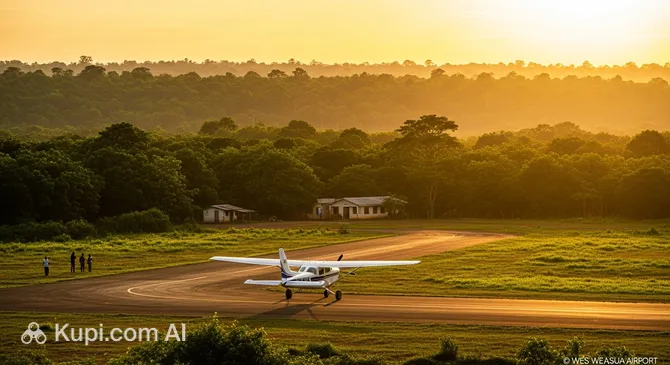
Weasua Airport. Source: Kupi.com Binoculars

Weasua Airport (WES), located in a picturesque and hard-to-reach region of Liberia, serves as a vital link for the city of Bopolu and the entire Gbarpolu County. This place is far from the usual hustle and bustle of giant international hubs: here reigns the atmosphere of the true African hinterland, where the runway is literally carved into the dense tropical forests. For travellers, this small airfield becomes a starting point for expeditions into the wild and an introduction to the authentic life of West Africa. The flight here is an adventure in itself, opening up breathtaking bird's-eye views of endless green expanses.

IATA Code WES
ICAO Code Not assigned
City Bopolu (Weasua settlement)
Distance to Centre ~28 km to Bopolu
Status Domestic / Regional
Passengers per Year Data unavailable

Features and Advantages of the Airport:

Weasua Airport is a classic example of "bush aviation," where functionality is more important than comfort. The main advantage of the air harbour is its location: it provides access to remote areas that are difficult to reach by land, especially during the rainy season. The surrounding nature creates a unique backdrop for take-offs and landings, turning them into an unforgettable spectacle for passengers. Despite its modest infrastructure, the airport is critically important for the region's logistics, ensuring the delivery of cargo and the movement of mining personnel.

Contact Information

Considering that Weasua Airport (WES) is a small regional airfield in a remote part of Liberia, it does not possess the standard service infrastructure inherent to large international hubs. The airport has no press office, 24-hour help desk, or dedicated communication channels. The main source of official information and the regulating body is the Liberia Civil Aviation Authority (LCAA).

  • Official Airport Website: There is no dedicated website. Information regarding the airfield's status can be checked on the resources of the Liberia Civil Aviation Authority.
  • Help Desk Phone: There is no direct terminal telephone number. For general aviation inquiries in the region, you can contact the LCAA: +231-776-998-848.
  • Airport Address: Visua Airstrip, Gbarpolu County, Liberia (landmark — vicinity of Weasua settlement, northwest of Bopolu city).
  • Email: There is no personal email for the airport administration. For official inquiries, the aviation authority address is used: liberiacaa@lcaa.gov.lr.
  • Social Media: There are no official airport accounts on social networks.
  • Lost Luggage Information: There is no centralised baggage tracing service. All issues must be resolved on the spot with the pilot or the representative of the charter airline operating the flight.
  • Passenger Support Contacts: Support is provided exclusively through the offices of the air carriers or private operators flying to this region.

How to Get to the Airport

When planning a route to Weasua Airport (WES), it is important to understand the specifics of the region. Since this is a remote dirt airstrip deep in Liberia, the usual standards of urban transport infrastructure are absent here. Getting here is a real expedition requiring preliminary preparation, especially during the rainy season when roads may be washed out.

Public Transport

There is no public transport as we know it—buses, scheduled route taxis, and certainly no trains or metro—in the vicinity of Weasua settlement and Bopolu city. The main means of transport for the local population are motorcycle taxis (known as "pen-pen"). This is the most affordable and fastest way to cover the distance from Bopolu to the runway, but it is suitable only for travellers with light luggage who are ready for an extreme ride off-road.

Transfers and Taxis

Classic taxi services (Uber or official city taxi fleets) do not exist in this area. The most reliable way to get to the airport is an individual transfer organised by the hosting party. If you are flying for work or tourism, it is strongly recommended to arrange a meeting in advance with representatives of the hotel, mission, or company hosting you. Private drivers on SUVs may agree to a trip from Bopolu, but the price must be negotiated in advance (usually costing between 20 to 50 USD depending on road conditions and bargaining skills).

Car Rental

There are no rental company offices at Weasua Airport itself or in the city of Bopolu. The nearest opportunity to rent a car is only available in the country's capital, Monrovia. For a trip to this region, it is critically important to choose a four-wheel drive SUV (4x4) with high clearance. The road from the centre of Bopolu to the airport (about 28 km) is a dirt track, passing through dense forest in places. Travel time can vary from 45 minutes to 1.5 hours depending on weather conditions.

Parking

There is no official guarded parking with markings at the airport. Vehicles are left on open areas next to the runway. This is spontaneous parking on grass or dirt, for which no fee is charged. Leaving a car unattended for a long period is not recommended.

Nearest Major Airports

Since Weasua accepts only small aviation, most travellers arrive in the country through international hubs and then transfer to charters or ground transport. The country's main air gateway is Roberts International Airport, located approximately 117 km from Weasua. This is where major international flights arrive.

For travellers planning a complex route through West Africa, other airports in neighbouring countries may be useful, although they are significantly further away:

Tips for Travellers: Always carry a supply of cash (small denomination US dollars or Liberian dollars), as electronic payments do not work in this area. Leave for the airport with plenty of spare time, considering the unpredictability of road conditions.
Terminals and Map

The infrastructure of Weasua Airport (WES) differs radically from familiar international standards. Here you will not find multi-level buildings made of glass and concrete, jet bridges, or confusing corridors. The airport is a compact "bush airstrip," where the entire structure is subordinated to one goal — ensuring basic conditions for the take-off and landing of light aircraft.

Number of Terminals and Their Purpose

There is virtually no division into classic terminals at Weasua Airport. The entire airport complex is a single functional zone under the open sky or with minimal utility structures. This zone serves both arriving and departing flights. Passengers of charter planes and helicopters are in immediate proximity to the aircraft parking spot.

Airport Map and Navigation

Navigation at the airport is intuitively clear and does not require the use of maps or digital boards. Due to the miniature size of the facility, all key points are within direct line of sight:

  • Aircraft Parking Zone: Located directly by the dirt runway.
  • Waiting Area: Typically, this is an open area or a small shed next to the transport parking spot.
  • Meeting Point: Passengers and greeters gather right at the aircraft side after the propellers stop.

Departure and Arrival Zones

There is no clear separation into departure and arrival zones fenced off by glass partitions here. The processes of boarding and disembarking take place sequentially on the same section of the apron:

  • Arrival: After landing, the plane taxis to the improvised parking area. Passengers step out onto the ground, and the pilot or an assistant personally hands out luggage from the cargo compartment.
  • Departure: Passengers wait for the aircraft's arrival next to the strip. Boarding takes place only upon the pilot's command after the vessel is fully prepared for the return flight.

Check-in and Pre-flight Screening

Procedures in Weasua are conducted in a simplified mode characteristic of small aviation in remote regions:

  • Check-in: There are no check-in counters. Confirmation of a passenger's presence occurs by checking against a list (manifest) held by the pilot. Passport control, if required, is conducted visually.
  • Screening: There are no scanners or metal detector frames. Screening of luggage and hand luggage may be conducted manually by an airline representative or security service (if present) before loading on board.
  • Time: All formalities take minimum time. However, it is recommended to arrive at the departure point 20–30 minutes before the appointed time to have time to speak with the pilot and load luggage.

Recommendations on Navigation and Conduct

Since Weasua is an unequipped airfield, the main rule here is adherence to safety regulations. Never walk onto the runway without permission and keep a safe distance from the aircraft's rotating propellers. In the rainy season, the airfield surface may be muddy, so comfortable, closed-toe shoes are recommended for moving from the transfer to the plane.

Airport History

The history of Weasua Airport (WES) is fundamentally different from the chronicles of major international hubs. Here you will not find exact dates of ceremonial ribbon cuttings, architectural competitions, or records of multi-million passenger flows. The history of this air harbour is a chronicle of the development of one of the most inaccessible and picturesque regions of West Africa, where aviation often became the only thread connecting settlements with the outside world.

Foundation and Early Stages

The creation of the airstrip in the area of Bopolu city and Weasua settlement was dictated by harsh necessity. Gbarpolu County, rich in natural resources and dense forests, historically suffered from a lack of quality roads. The airport was formed not as a commercial project, but as a vital logistical hub. Initially, it was simply a clearing in the jungle, prepared to receive light single-engine aircraft delivering mail, medicines, and specialists deep into the country.

Development and Modernisation

Unlike capital airports, "modernisation" in Weasua meant not the construction of glass terminals, but a constant struggle with tropical nature. The main stages of the airport's development can be considered:

  • Runway Consolidation: Transforming a temporary dirt pad into a more stable surface capable of receiving aircraft even during periods of high humidity.
  • Mission Support: The airport became a key point for humanitarian and missionary aviation services, which historically played a huge role in the development of air travel in remote corners of Africa.
  • Economic Integration: With the development of the mining industry and forestry in the region, the importance of the airfield grew — it began to be used for personnel rotation and delivery of urgent cargo.

Interesting Facts and Historical Features

Weasua Airport, despite its modest size, possesses a unique character formed over decades:

  • Visual Flights: Throughout its history, the airport has accepted flights exclusively under Visual Flight Rules (VFR). This means the history of this place is written by the skill of pilots capable of navigating by ground landmarks and landing the plane "by eye" without the help of complex electronics.
  • Connection with Nature: The history of the airport is a history of coexistence with the jungle. Locals recount that during quiet periods, the runway often became a walking ground for wild animals, which added colour (and difficulty) to the pilots' work.
  • "Green Tunnel": One of the historical features of the approach to landing in Weasua is the need to descend over a dense forest canopy, creating a sensation for passengers of flying through a green canyon before touching the ground.

Today, Weasua Airport remains a monument to "bush aviation," preserving the spirit of romance of early flights and fulfilling its main historical mission — to be a reliable bridge where roads end.

Services and Amenities

For passengers travelling to or departing from Weasua, it is important to remember: Weasua Airport (WES) is not a familiar transport hub with developed infrastructure, but a remote airstrip in the heart of the Liberian hinterland. The level of service here corresponds to a "wild" expedition format. The traveller's comfort in this place depends entirely on their own preliminary preparation.

Dining and Shopping

There are absolutely no cafes, restaurants, or shops on the airfield territory or in its immediate vicinity. You cannot even buy a bottle of water or a light snack here. Travellers are strongly advised to stock up on provisions and drinking water in advance, back in Monrovia or Bopolu. If your flight is delayed, having your own food supply will become critically important.

Waiting Areas and Communication

Concepts of VIP lounges or comfortable waiting zones are not applicable in Weasua. Passengers wait for departure under the open sky or under the canopy of trees providing shelter from the tropical sun. Wi-Fi and fixed internet access points are absent, and mobile network coverage may be unstable or non-existent. Charging stations are also not provided, so having a fully charged power bank is a mandatory condition for any tourist.

Financial and Medical Services

There are no ATMs, currency exchange points, or bank branches in the airport area. Any settlements with drivers or locals are made exclusively in cash (Liberian dollars or small US dollar bills). There is no medical point at the airfield. The nearest qualified help is available only in the city of Bopolu, so having a personal first aid kit with necessary medications is a matter of personal safety.

Services for Passengers with Children and Reduced Mobility

Infrastructure for travellers with children (mother and child rooms, playgrounds) is not provided. Parents should monitor children closely, as the territory is unfenced and located in close proximity to wild nature. For passengers with disabilities, the airport presents a serious challenge: dirt surfaces, lack of ramps, and absence of special toilets make movement without outside help practically impossible. Organisation of boarding and disembarking must be coordinated with the air carrier in advance.

Accommodation and Business Services

There are no hotels at the airfield itself. Travellers requiring an overnight stay should look for accommodation options in the nearest major settlement — the city of Bopolu (about 28 km from the strip). There, one can find modest guesthouses where conditions are typically basic. Conference rooms and business centres are absent in this region; any business meetings are held in an informal setting or at missions and administrative buildings in the city.

Where to Eat

The gastronomic situation at Weasua Airport (WES) is entirely dictated by its status as a remote dirt airfield. It is important for travellers to understand: there are no familiar food courts, coffee shops, or vending machines here. Dining in Weasua is a matter of personal preparation and the supplies you bring with you.

Restaurants, Cafes, and Bars

Establishments serving food are completely absent on the airfield territory and in its surroundings. There is no division into terminals, meaning there are no zones with restaurants either landside or airside. The entire infrastructure is limited to the runway, so it is impossible to buy food or drinks on the spot. The nearest points where hot food can be found are only in the city of Bopolu (about 28 km from the strip).

Dining Recommendations: "Bring Your Own"

The only reliable option to avoid going hungry is to organise your meals yourself. The format of travel to this region of Liberia resembles an expedition.

  • Quick Snack: Be sure to take non-perishable foods with you: nuts, energy bars, crackers, dried fruits. This is critically important if the flight is delayed due to weather conditions.
  • Full Lunch: If you plan a long wait, bring ready-made lunch boxes from a hotel or restaurant in Monrovia.
  • Water: This is the most important point. There is no drinking water at the airport. Carry a supply of at least 1.5–2 litres per person.

Local Cuisine and What Can Be Found Nearby

Although there is no food at the airport itself, if you decide to have a snack in the city of Bopolu before leaving for the airfield, you can get acquainted with authentic Liberian cuisine in local "cook-shops" (small street canteens). Sanitation levels there are basic, but the dishes are very filling:

  • Rice: The basis of any meal in Liberia. Usually served in huge portions.
  • Sauces and Stews: Rice is always topped with thick sauces. Popular options include Cassava Leaf, Palm Butter (an oily sauce from palm fruits), or Potato Greens (from sweet potato leaves).
  • Fufu: A dough-like mass made from cassava or plantains, eaten with hands by dipping into spicy soup.

Dietary Nutrition (Vegetarian, Halal, Allergies)

Given the lack of service at the airport, adherence to a diet falls entirely on the passenger's shoulders:

  • Vegetarians and Vegans: Local cuisine in neighbouring settlements is often cooked with meat or fish stocks (even vegetable stews). Therefore, it is safest to bring your own food.
  • Halal: Liberia is a country with a mixed religious composition, and Halal products are generally available in the country, but naturally, none are available at this remote airfield.
  • Gluten-free: The concept of "gluten" is unknown in the local hinterland. If you have celiac disease, consuming local food in Bopolu is risky; rely only on your proven supplies.

Prices and Opening Hours

Since there are no official points of sale, the concept of "opening hours" is not applicable. Improvised markets in the nearby city of Bopolu operate during daylight hours (usually from 07:00 to 18:00). Prices in the local city canteens are extremely low: a full portion of rice with sauce can cost between 2 to 5 USD (payment in cash, preferably in Liberian dollars).

Travel Tips

Travelling through Weasua Airport (WES) is not a standard flight, but a true expedition into the conditions of Liberia's wild nature. Familiar rules of international terminals do not apply here, so flight preparation requires special attention to details and logistics.

Optimal Arrival Time

Unlike large airports, there is no need to arrive 2–3 hours early here. Boarding procedures take mere minutes. However, it is critically important to correctly calculate the travel time to the airfield itself. The journey from Bopolu (28 km) on a dirt road can take from 45 minutes to one and a half hours depending on the season and track conditions. It is recommended to arrive at the runway 30–40 minutes before the scheduled aircraft arrival time to meet the plane and calmly load your belongings.

Check-in and Security "Expedition Style"

Be prepared for the fact that there are no familiar check-in counters or conveyor belts here.

  • Check-in: Takes place at the aircraft side. The pilot checks your identity against the passenger list. Keep your passport handy, but don't pack it too far away — it may be needed several times.
  • Screening: The absence of metal detector frames does not mean a lack of control. The pilot or security officer has the right to manually search your luggage. Treat this with understanding: it is done for flight safety.

Seat Selection and Views

In small aircraft (usually Cessna Caravan or similar models), there is no advance seat reservation. Seating is directed by the pilot based on the aircraft's centre of gravity.

  • If the weight balance allows, ask for a window seat. Flying over the dense forests of Gbarpolu County at a low altitude offers stunning views that are impossible to see from the cruising altitude of a large airliner.
  • Do not argue with the pilot if you are asked to change seats — the stability of the aircraft in the air depends on it.

Luggage and Hand Luggage

Light aviation has strict take-off weight limitations.

  • Packing: Use soft bags or backpacks instead of hard suitcases. They are easier to stow in the limited cargo hold of a small plane.
  • Weight: Strictly adhere to the norms specified by your carrier (usually 15–20 kg). An extra kilogram can be a reason for refusal to carry luggage.
  • Prohibitions: Despite the lack of scanners, safety rules are standard: no flammable substances, weapons, or dangerous items. Take only the most valuable items in hand luggage: documents, money, electronics, and medicines.

Tips for Connecting Passengers

If you are flying from Weasua with a subsequent connection to an international flight in Monrovia (Roberts International Airport), allow a huge time buffer. Weather in the tropics is changeable, and departure from Weasua may be delayed due to rain or fog. The ideal option is to return to Monrovia a day before the international departure to eliminate the risk of missing it.

Customs Nuances

There is no customs control in Weasua, as flights are domestic only. However, remember that you are in a region with unique flora and fauna. Do not attempt to take out rare plants, souvenirs made of ivory, or other prohibited materials — this will lead to serious problems when departing the country at the main airport.

How to Save Nerves and Money

  • Cash: Carry small bills (USD or LRD). Paying for excess baggage or porter services with a card will be impossible.
  • Your Own Provisions: Bring water and food. There is nowhere to buy them at the airport, and the wait may drag on. This will save not so much your money, but your health.
  • Group Transfer: Renting an SUV alone is expensive. Try to cooperate with other travellers or mission staff for a joint trip from Bopolu.

Actions in Case of Flight Delay

Delays in "bush aviation" are common. If the plane has not arrived on time:

  1. Do not panic. Most often the reason is weather en route.
  2. Save battery. Your phone is your only connection to the world. Use it sparingly, as there are no sockets in the field. Having a charged power bank is mandatory.
  3. Have a Plan "B". Find out contacts of a guesthouse in Bopolu in advance in case the flight is cancelled and you have to return to the city for the night.

Reached the end of the page?

That means the route is fully explored