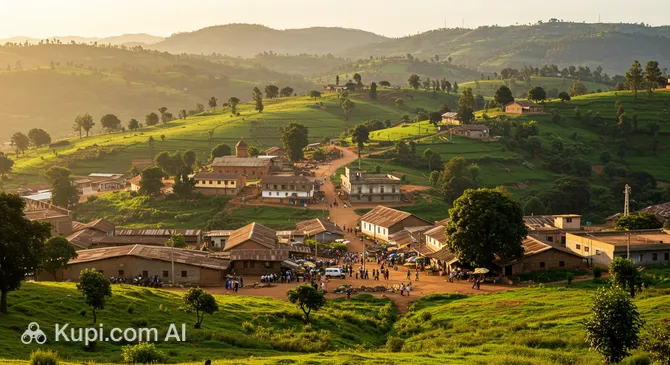
Mamou is a distinctive city located in the central part of Guinea. Known as an important transportation hub, it serves as a kind of "gateway" connecting the country's coastal regions with the inland Fouta Djallon highlands. The city is not a typical tourist center, but it is here that you can feel the true rhythm of life in the region, observing the bustling transit and daily activities of the local residents.
The city's geographical location at an altitude of about 737 meters above sea level gives it a slightly more moderate climate than on the coast. As the administrative center of the region, Mamou brings together a significant number of residents in its agglomeration—by some estimates up to 376,000 people. To better understand the history of development of this place, it is worth remembering that the city grew thanks to the construction of an important railway line connecting the coast with Kankan.
Mamou. Illustration.
Source: Kupi.com AI
The atmosphere here is steeped in the spirit of rural Guinea: the city is surrounded by picturesque hills typical of the savanna. The main features of Mamou are concentrated around its role as a crossroads where trade routes from Kindia, Dalaba, and Faranah meet. A visit to this city is an invitation to see Guinea without filters, enjoy the beauty of the surrounding landscapes, and appreciate the practical hospitality of the central region.
Weather Overview
The climate in Mamou is typical for a tropical region with a distinct alternation between the dry season and the rainy season. Thanks to its location in the Fouta Djallon highlands, it is slightly cooler and fresher here than on the coast, creating a more comfortable microclimate for travelers. To plan a perfect visit, it is worth checking the weather in Mamou in advance.
The hottest months are March and April, when daytime temperatures can rise to +35°C...+37°C. During this period, there is almost no precipitation. Conversely, from June to September, the city is covered by heavy rainfall, peaking in August when more than 500 mm of rain falls. Winter months such as December and January delight with dry weather and comfortable average temperatures around +25°C, although nights can be quite fresh.
Average monthly temperature
Average monthly precipitation
Interesting Facts
Mamou emerged and developed primarily as an important station on the strategic railway connecting Conakry and Kankan.
The city is officially called the "gateway" to the Fouta Djallon region, as almost all routes from the coast to the interior of the country pass through it.
The National School of Forestry (ENATEF) is located on the outskirts of the city, making it an important center for environmental education in Guinea.
The region around Mamou covers an area of more than 17,000 square kilometers, representing a unique mix of savanna and highlands.
According to one version, the city's name has roots in the local Fulfulde or Susu dialects, although the exact etymology remains a subject of debate.
How to Get There
Mamou occupies a key position in the country's transport system, being the main crossroads on the way from Conakry to the interior of the continent. The city connects the capital with important centers such as Kankan and Labé. If you are planning a visit, it is useful to research the specifics of traveling to this region beforehand to make the trip as comfortable as possible.
The city does not have its own airport, so air travelers usually land in Conakry and then continue their journey by land transport. A highway leads from the capital to Mamou, covering a distance of about 270 kilometers. Travel time depends heavily on the condition of the road surface and traffic but usually takes several hours.
The railway connecting the coast with Kankan plays an important role in the city's history and logistics. Although passenger service can be irregular, the Mamou railway station remains an iconic landmark and an important reference point. Within the city and for trips to neighboring settlements, "shared taxis" (collective taxis) or minibuses are most commonly used, departing as they fill up.
Station
Passenger traffic
Distance
1
187 km
Main Attractions
Mamou is primarily known as an administrative and transport hub, so it is difficult to find classic architectural monuments here. However, the heart of the city is its central market and railway station. This is where life bustles, and the atmosphere of commercial activity allows you to immerse yourself in the daily reality of the Guinean province. Walking through the center, you can see monumental mosques and a Protestant church, which are the main architectural landmarks for the residents.
The main beauties lie beyond the urban area. Mamou is located in the foothills of the Fouta Djallon, and the surrounding landscapes are breathtaking. Tourists passing through the city often stop to admire the views of the hills and valleys. In this region, you can find hidden small waterfalls and picturesque trails leading through the savanna and small forest areas.
For those interested in culture and education, the National School of Forestry of Guinea (ENATEF), located in the vicinity, may be of some interest. This educational institution emphasizes the importance of ecology and the region's natural resources. While Mamou does not offer flashy attractions, its honest and simple character combined with the natural surroundings make it a worthwhile stop on the way inland.
Local Cuisine
The culinary traditions of Mamou are closely linked to the culture of the Fula people, who predominate in this region. The basis of the diet is rice, served with a variety of thick sauces. Peanut sauce (mafé), which has a rich flavor and aroma, is particularly popular. It is also worth trying meat dishes and fresh vegetables, which are sold in abundance at local markets.
Street food is an important part of the city's gastronomic scene. At busy intersections and near the station, you can find vendors offering fried plantains, cassava, and freshly baked flatbreads. A characteristic feature is the use of local spices and herbs grown in the Fouta Djallon highlands, which gives the food a unique regional character.
Local teas and herbal infusions remain favorite drinks. Due to the cultural characteristics of the region, the choice of alcoholic beverages may be limited, but non-alcoholic drinks based on ginger or hibiscus are available everywhere. Restaurants in Mamou are rare, so the best way to experience the local cuisine is by visiting markets or guesthouses, where food is often home-cooked.
Travel Tips
Preparing for a trip to Mamou requires attention to detail, as this region has its own specifics. These practical tips will help make your journey more comfortable and safe.
Clothing and Essentials: Choose light clothing made of natural fabrics for the daytime, but be sure to bring a windbreaker or sweater—evenings in the Fouta Djallon highlands can be cool. For visiting mosques and religious quarters, choose modest clothing that respects local traditions.
Transport: The most efficient way to travel between cities is by collective taxis (bush taxis). Within Mamou, it is most convenient to get around by taxi or on foot, as the city is quite compact.
Finances: International cards are practically not accepted in Mamou, so always carry a sufficient supply of cash in Guinean francs. ATMs are rare and can be unreliable.
Health: Be sure to use insect repellent and drink only bottled water. Mamou is a region with a tropical climate, so precautions against malaria are advisable.
Communication: The official language is French, but most residents speak Fula or Susu. Learn a few basic phrases in French—it will significantly ease communication in the markets.
Etiquette: Greet everyone you come into contact with. Politeness and patience are key to a good relationship with local residents.
What to Avoid: It is not recommended to walk alone on the outskirts of the city after dark. Also, try not to take photos of administrative buildings and people without their explicit consent.
Connectivity: For stable internet, it is best to buy a local SIM card in Conakry before heading to Mamou, as Wi-Fi in the city's hotels can be very weak or non-existent.
May your introduction to Mamou become a vivid and honest discovery of a real Guinea, full of life and natural beauty!
Entertainment & Nightlife
Nightlife in Mamou is quite modest, as the city is oriented towards transit and administrative work. There are no large-scale nightclubs or noisy discos typical of metropolises. The main evening meeting places for locals and passing travelers are small local bars, such as "Bar Luna", or cozy street spots where you can enjoy cold drinks and socialize in an informal setting.
The evening rhythm of the city is set by the markets and small shops that remain open until dusk. This is the time when the heat subsides and the streets fill with people. The crowd in the establishments mainly consists of local residents and workers from humanitarian missions. For a more varied nightlife experience, travelers usually head to Conakry or Labé, where the selection of venues is significantly wider.
Daytime entertainment in Mamou focuses on exploring the natural landscapes. Outdoor enthusiasts can go on short hikes through the Fouta Djallon hills or have a picnic near the closest natural springs. The lack of large theaters and museums is compensated for by the authentic atmosphere of the city, where every visit to the market or a stroll through the central squares turns into a small exploration of local life.
Parks & Museums
In Mamou itself, you will not find large museums or art galleries, as the city primarily serves practical functions. However, the absence of classic exhibition halls is compensated for by nature itself. The entire region around the city can be considered a natural open-air museum, where the unique landscapes of the Fouta Djallon highlands serve as the exhibits.
Natural green zones and the hills surrounding the urban development take the place of city parks here. Local residents often head to the nearby elevations to take a break from the city bustle. Although there are few specially equipped recreational areas in the city center, the lush vegetation and open spaces of the savanna create a pleasant visual backdrop for walks.
History and ethnography enthusiasts should look toward the markets and craft quarters. Here, by observing the work of fabric or wood craftsmen, you can learn much more about the region's culture than in a formal museum. The lack of major cultural sites makes Mamou a place for contemplative relaxation and observation of Guinea's untouched nature.
Getting Around
The transport system of Mamou is as simple and functional as possible, reflecting the city's status as a vital transit hub. The main form of transport for traveling between cities is bush taxis or minibuses. They depart from special stations (gare routière) and are the most accessible way to travel around Guinea.
Within Mamou itself, collective taxis and moto-taxis predominate. The city is quite compact, so the central part can be easily explored on foot. However, for trips to distant neighborhoods or to the markets on the outskirts, local residents prefer to use the services of private drivers. The cost of a trip is usually fixed, but it is better to confirm it in advance.
The railway connection that gave life to the city is currently used mainly for freight transport, but the station remains a key landmark in the urban space. It is important to remember that roads in the region can be dusty in the dry season and difficult to pass during the rainy season, so when planning trips, it is always worth allowing extra time for possible delays.
Accommodation
Accommodation options in Mamou are practical in nature and primarily aimed at transit travelers, humanitarian workers, and local entrepreneurs. You will not find luxury five-star hotels or large chain complexes here. Most hotels offer modest but clean rooms with basic amenities.
The city center, located near transport hubs and markets, is considered the most convenient area to stay. This allows for quick access to the bus station or the railway station, which is especially important if Mamou is only an intermediate point on your route. Some guesthouses are located slightly away from the noisy streets, offering a more peaceful atmosphere.
When choosing accommodation, it is worth relying on reviews from other travelers and recommendations from local residents, as online booking systems cover only a small portion of available options. Prices for accommodation in Mamou remain affordable and accessible for budget tourists. It is recommended to book accommodation in advance if you plan to travel during major holidays or administrative events, when the demand for rooms may increase.
Nearby Cities
Mamou is an ideal starting point for those who want to explore the picturesque highlands of central Guinea. Thanks to its location at the crossroads, it is easy to reach several interesting cities and natural areas from here, each with its own unique charm.
Just 39 kilometers away is Dalaba, often called the "Guinean Switzerland" for its cool climate and breathtaking mountain landscapes. Another wonderful destination for a trip is Kindia, located about 93 kilometers away. It is famous for its waterfalls and fruit orchards. It is also worth paying attention to Labé, the cultural capital of the region; the journey there will take a bit longer but will be rewarded by the richness of local traditions.
City
Population
Distance
Dalaba
6 349
39 km
Pita
20 052
83 km
Kindia
181 126
93 km
Kabala
18 770
105 km
Labe
107 695
107 km
Exploring the surroundings of Mamou will allow you to see the full diversity of Guinean nature—from dry savannas to humid forested hills. Most of these trips can be made by shared taxi, which will add authenticity to your journey and allow you to get closer to the local way of life.
Shopping & Souvenirs
Shopping in Mamou is primarily about visiting its colorful markets. There are no glittering shopping malls, but there is an abundance of goods reflecting the soul of Guinea. The main trading areas are concentrated around the railway station and the central mosques. These are places where you can find everything from fresh tropical fruits to basic necessities.
Travelers should take note of the products made by local artisans. Mamou is famous for its fabrics, especially traditional cloths with unique Fula patterns. You can also find high-quality leather goods and woven baskets at the markets, which make excellent souvenirs. Bargaining is common here and an important part of the communication process with sellers.
The working hours of shops and stalls usually follow the daylight: trade begins early in the morning and winds down by sunset. Payment is made predominantly in cash in the local currency. Mamou is a place for practical shopping where, instead of branded items, you will find authentic household goods and crafts that cannot be found anywhere else.