Support

Bahubali Monolithic Statue

About

The Bahubali Monolithic Statue, also known as Gommateshwara, is one of the most impressive and significant landmarks located in the town of Dharmasthala, India. This majestic sculpture is one of the tallest monolithic statues in the world, carved from a single stone, and attracts many pilgrims and tourists with its grand scale and deep spiritual meaning.
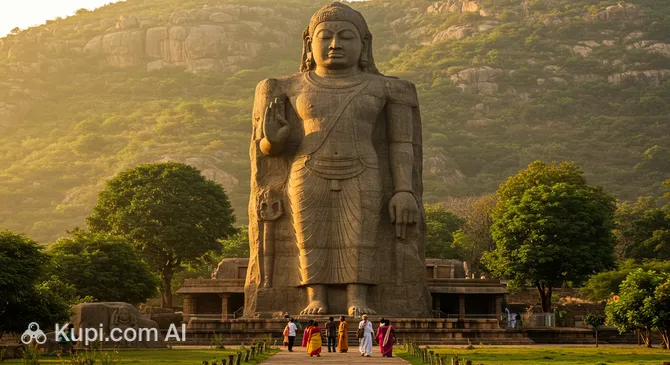
Bahubali Monolithic Statue. Illustration.
Source: Kupi.com AI

Traveller photos:

Creating this outstanding statue was a true feat of ancient craftsmanship. It was fashioned from a single block of granite by the talented architect Aristenemi in 981 AD. Two years later, in 983, the monument was installed at its current site, where it still stands today as a testament to the high level of engineering and artistic skill of that era.

The Bahubali statue is striking in its size—it was designed by its creators to be visible from up to 30 kilometers away. Remarkably, over its thousand-year history, the monument has undergone almost no erosion or decay, preserving its original appearance. Bahubali is depicted standing in deep meditation in a pose known in Jainism as kayotsarga, symbolizing detachment and spiritual self-contemplation.

Contacts

The Bahubali Monolithic Statue is a prominent landmark in the town of Dharmasthala. As it is a monumental site, specific contact information is generally not provided.

To visit the statue, we recommend following the signs within Dharmasthala itself or visiting local tourist information centers for precise directions. Information regarding access hours and how to get there can also be found on the official tourism portals of India or the region.

How to contactContact
AddressX94H+4GC, Ujire-Dharmastala Rd, Dharmasthala, Karnataka 574216, India
Phone+91 80 2235 2828

What to Do

A visit to the Bahubali Monolithic Statue in Dharmasthala begins with passing through the intricately decorated Akhandabagilu gate. Note the detailed carvings depicting the goddess Lakshmi surrounded by two elephants—a symbol of prosperity. Your path will then lead through several small temples, creating an atmosphere of peace and anticipation before reaching the main shrine.

The highlight of the visit is undoubtedly the majestic Bahubali Monolithic Statue itself, which towers in the inner courtyard. You can not only view the giant figure from all sides but also explore the surrounding complex. Of particular interest is the enclosed gallery running along the perimeter of the courtyard. Its many niches house images of Jain teachers, providing a deeper insight into this ancient religion.

This site is of immense significance to followers of Jainism, serving as an important pilgrimage center. However, it also attracts many tourists from around the world interested in India's rich religious and cultural history. Observing rituals, if any are held during your visit, or simply contemplating the monumental sculpture and its spiritual atmosphere, will leave a lasting impression.

Getting There

The Bahubali Monolithic Statue is one of the key attractions in Dharmasthala, a renowned pilgrimage center in the state of Karnataka, India. Due to this status, transport accessibility to Dharmasthala is quite good, especially when traveling from other cities in the region.

For travelers from other parts of India or from abroad, the primary route to Dharmasthala often goes through Mangalore. Located about 70-75 kilometers away, this city has the nearest airport (Mangaluru International Airport) and a major railway station. You can reach Dharmasthala from Mangalore by scheduled bus or taxi. Regular bus services also connect Dharmasthala with major cities in Karnataka such as Bangalore and Mysore.

Upon arriving in Dharmasthala, reaching the Bahubali Monolithic Statue directly is easy. Auto-rickshaws (also known as tuk-tuks) are the most convenient and common local transport, offering services throughout the city at relatively low costs. Alternatively, taxis are available. As the statue is a very well-known site of pilgrimage and tourist interest, local drivers know the way perfectly.

Nearest city: Dharmastala

History & Facts

The Bahubali Monolithic Statue in Dharmasthala is dedicated to one of the most revered figures in Jainism. According to ancient legends, Bahubali was the son of Rishabhadeva, the first Jain Tirthankara and emperor. After inheriting the kingdom of Takshashila, Bahubali became involved in a confrontation with his brother Bharat. After winning all the duels and conquering his brother's lands, Bahubali made a decision that changed his fate: he renounced power and worldly goods in favor of his brother, choosing the path of a monk and spiritual quest.

As an ascetic, Bahubali immersed himself in deep meditation, which legend says lasted many months. He remained motionless for so long that climbing vines wrapped around his legs and arms, and birds built nests in his hair and beard. This imagery symbolizes his complete detachment from the material world. However, pride and a reluctance to greet senior monks stood in his way to enlightenment. Legend has it that only after his nun-sisters sang to him, urging him to "step down from his elephant"—a metaphor for pride—did Bahubali gain insight, cast aside his pride, and achieve self-realization.

The majestic statue in Dharmasthala, like other similar monuments in India, is a tribute to Bahubali's incredible strength of spirit and self-sacrifice. The tradition of venerating and erecting statues of this saint has a long history. For instance, it is known that one significant Bahubali statue was commissioned by Chamundaraya, a minister of the Western Ganga Empire. This empire was an ally of the Hoysala dynasty, whose subjects practiced Jainism for about a century during a period of seeking independence from the Chola Empire. Thus, the image of Bahubali became not only a symbol of spiritual achievement but also an important part of the region's cultural and religious heritage.

Time Needed

When planning a visit to the majestic Bahubali Monolithic Statue in Dharmasthala, it is worth setting aside about 1-2 hours. This will be enough time to leisurely view the statue, soak in the atmosphere of the place, and take commemorative photos. Of course, the length of the visit may vary depending on your personal interest and pace.

During this time, you can approach the base of the statue and appreciate its monumental scale and craftsmanship. Visitors usually also take time to walk around the statue, viewing it from different angles. If there are information boards or small accompanying elements on-site, seeing them will also fit within this timeframe.

For a deeper immersion, or if you plan to spend time in meditation or quiet contemplation, you might need a bit more time. In any case, even a short visit to this iconic site in India will leave a vivid impression.

Working Hours

The Bahubali Monolithic Statue in Dharmasthala is a significant site for pilgrimage and tourism. Generally, the statue is open to visitors daily; however, exact opening hours may vary, especially depending on ritual times and the season. Typically, such sites are open from early morning until evening.

Currently, precise information regarding opening hours and the necessity of advance ticket booking is unavailable. We recommend checking current hours and any potential restrictions on the official Dharmasthala temple complex website or at local tourist information centers before your visit. This is especially important if you are planning a trip during major festivals or holidays, when the schedule may change. Overall, the statue is available to visit year-round.

7:00 – 18:30

Nearby

Visiting such an iconic site as the Bahubali Monolithic Statue is a highlight in itself. However, to make your trip to Dharmasthala even more fulfilling, it's worth taking time to explore the surroundings. Often, it is the smaller but interesting sites nearby that help you gain a deeper understanding of the culture and atmosphere of this amazing part of India.

Near the Bahubali Monolithic Statue, there are several other attractions that can complement your experience and show different facets of this location. Below is a list of some of them, with approximate distances provided:

NameDistance
Gateway of Dharmasthala0.3 km
Annappa Hill0.4 km
Manjusha Museum0.6 km
Netravathi River Barrage1.4 km
Shree Rama Kshethra2.5 km
Devatha Homestay3 km

Reached the bottom of the page?

Looks like you know this route inside out