Support

Krishna's Butter Ball

About

In the coastal town of Mahabalipuram, located in India, there is an amazing natural wonder that attracts travelers from all over the world — Krishna's Butterball. This is a giant granite boulder weighing about 250 tons, standing approximately 6 meters high and 5 meters wide, which seems frozen in time. It balances on a smooth rocky slope at such an angle that it appears ready to roll down at any moment, yet it has remained motionless for over 1,200 years.
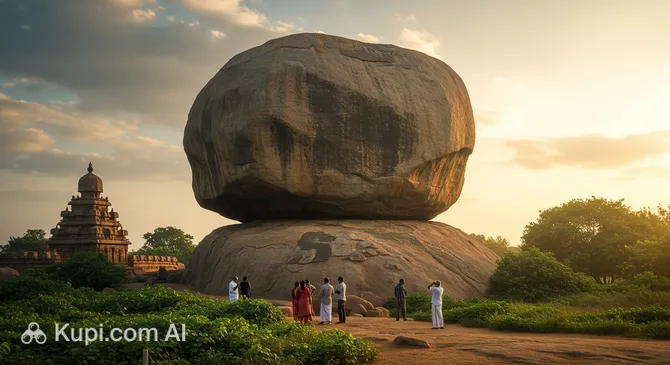
Krishna's Butter Ball. Illustration.
Source: Kupi.com AI

Traveller photos:

The boulder got its unusual name from Hindu mythology. Legend has it that the god Krishna loved to steal butter as a child, and this stone resembles a giant globule of butter that he dropped. In the local Tamil language, the stone is called "Vaan Irai Kal," which means "Stone of the Sky God." This name reflects the awe it inspires in locals, who consider it a divine creation.

Despite its apparent instability, the stone is absolutely stationary. In 1908, the Governor of Madras, Arthur Lawley, even attempted to move it using seven elephants, fearing it might roll down onto the town, but the boulder did not budge. Today, Krishna's Butterball is not only part of the Mahabalipuram Group of Monuments, a UNESCO World Heritage site, but also a favorite spot for tourists. Visitors love taking fun photos, creating the illusion that they are trying to hold up or push the giant stone that has defied both humans and the forces of nature for centuries.

Contacts

This unique natural monument does not have dedicated contact details as it is part of the publicly accessible Mahabalipuram historical complex. Finding Krishna's Butterball is very easy: it is located in the heart of the town, among other ancient monuments, and is clearly visible from afar. You can find all up-to-date information regarding visiting hours and ticket prices on official tourism websites or at local information centers.

How to contactContact
AddressE Raja St, Mahabalipuram, Tamil Nadu 603104, India
Phone+91 1800 4253 1111

What to Do

A visit to Krishna's Butterball is an opportunity not only to admire a rare geological phenomenon but also to take many unique photographs. This is the main activity at the boulder: tourists and locals alike love posing as if they are "supporting" or "pushing" the giant stone. This activity is especially popular with families and groups of friends who compete in creativity to capture themselves next to a natural wonder that has defied gravity for centuries.

However, seeing the boulder itself is only part of the experience. An extensive area for walking stretches around it, and just a few steps away, you can find other famous monuments of Mahabalipuram. Among them is the grand bas-relief composition "Arjuna's Penance," also known as "Descent of the Ganges." Thus, a visit to this site can easily be combined with exploring ancient rock-cut temples and enjoying picturesque coastal views, turning a walk to the boulder into a complete and enriching excursion.

Getting There

Reaching Krishna's Butterball is quite simple as it is located in the popular tourist town of Mahabalipuram. The town itself is situated about 60 km south of Chennai, the capital of Tamil Nadu. The most convenient way to get to Mahabalipuram from Chennai is by taxi, rental car, or local bus. The journey typically takes about an hour and a half, though travel time can vary depending on traffic conditions.

Once you are in Mahabalipuram, finding the giant boulder is effortless. The attraction is located in the historical part of town, making it an easy walk from most hotels and guesthouses. A stroll to Krishna's Butterball will be a pleasant part of your sightseeing, as you will encounter other famous monuments belonging to the UNESCO heritage complex along the way.

If you are traveling through Tamil Nadu, keep in mind that buses regularly run to Mahabalipuram from other major cities in the region. Organized sightseeing tours are also available for tourists, often including a visit to the boulder in their itinerary. This is a convenient option for those who want to see all the main treasures of this amazing place in one day without having to plan the route themselves.

Nearest city: Mahabalipuram

History & Facts

While Krishna's Butterball is a natural creation, its history is inextricably linked to the Pallava dynasty, which ruled southern India from the 3rd to the 9th century. It was during their golden age in the 7th century that the coastal town of Mahabalipuram became the main port and artistic hub of this powerful kingdom. The Pallavas were great patrons of architecture and sculpture, commissioning numerous temples and bas-reliefs carved directly into the rocks. This giant boulder, fitting perfectly into the man-made landscape, became a natural addition to the grand architectural vision of the rulers.

Geologically speaking, Krishna's Butterball is a classic example of a "balanced rock" or "weathering remnant." It was not brought here by a glacier or placed by humans. This granite monolith was formed as a result of centuries of spheroidal weathering. Under the influence of wind, rain, and sharp temperature fluctuations, the surrounding bedrock gradually eroded and crumbled away, while the more durable core remained virtually intact. Over time, the stone was exposed on the surface, frozen in its seemingly impossible position on the slope.

The uniqueness of the boulder is highlighted by its proximity to man-made masterpieces, such as the Pancha Rathas ("Five Chariots") temple complex and the famous Shore Temple. While these structures demonstrate the supreme skill of ancient stonemasons who transformed solid rock into elegant buildings, Krishna's Butterball serves as a kind of natural counterpoint. It embodies the power and majesty of nature, entering into a silent dialogue with human creations and creating a wonderful harmony between art and nature within the sacred space of Mahabalipuram.

Time Needed

When planning a visit to Krishna's Butterball, you can expect a fairly quick but impressive encounter with this natural wonder. To see the boulder itself, take a few creative photos, and walk around the surrounding area, 30 to 60 minutes is quite sufficient. This will give you enough time to fully experience the scale and uniqueness of this balancing stone, which has defied gravity for centuries.

However, keep in mind that Krishna's Butterball is just one of the jewels in the crown of the ancient town of Mahabalipuram. If you want a more complete picture of this historical site, it is recommended to set aside more time. To leisurely explore other nearby monuments, such as the famous "Descent of the Ganges" bas-relief or the cave temples, it's better to budget about 2–3 hours. This approach will allow you to immerse yourself in the atmosphere of this amazing UNESCO World Heritage complex without rushing.

Working Hours

One of the main advantages of Krishna's Butterball is its accessibility. Contrary to some reports of 24-hour access, the area around the boulder is open to visitors daily from 6:00 AM to 6:00 PM. Entry to the site is free, and you do not need to book tickets or register in advance. The attraction is open to guests year-round, making it easy to include in any Mahabalipuram itinerary.

While the boulder can be viewed at any time during opening hours, it is highly recommended to plan your visit during daylight. This is not only for safety reasons but also because daylight allows you to take the best photos and fully appreciate the scale of this natural phenomenon. Furthermore, other monuments within the UNESCO-listed Mahabalipuram complex have their own operating hours, so a daytime visit will allow you to combine seeing the boulder with a full tour of the surrounding area.

6:00 – 18:00

Nearby

Visiting Krishna's Butterball is undoubtedly a memorable experience, but a trip to Mahabalipuram would be incomplete without exploring its surroundings. This ancient town, recognized as a UNESCO World Heritage site, is a true treasure trove of monumental art and architecture from the Pallava dynasty. A walk through its territory will allow you to dive deeper into the history and culture of southern India.

A huge advantage is that many iconic attractions are located within walking distance of the famous boulder. In just a few minutes, you can reach ancient rock-cut temples and grand bas-reliefs, making exploration incredibly convenient. Below is a list of interesting sites located very close by.

NameDistance
Descent of the Ganges (Arjuna's Penance)0.1 km
Varaha Cave Temple0.1 km
The Golden Palate0.2 km
Sri Sthala Sayana Perumal Temple0.2 km
Madras Chronicle0.3 km
Mahabalipuram Lighthouse0.4 km
Olakkannesvara Temple0.5 km

Reached the bottom of the page?

Looks like you know this route inside out