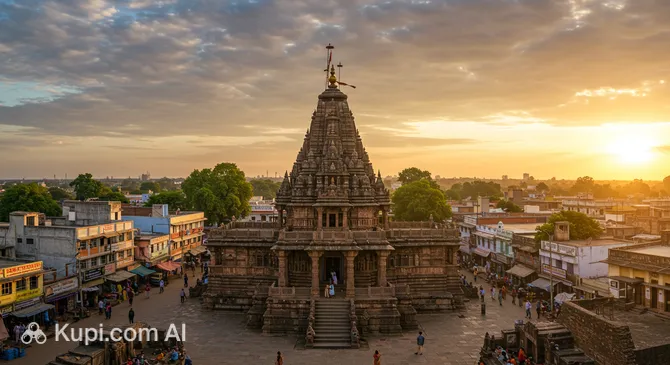
Located in the heart of Maharashtra state, Parbhani is a fascinating blend of agricultural traditions and deep spirituality. This city, the administrative center of the district of the same name, is nestled in the fertile Godavari River valley. With a population of about 307,000 people, it retains the atmosphere of authentic provincial India, where daily life is closely intertwined with age-old rituals and the seasonal rhythms of farming.
Parbhani. Illustration.
Source: Kupi.com AI
The city's rich historical heritage dates back to the era of ancient temples and the rule of great dynasties, including the Mughals and the Nizams of Hyderabad. The city's name itself is derived from the majestic temple of Goddess Prabhavati, which for centuries was considered its main spiritual symbol. Today, the city is known as an important center of the cotton ginning industry, surrounded by the picturesque Ajanta and Balaghat hills.
For the traveler, Parbhani is primarily interesting for its religious shrines, such as the unique Pardeshwar temple, and the sincere hospitality of the local people. A visit to this city is an opportunity to see India without tourist filters, immerse yourself in the authentic life of the Marathwada region, and feel the calm rhythm of life on the banks of sacred rivers. We invite you to discover this underrated but deeply symbolic corner of Maharashtra.
Weather Overview
The climate in Parbhani is distinctly tropical with three clear seasons. The hottest period occurs in April and May, when air temperatures can reach an impressive 40–45°C. During this time, a dry heat envelops the city, and scorching winds from the plateau make daytime walks a real challenge. You can find the latest forecast and explore the regional climate in more detail in our dedicated section.
From June to September, monsoons arrive in the city, bringing long-awaited coolness and heavy rainfall. In July and August, rains can be prolonged, turning dusty plains into lush green fields. Expect a warm summer with occasional thunderstorms and mild, dry winters. The winter period (from November to February) is considered the most comfortable for visiting: average temperatures range between 15–25°C, providing ideal conditions for sightseeing.
Average monthly temperature
Average monthly precipitation
Interesting Facts
Parbhani is a place where history and traditions are hidden in details that can surprise even a seasoned traveler.
A name with history: The modern name of the city is a corrupted form of "Prabhavati Nagar," named after the Goddess Prabhavati, whose ancient temple was once the city's dominant landmark.
A mercury miracle: The local Pardeshwar Temple houses one of the world's largest Shivalingas made entirely of purified mercury and solid amalgams.
Land of Saints: The Parbhani region is often called the "land of saints" (Santan-chi-bhumi), as it is associated with the names of many revered Indian sages and poets, including Saint Janabai.
Cotton giant: The city plays a key role in the Maharashtra economy as a major center for processing and pressing cotton, which is grown on the fertile plains of the Godavari valley.
A long history of autonomy: Parbhani was under the rule of the Nizams of Hyderabad for nearly 650 years and became part of independent India only in 1948.
How to Get There
Parbhani is an important transport hub in the Marathwada region, providing convenient connections to major cities in central and western India. Although the city does not have its own airport, travelers can use air hubs in neighboring regions, making trip planning a fairly simple and straightforward process. You can learn more about how to get to the city by various modes of transport on our specialized page.
The nearest major air hub is Aurangabad Airport, located about 200 kilometers away. From there, you can reach the city center by taxi or regular buses; travel time takes between 4 to 6 hours depending on road conditions. Flying into Hyderabad is also an option, from which there are frequent bus and train connections.
Rail transport is the most popular and budget-friendly way to reach the city. Parbhani Railway Station is a key point on the Secunderabad–Manmad line. High-speed trains from Mumbai, Hyderabad, Pune, and Nagpur pass through it. A trip from Mumbai takes about 10–12 hours, while from Aurangabad it is only 4–5 hours, making the train an ideal option for tourists.
Station
Passenger traffic
Distance
Hazur Sahib Nanded railway station
7
57 km
Chhatrapati Sambhaji Nagar railway station
7
167 km
Bidar railway station
3
168 km
Kalaburagi Junction railway station
6
216 km
Jalgaon railway station
6
232 km
Bus services are also highly developed. Regular services by state (MSRTC) and private carriers connect Parbhani with all major cities in the state. It is worth considering that travel times may increase during the monsoon season due to rain, so it is recommended to allow extra time for the journey.
Main Attractions
Despite the fact that Parbhani is not a typical tourist center, the city and its surroundings hide several truly outstanding monuments. One of the most impressive shrines is the Mrityunjaya Pardeshwar Temple. This pilgrimage site is famous for its unique Shivalinga, made of mercury (parada), weighing about 250 kilograms. The majestic white marble temple building rises 80 feet high, attracting believers and architecture enthusiasts from across the country.
Another important spiritual site is the ancient Mudgaleshwar Temple, located in a very unusual place right in the middle of a riverbed. During the monsoon season, when the water level rises, the temple appears to be floating downstream, creating an incredibly mystical scene. Also of historical significance is the Prabhavati Temple, which was converted into a mosque during the Mughal period and today serves as a reminder of the region's complex and multilayered history.
For those ready to venture outside the city, a visit to Jintur, located nearby, is a must. Here you can find the famous Jain cave temples dedicated to Tirthankara Neminatha. Among the city's landmarks, the Shivaji Udyan garden and the tomb of Hazrat Sayyad Shah Turabat, which serve as important cultural and social hubs for city residents, are also worth noting.
Local Cuisine
The gastronomy of Parbhani is a celebration of Maharashtra flavors, where spices, local grains, and legumes play the leading roles. The local diet is based on vegetarian dishes known for their significant spiciness. You should definitely try misal pav—a spicy sprouted mung bean soup served with soft buns. This is a classic local breakfast that provides energy for the whole day.
Another symbol of street food is the legendary vada pav, often called the "Indian burger." This is a deep-fried potato patty in a bun with spicy chutney sauce. Thanks to the proximity to fertile plains, fresh vegetables and greens are always in abundance in the city, used to prepare a variety of sabzis and dals served with fragrant chapati or sorghum bhakri flatbreads.
The food culture here is simple and democratic: the best dishes are usually found in small eateries near markets or in modest family restaurants. Among drinks, traditional masala tea with spices and milk remains a favorite, while on hot days, fresh-pressed local fruit juices are popular. It is worth noting that due to strong religious and Jain traditions, vegetarianism prevails here, and meat dishes are much rarer and found in specialized establishments.
Travel Tips
When planning a trip to Parbhani, be prepared for an immersion into the life of the real Indian heartland. These practical tips will help make your journey as comfortable and safe as possible.
Clothing and dress code: Choose light clothing made from natural fabrics, as it can be very hot in the region. When visiting temples, be sure to wear modest clothing that covers your shoulders and knees. Don't forget comfortable shoes that are easy to remove before entering shrines.
Transport within the city: Use auto-rickshaws for moving around. This is inexpensive and convenient. Agree on the price before the start of the trip. After dark, it is better to call a taxi through official services or ask the hotel to help with a car.
Finances: The main currency is the Indian Rupee. Always carry a supply of cash in small bills, as cards are not accepted in markets and by rickshaw drivers. ATMs are available in the center, but they may not always work with foreign cards.
Health: Drink only bottled water and avoid ice in street drinks. Take a basic first-aid kit and insect repellent with you. Due to high dust levels in the dry season, a protective mask may be useful.
Communication: The main languages are Marathi and Hindi. English is understood by hotel staff and young people, but it is useful to learn a couple of phrases in the local language for communicating at markets. It is best to buy a SIM card at major communication stores in the center by presenting your passport.
Local etiquette: Greet people with the traditional Namaste gesture. Always remove your shoes when entering a home or temple. Remember that the right hand is considered clean; use it for giving money or food.
What to avoid: It is not recommended to walk alone in poorly lit outskirts of the city late at night. Also, refrain from photographing people and religious ceremonies without prior permission.
Hydration: Always carry a bottle of water with you. The heat in Maharashtra can be exhausting, especially from March to May, so hydration is extremely important.
May your visit to Parbhani be filled with vivid discoveries and warm encounters in this hospitable land of saints and ancient traditions!
Entertainment & Nightlife
Entertainment in Parbhani is predominantly traditional and closely linked to the local lifestyle. You won't find noisy nightclubs or bars typical of large megacities here. The main centers of evening activity are the local markets and squares, where residents gather to socialize, exchange news, and enjoy street food. The atmosphere of these places is filled with the sounds of daily hustle and the aroma of spices.
The city's cultural life revolves around religious festivals and holidays, such as Ganesh Chaturthi or Diwali. During these periods, the streets are transformed: solemn processions, traditional music concerts, and open-air theatrical performances are held. If you are looking for more modern leisure, several cinemas operate in the city, showing the latest Bollywood releases, which is a favorite pastime for local youth.
For fans of active recreation and quiet walks, the Shivaji Udyan garden remains the main destination during the daytime. On weekends, you can see families having picnics and young people relaxing in the shade of the trees. For a more intense nightlife or large-scale entertainment events, travelers usually head to neighboring Aurangabad or Nanded, which are a few hours' drive away.
Parks & Museums
There are not as many green zones in Parbhani as in large resort cities; however, those that exist are greatly loved by the local residents. The main place for relaxation is Shivaji Udyan. This cozy municipal park offers a refuge from the daytime heat under the shade of old trees. Families with children often walk here, and in the evenings, the place becomes a center of attraction for young people and the elderly who prefer leisurely strolls.
There are currently no museums in the classical sense in the city; however, their role is successfully fulfilled by local temples such as Mrityunjaya Pardeshwar. These sacred spaces house not only religious relics but are also true open-air galleries showcasing the skill of local craftsmen, sculptors, and architects. Every detail of the temple's decoration tells its own story, reflecting the stages of development of Marathwada culture.
The banks of the Godavari and Purna rivers also serve as natural recreational areas for city dwellers. Residents often go to the river ghats for rituals or family picnics. Although the leisure infrastructure here is minimally developed, it is in such places that one can feel the authentic connection between people and nature, which is so important for daily life in this agricultural region.
Getting Around
The transport system in Parbhani is focused on practicality and accessibility. The main form of city transport is auto-rickshaws and cycle-rickshaws. This is the fastest and most maneuverable way to move through the narrow and often congested streets of the center. It is worth agreeing on the price of the trip in advance, as meters are rarely used, and the fare may be slightly inflated for tourists.
Intercity and suburban connections are provided by buses of the state company MSRTC (red ST buses). They connect Parbhani with nearby villages and major cities in the state. Buses run frequently but can be very crowded during peak hours. The railway also plays an important role in internal travel: many residents use suburban trains to travel to neighboring areas such as Aurangabad or Nanded.
Walking through the city center is quite possible, but you should take into account the dustiness of the roads and the lack of sidewalks in some areas. There is no metro or tram system in the city. For comfortable long-distance trips or excursions to the surrounding areas, it is best to rent a taxi with a driver for the whole day—this will save time and ensure a proper level of comfort in the hot climate.
Accommodation
Accommodation options in Parbhani are primarily geared towards pilgrims, transit travelers, and business people. Budget hotels and lodges predominate, offering a basic level of comfort at very affordable prices. Most establishments are concentrated around the railway station and the central bus station, which is convenient for those arriving in the city late at night or leaving early in the morning.
For those looking for a bit more convenience, there are several mid-range hotels in the city. They offer air-conditioned rooms, Wi-Fi, and on-site restaurants. Luxury five-star resorts are absent in the city, so travelers accustomed to a high level of service should prepare for functional and simple accommodation. The average cost of an overnight stay ranges from 1,000 to 3,000 rupees.
If you plan to visit the city during major religious festivals or holidays, it is highly recommended to book accommodation in advance through popular Indian online services. During such periods, the demand for rooms increases sharply. For a long-term stay, you can consider renting private apartments, which would be a more economical option and allow you to better experience the local lifestyle.
Nearby Cities
Parbhani serves as an excellent starting point for exploring the lesser-known but extremely interesting corners of the Marathwada region. The city's surroundings are rich in spiritual shrines and historical monuments that provide a deeper understanding of the culture and traditions of central India.
For a day trip, the town of Pathri, located just 36 kilometers away, is ideal. It is known for its temples and is considered an important point on pilgrimage routes. It is also worth visiting Manwath, which is a major agricultural trading center and offers a glimpse into the life of a typical farming town in the region. If you are interested in a quieter atmosphere, visit Walur or the town of Selu, which are easily reachable by local bus or train.
City
Population
Distance
Manwat
32 488
30 km
Walur
11 008
34 km
Pathri
36 853
36 km
Selu
46 915
41 km
Loha
24 125
50 km
A journey through these towns will give you plenty of impressions: from the majestic Jain temples in Jintur to the bustling markets in Nanded. Exploring the surroundings of Parbhani is the best way to see the real, non-tourist India in all its diversity and majesty.
Shopping & Souvenirs
Shopping in Parbhani is primarily about visiting traditional bazaars, where trade follows the same rules as decades ago. There are no massive shopping and entertainment centers with global brands in the city, but there are colorful markets concentrated around the central square and the railway station. Here you can find almost everything: from the freshest spices to handmade crafts.
Since the region is a major cotton producer, be sure to look for cotton fabrics and clothing. Products made from local textiles are of high quality and natural, and their prices will be a pleasant surprise. Jewelry shops offering traditional Indian ornaments and copperware stores selling items made by local craftsmen are also popular.
As souvenirs from Parbhani, people most often bring religious items from the temples: prayer beads, small idols, and incense. Markets usually operate from early morning until late evening, with activity peaking on Sundays. Payment in most outlets is made in cash (rupees), although larger stores are starting to accept cards and electronic payments. Don't forget to bargain at the markets—it is an important part of the local communication culture.