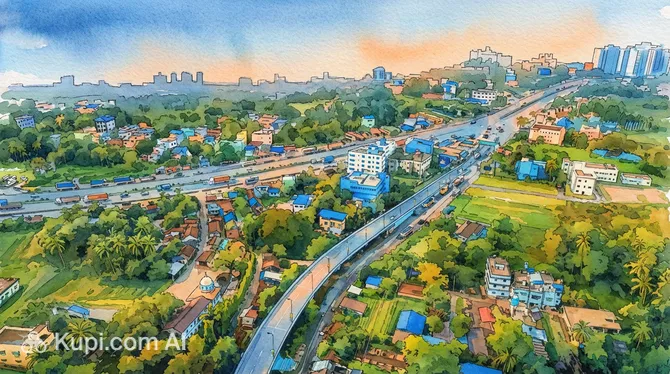
Uluberia is a dynamic industrial and commercial center located in the state of West Bengal in India. The city stretches along the western bank of the Hooghly River and its tributary, the Rupnarayan, which historically defined its development as an important trading hub. Today, it is a place where everyday Bengali life bustles, filled with the noise of markets and the energy of industrial districts.
Uluberia. Illustration.
Source: Kupi.com AI
The city's geographical location makes it an important part of the Kolkata Metropolitan Area. With a population of approximately 235,345 people, Uluberia is a typical suburban hub where functionality prevails over tourist polish. Although the city is considered primarily industrial, it retains a special charm thanks to its proximity to great rivers and its traditional way of life.
Tourists can experience the authentic atmosphere of "unpolished" India here. The region's rich heritage is evident in ancient temples and remnants of colonial architecture that stand alongside modern factories. A walk along the banks of the Rupnarayan River at sunset allows you to see the city from its most picturesque side.
Uluberia is an ideal destination for those who want to see real Bengali life beyond the standard tourist routes. We invite you to visit this lively city to feel the rhythm of Indian industry and the hospitality of the local people.
Weather Overview
Uluberia is located in the tropical climate zone of West Bengal, characterized by three distinct seasons. Summers here can be truly hot: in April and May, the thermometer often rises to +38°C... +40°C. High humidity, caused by the proximity of the Hooghly River, makes the heat more palpable, so tourists are recommended to plan their main activities for the morning hours.
From June to September, monsoons come to the city, bringing heavy rainfall. In July and August, rains can be very intense, sometimes leading to flooding in low-lying areas. Check the current weather in the city before your trip to be prepared for the possible whims of nature. Winter, lasting from November to February, is the most pleasant time to visit: temperatures stay in a comfortable range of +15°C... +25°C, and the sky remains clear.
It is worth considering that the industrial nature of the city and dense traffic during the dry months can contribute to the accumulation of dust and smog in the air. During this period, the environmental situation may be less favorable than in the rainy season, which, despite the humidity, perfectly cleans the city's atmosphere of urban pollutants.
Average monthly temperature
Average monthly precipitation
Interesting Facts
Uluberia is an important administrative center and part of the massive Kolkata Metropolitan Area, which has a population exceeding 14 million people.
The Hooghly and Rupnarayan rivers have ensured the city's status as a strategic trade hub connecting the interior regions of Bengal with the ocean for centuries.
Despite its status as an industrial giant, the literacy rate within Uluberia's city limits reaches an impressive 80.54%, which is higher than the average in many regions of the country.
The Uluberia Industrial Park is home to about 70 large enterprises, specializing primarily in mechanical engineering and textile production.
According to demographic projections, the city's population will grow to 331,000 by 2026, confirming its status as one of the fastest-developing centers in the region.
How to Get There
Uluberia enjoys excellent transport accessibility, serving as an important transit point on the way to Kolkata. The city is conveniently located relative to the state's main highways and railway lines. For tourists, the most relevant task is planning a route to Uluberia from the major transport hubs of West Bengal.
The nearest and most convenient air hub is Netaji Subhash Chandra Bose International Airport (CCU) in Kolkata. A trip from the airport to Uluberia by taxi or rental car takes about 1.5–2 hours, depending on traffic density near the bridges across the Hooghly. You can also use transfer services offered by many of the metropolis's hotels.
Railway communication is the most popular and budget-friendly way to reach the city. Many suburban and long-distance trains running along the Kolkata–Howrah line stop at Uluberia Station. The journey from Howrah Station takes about 1–1.5 hours, making the city accessible even for short day trips.
Station
Passenger traffic
Distance
Howrah railway station
21
29 km
Jashore Junction railway station
5
137 km
Durgapur railway station
7
138 km
Rajshahi Railway Station
3
217 km
Dhanbad Junction railway station
8
224 km
In addition, state and private buses regularly run to Uluberia from Kolkata and other towns in the district. Keep in mind that during morning and evening rush hours, travel time can increase significantly due to traffic congestion caused by heavy freight movement in the industrial zones.
Main Attractions
Uluberia is primarily an industrial city, so you won't find standard tourist "postcards" here. However, its charm lies in the authenticity of everyday life. One of the most pleasant locations to visit is the bank of the Rupnarayan River. This spot is perfect for leisurely walks at sunrise or sunset, when the water is tinted in golden hues and the hustle and bustle of the commercial quarters subsides a bit.
The spiritual heart of the city is the Uluberia Kali Mandir, dedicated to the goddess Kali. This place attracts locals with its atmosphere of peace and traditional rituals. Visiting the temple is a great way to touch the religious traditions of West Bengal away from the crowds of foreign tourists.
For those ready for a short trip outside the city limits, Garchumuk Deer Park is a real find. This deer park is located in a picturesque spot at the confluence of rivers and is a popular destination for excursions and picnics. Here you can enjoy relative silence, observe animals, and take a break from Uluberia's industrial landscape.
If you want to feel the real rhythm of the city, head to the Uluberia Hat market. This is the epicenter of local trade, where you can see a vast variety of goods—from the freshest produce to locally produced textiles. The market is not just a place for shopping, but a living social organism reflecting the character of this hardworking city.
Local Cuisine
The gastronomic identity of Uluberia is inextricably linked with the traditions of West Bengal. The staple of the local diet is rice and fish, which is caught in abundance in the Hooghly River. You should definitely try ilish (Hilsa) or rui—fish prepared as a spicy curry with mustard oil, which gives the dishes a unique, slightly pungent aroma.
Street food in Uluberia's markets is an adventure in itself. Try chaat, crispy samosas, or phuchka (the Indian version of pani puri). These snacks are prepared right before your eyes and are immensely popular with the locals. To complement your meal, you can always find fresh dal (lentil soup) and various vegetable curries.
Bengal is famous for its desserts, and Uluberia is no exception. Don't miss the chance to taste the delicate rasogulla (cottage cheese balls in syrup) or mishti doi—a traditional sweetened yogurt often served in clay pots. These sweets are a perfect conclusion to any meal.
The dining culture here is simple and democratic: most establishments are small family-run cafes or street stalls. Among drinks, the most popular is masala tea, brewed here with plenty of milk and spices. Alcohol is rarely found for sale, so fresh juices and traditional tea are the main accompaniments to food.
Travel Tips
Visiting Uluberia will allow you to see India without any filters, but for a comfortable trip, several important nuances should be considered. These practical tips will help you better navigate the rhythm of this bustling industrial city.
Clothing and Essentials: Choose lightweight clothing made of natural fabrics (cotton, linen), as the region experiences high humidity and heat. When visiting temples, be sure to cover your shoulders and knees. During the dry season, it is useful to have a light mask for protection against dust in industrial zones.
Transport: Use trains for trips to Kolkata, and auto-rickshaws within the city. If you value comfort, book taxis through Uber or Ola apps to avoid haggling with drivers.
Finances: Always carry an adequate supply of cash in rupees in small denominations. Credit cards are only accepted in very large stores, and ATMs may not always be handy.
Health and Safety: Drink only bottled water. After dark, it is better to avoid walking on the outskirts of industrial zones. Carry a basic first-aid kit and hand sanitizer.
Communication: The main language here is Bengali, though many understand Hindi. English is limited, so it is worth learning a few basic phrases or using an offline translator.
Local Etiquette: Always remove your shoes when entering homes and temples. It is customary to greet people with the traditional namaste gesture.
What to Avoid: Do not take photos of industrial sites or people without their permission. Also, avoid traveling on overcrowded trains during peak hours if you are not prepared for extreme congestion.
Connectivity: Buy a local SIM card (e.g., Airtel or Jio) in Kolkata, as the registration process for a foreigner in Uluberia itself may take more time.
Be open to new experiences, show respect for local traditions, and Uluberia will reveal itself to you as a wonderful example of hardworking and vibrant India.
Entertainment & Nightlife
Uluberia is a city that lives by the rhythm of the workday, so classic nightlife with clubs and bars is virtually non-existent here. Locals prefer to spend their evenings in a more relaxed setting, gathering at markets or strolling along the banks of the Rupnarayan River. If you are looking for vibrant parties and modern entertainment centers, it is better to head to neighboring Kolkata or Howrah.
Daytime entertainment in the city is practical and social in nature. The main event for locals and visitors alike is visiting the markets, which turn into lively social hubs by evening. Family picnics in the city's surroundings are also a popular form of relaxation, especially in green areas by the water where one can enjoy the cool breeze from the river.
For cultural leisure, residents often visit temporary fairs and festivals timed to religious holidays. During these times, the city is transformed: streets are decorated, and spontaneous concerts and performances are held. At other times, the atmosphere remains calm and traditional, allowing tourists to fully immerse themselves in the authentic Bengali environment.
Parks & Museums
Uluberia is an industrial city, so you won't find classic museums with extensive exhibits here. The role of cultural and historical heritage is played by the streets themselves and the old buildings scattered among the industrial zones. For the curious tourist, the main interest lies in the living backdrop of Bengali life and the architecture of local temples.
The situation with green spaces within the city is also challenging: dense construction and active production leave little room for parks. The primary "natural lungs" of the city is the river shoreline, which is used by residents as a space for relaxation and walking. Although there is no organized park infrastructure here, the proximity to the water provides much-needed coolness and a sense of openness.
If you are looking for a proper nature retreat, it is worth heading to Garchumuk Deer Park, located nearby. This is the most significant natural area in the vicinity, where you can see deer and enjoy views of the confluence of the Damodar and Hooghly rivers. For the residents of Uluberia, this park is the main destination for out-of-town trips and experiencing wildlife.
Getting Around
The transport system of Uluberia is oriented towards meeting the needs of a huge number of people moving daily between residential quarters and industrial zones. The backbone of the system consists of suburban trains connecting the city with Howrah Station in Kolkata. This is the fastest way to travel; however, be prepared for severe overcrowding in the carriages during peak hours—from 7 to 10 AM and from 5 to 8 PM.
Within the city and for short-distance trips, auto-rickshaws and cycle-rickshaws are indispensable. These are maneuverable and inexpensive modes of transport capable of navigating the chaotic traffic of narrow streets. It is better to agree on the fare for a rickshaw ride in advance, as meters are rarely used here. There are also local buses running between districts, which are often crowded but extremely cheap.
For more comfortable trips, especially to Kolkata or the airport, it is recommended to call a taxi through popular apps like Uber or Ola. This ensures a fixed price and the presence of air conditioning, which is important in the hot climate of West Bengal. Walking around the city can be difficult due to the lack of sidewalks and high dust levels near industrial sites.
Accommodation
Uluberia is primarily an industrial and business center, so the infrastructure for classic tourism is moderately developed. Most accommodation options consist of budget guesthouses and apartments aimed at people coming to the city for business or long-term work. Most of these options are concentrated in the central part of the city, near the railway station, which is convenient for transit travelers.
The price range in local guesthouses starts at approximately 1,000 rupees per night. Conditions in such establishments are usually basic: a bed, a fan or air conditioner, and a minimal set of amenities. For those seeking a higher level of comfort, it is better to look for chain hotels and luxury resorts in Howrah or directly in Kolkata, from where Uluberia can be reached in an hour or an hour and a half.
If you plan to visit during major regional festivals, such as Durga Puja, we recommend booking accommodation in advance, as the demand for any available space in the suburbs of Kolkata rises sharply. To find and book, it is best to use popular international services or Indian accommodation aggregators, and be sure to check for the presence of an air conditioner, which is critical for the local climate.
Nearby Cities
Thanks to its location in a densely populated region, Uluberia serves as an excellent starting point for exploring the small but colorful settlements of West Bengal. The city's surroundings offer tourists the chance to see state life from different angles—from coastal fishing villages to bustling commercial suburbs.
Just a few kilometers away is the town of Pujali, known for its river landscapes and calm pace of life. It is also worth noting the town of Budge Budge, which holds significant historical importance and is closely linked to the region's river transport. Trips to these places are easily made by local transport or suburban trains.
For those seeking a more lively atmosphere, Bauria or Panchla are excellent choices. These towns, like Uluberia itself, are steeped in the spirit of Bengali trade and craftsmanship. They can be reached in literally 15-20 minutes, making them ideal candidates for short introductory outings during the day.
City
Population
Distance
Pujali
37 047
5 km
Panchla
26 432
8 km
Sahapur
9 022
9 km
Bauria
16 764
9 km
Budge Budge
76 837
9 km
Exploring nearby towns allows you to form a more complete picture of life in India, seeing the variety of cultural and daily nuances of the Howrah region. Each of these destinations will add new colors to your journey through West Bengal.
Shopping & Souvenirs
Shopping in Uluberia is primarily about experiencing the flavor of local bazaars rather than strolling through sterile shopping centers. The main shopping destination is the Uluberia Hat market. Here you can find almost everything: from the freshest Indian spices and seasonal fruits to high-quality textiles produced in local factories. It is an ideal place to buy everyday Indian clothing or fabric cuts at very attractive prices.
The city is not famous for producing specific souvenirs; however, it is worth bringing back traditional Bengali sweets, which stay fresh for a long time. Also, pay attention to cotton and jute products—Uluberia is in a region that has historically led in the production of these materials. Shops usually operate from 9:00 AM to 9:00 PM, and Sunday can be the busiest day at some markets.
Keep in mind that cash is the predominant payment method in Uluberia, especially in markets and small shops. There are no large shopping centers with international brands here; for those, locals usually travel to Kolkata. If you decide to bargain at a local market, do it with a smile—for Bengali sellers, it is an important part of the communication process.