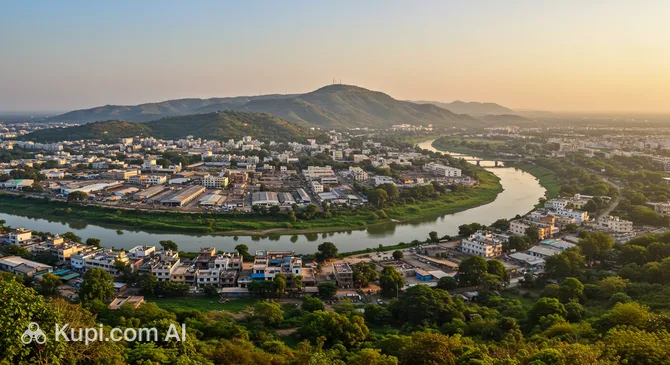
Yamunanagar is a dynamically developing industrial hub located in the state of Haryana in India. The city has rightfully earned the title of the country's "timber capital" due to its massive cluster of plywood and paper manufacturing enterprises. Situated at the scenic foothills of the Shivalik Hills on the banks of the sacred Yamuna River, it combines the energy of a working city with the tranquility of natural landscapes.
The city's modern appearance began to take shape actively after 1947, when the history of Yamunanagar received a new impetus for development through an influx of migrants who transformed the small Abdulahpur station into a major economic hub. Today, it is home to over 216,000 people, and the atmosphere is permeated with a spirit of entrepreneurship and hard work.
Yamunanagar. Illustration.
Source: Kupi.com AI
For travelers, the city is primarily interesting for its surroundings: from ancient Buddhist monuments to rich forest areas. Yamunanagar serves as an excellent base for those who want to see the "real" industrial India, which still retains its historical charm and proximity to the mountains. Visit this city to feel the rhythm of life in Haryana and discover the region's unique ecological trails.
Weather Overview
Yamunanagar is located in a subtropical climate zone, characterized by sharp seasonal changes. Summers in the city (from April to June) can be very hot, with temperatures often rising to +40°C and above, which, combined with the city's industrial pace, can be a challenge for tourists. Dry weather prevails during this period, followed by the arrival of monsoons at the end of June.
The wettest time is July and August, when the region experiences heavy rainfall, reaching up to 350 mm per month. Winter (December–January) brings a pleasant chill, with daytime temperatures around +18°C and nighttime lows of +7°C. You can check the detailed weather in Yamunanagar by month to choose the ideal time for your visit.
The optimal time for a trip is considered to be from October to March. During these months, comfortable dry weather sets in, ideal for walks in the nearby hills and visiting national parks, when the nature of the Shivalik foothills is at its best.
Average monthly temperature
Average monthly precipitation
Interesting Facts
Before India gained independence, modern Yamunanagar was just a tiny village called Abdulahpur, which grew around a railway station.
The city is known as the "Timber Capital of India" due to the vast number of sawmills and plywood factories that supply materials to the entire country.
In the city's surroundings lies a unique monument—the Chaneti Buddhist Stupa, which, according to legend, was built by Emperor Ashoka himself in the 3rd century BC.
Yamunanagar produces not only paper and wood but also high-quality stainless steel utensils that are exported beyond the state.
The district received its status as a separate administrative unit quite recently by historical standards—on November 1, 1989.
How to Get There
Yamunanagar is an important transport hub in Haryana, making it easily accessible for travelers. The city is conveniently located on National Highway NH-73, connecting it to Chandigarh (about 106 km), while the journey from Delhi takes approximately 4-5 hours via NH-44. You can learn more about various ways to travel to plan your route most effectively.
For those who prefer air travel, the nearest major airports are located in Chandigarh (IXC) and Delhi (DEL). From these aviation hubs, the city can be reached by taxi or intercity bus, with travel times ranging from 2 to 5 hours depending on the arrival point.
Railway communication is one of the most convenient ways to reach the city. The main station, Yamunanagar-Jagadhri (YJUD), is located on the strategic Amritsar–Kolkata line. Trains from Delhi, Ambala, and other major North Indian cities stop here. The Jagadhri Workshop station also operates, serving the industrial districts.
Station
Passenger traffic
Distance
Dehradun railway station
10
77 km
Kalka railway station
8
85 km
Shimla railway station
5
108 km
Ludhiana Junction railway station
8
162 km
Delhi Junction railway station
11
163 km
Main Attractions
While Yamunanagar is primarily known as an industrial giant, its surroundings hide real treasures for history and nature lovers. One of the most significant sites is the ancient Chaneti Buddhist Stupa, dating back to the era of Emperor Ashoka. This place, mentioned in the records of the famous traveler Xuanzang, allows you to touch the spiritual heritage of ancient India.
For those seeking a comfortable retreat, the region is home to the Grey Pelican Tourist Resort. This is a popular spot among visitors where you can relax in a peaceful setting. If you are interested in a modern urban environment and active leisure, it is worth checking out the Kingdom Gym and Trampoline Park—an excellent place for family time.
Connoisseurs of gastronomy and pleasant evenings should pay attention to establishments such as Romeo Lane The Brew Garden or the stylish Aviary Cocktail Nest. These locations offer a modern level of service and an atmosphere that harmoniously complements the city's industrial rhythm. Don't forget to also visit Kalesar National Park, located nearby, to see leopards and enjoy the Shivalik foothills.
Local Cuisine
The culinary traditions of Yamunanagar are deeply rooted in the cultures of Haryana and Punjab. The diet's foundation consists of hearty wheat-based dishes like roti and various parathas. Be sure to try the local dal (lentil soup) and saag—a flavorful dish made of greens and spices. Thanks to the influence of Punjabi cuisine, Amritsari kulcha and the refreshing lassi drink can be found everywhere.
The city's gastronomic scene is mainly represented by cozy dhabas (traditional roadside cafes) and family restaurants. If you are looking for something familiar and quick, there is a Fast Food Restaurant (Burger King) in the city, offering a familiar menu with an Indian twist. For lovers of active recreation and snacks, the cafe at the Kingdom Gym and Trampoline Park is also a good choice.
Locals appreciate street food: at the Jagadhri markets, it's worth trying chole bhature and freshly squeezed juices. A feature of the local cuisine is the predominance of vegetarian dishes, though chicken or mutton curries can always be found in hotel restaurants and larger cafes. End your meal with a cup of strong, aromatic masala chai, which is served here at every turn.
Travel Tips
A visit to Yamunanagar will allow you to see India from its industrial and natural sides. To make your trip comfortable and productive, we have prepared several practical tips.
Clothing and Essentials: Choose light cotton clothing for the summer, but be sure to bring warm items (a sweater or jacket) if you plan a visit from December to February. When visiting temples like Adi Badri, choose modest clothing that covers your shoulders and knees.
Transport: For getting around the city, it is most convenient to use auto-rickshaws. If you plan a trip to Kalesar National Park, it is better to book a taxi for the whole day through your hotel or the Uber/Ola apps.
Finances: The official currency is the Indian Rupee (INR). Cards are accepted in large stores and hotels, but you will definitely need cash at the markets. ATMs are easy to find in the city center and near the stations.
Health and Safety: The city is quite dusty due to the factories, so people with allergies should carry a mask. Drink only bottled water and avoid ice in street drinks.
Communication: The main language is Hindi, but staff in hotels and large stores have basic English skills. For internet, it is better to buy a local SIM card (e.g., Airtel or Jio) near the central market.
Local Etiquette: Always remove your shoes when entering homes or temples. The traditional greeting "Namaste" is always met with a smile.
What to Avoid: It is not recommended to walk alone on the outskirts of industrial zones after dark. Also, try not to photograph industrial facilities without security permission.
Extra Tip: If you love nature, dedicate an entire day to a trip to the Shivalik foothills—the air there is much cleaner, and the views of the Yamuna River are simply stunning.
We hope these tips help you get to know Yamunanagar better and ensure you have only pleasant impressions from your trip!
Entertainment & Nightlife
Nightlife in Yamunanagar is relatively quiet, which is typical for an industrial center. Most evening activity is concentrated around the central markets of Jagadhri and modern cafes. Nevertheless, stylish leisure spaces are gradually appearing in the city. For example, Romeo Lane The Brew Garden offers a great atmosphere for those who want to spend an evening with friends in a cozy garden with quality drinks.
Another notable spot for an evening cocktail is Aviary Cocktail Nest. Local youth and business people who appreciate modern design and quality mixology gather here. Most such establishments operate until midnight, and the atmosphere becomes more lively on weekends. For safe travel around the city at night, it is recommended to use taxis called via mobile apps like Uber or Ola.
Daytime entertainment in the city is represented by cinemas showing the latest Bollywood releases and walking areas in the markets. If you are traveling with family, a visit to an amusement park or trampoline centers, which are popular leisure formats for locals, would be an excellent choice.
Parks & Museums
Despite its industrial status, Yamunanagar boasts proximity to unique natural areas. The region's main "green" treasure is Kalesar National Park, sprawling over more than 11,000 hectares. It is an ideal place for walking and wildlife observation, where you can spot leopards and various birds amidst dense forests.
There are few park zones within the city itself; however, residents and visitors often frequent the Grey Pelican Tourist Resort, whose grounds serve as a great spot for outdoor relaxation. Also popular is the Kingdom Gym and Trampoline Park, where modern sports facilities replace traditional park leisure for youth and families with children.
There are no classic indoor museums in Yamunanagar, but their role is played by open-air historical monuments. The Chaneti Buddhist Stupa and the Adi Badri temple complex are living testimonies to the region's centuries-old history. Visiting these places replaces a trip to a gallery, offering panoramic views of the Shivalik Hills and ancient architecture instead of static exhibits.
Getting Around
The transport system in Yamunanagar is typical of large industrial centers in India. The main means of transportation within the city are auto-rickshaws and cycle-rickshaws, which allow for maneuvering through heavy urban traffic. This is the most affordable and fastest way to reach markets or the railway station, though the fare should be agreed upon in advance.
Bus services connect Yamunanagar with neighboring cities and states. Regular flights depart for Chandigarh, Delhi, and Ambala. City buses are also present, but they are often overcrowded, so tourists more frequently choose rickshaws or taxis. During peak hours (morning and evening), traffic jams can occur on main roads, especially in industrial zones where heavy freight transport is active.
For comfortable travel around the city and its surroundings, it is recommended to use taxi-hailing apps. This eliminates the need to haggle and ensures a fixed cost. Walking through industrial areas can be tiring due to dust and heavy traffic, so it is better to rent a car with a driver for the whole day when sightseeing.
Accommodation
Accommodation options in Yamunanagar are mainly geared towards business travelers and transit tourists. Middle-class hotels (2-3 stars) and guest houses predominate here, offering a basic set of services. Most of these properties are concentrated near railway stations and along major highways, which is convenient for those stopping over.
For a more comfortable and peaceful stay, consider the Grey Pelican Tourist Resort. This is one of the few places in the city offering a resort-style stay with a wider range of amenities and landscaped grounds. It is best to book such options in advance, especially if your trip coincides with local holidays or festivals.
The price range in the city is quite affordable, making it accessible for budget travelers. When choosing accommodation, we recommend checking for air conditioning, as temperatures can be very high during the summer months. Major online booking systems work reliably, providing up-to-date information on availability and prices.
Nearby Cities
Yamunanagar serves as an excellent starting point for exploring the northern regions of Haryana and neighboring Uttar Pradesh. Thanks to the well-developed road network, tourists can easily make short trips to colorful towns and historical sites located within an hour's drive.
Just 14 kilometers away is the small town of Mustafabad, and slightly further is Sarsawa, known for its proximity to an airbase and picturesque rural landscapes. Also worth noting is Ladwa, through which pilgrims heading to the shrines of Kurukshetra often pass. These small settlements allow you to see the unhurried life of the Indian countryside.
City
Population
Distance
Mustafabad
8 665
14 km
Mokarrampur
10 342
18 km
Sarsawa
18 956
18 km
Nakur
22 712
23 km
Ladwa
28 887
26 km
Exploring the surroundings of Yamunanagar is an opportunity to see the diversity of India: from industrial giants to quiet farmlands and ancient shrines in the Shivalik foothills. Each of these destinations will add new colors to your journey through the region.
Shopping & Souvenirs
Shopping in Yamunanagar is primarily about exploring local bazaars and traditional goods. The city is famous for its wood and stainless steel products, so you can find high-quality kitchenware and unique interior items at the central Jagadhri markets. This is a great opportunity to purchase something useful and durable at very affordable prices.
For those who prefer a more familiar one-stop shopping format, there is Suvidha Stores. Here you can find textiles, clothing, and household goods that are popular with local residents. Although there are no massive Western-style shopping malls in the city, the markets near the railway stations offer a huge selection of fabrics and ready-made Indian-style clothing.
Shops usually open around 10:00 AM and stay open until late evening, with a small break during the hottest part of the day. It is customary to pay with cash (Indian Rupees) at the markets, while larger outlets like Suvidha Stores accept bank cards. Don't forget to look out for local sweets and sugar, for which this region is also famous.