Support

Bajawa Soa Airport

About the Airport

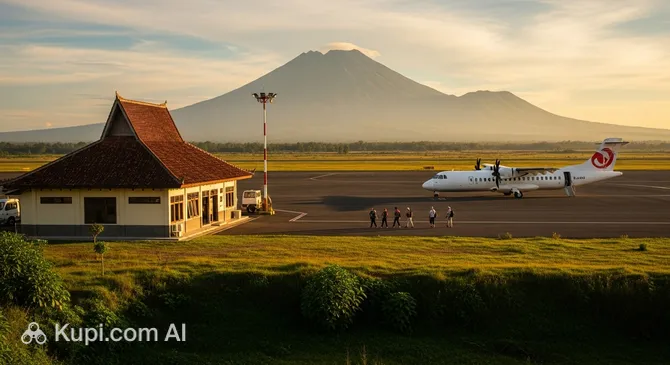
Bajawa Soa Airport. Source: Kupi.com Binoculars

Bajawa Soa Airport is not merely a transport hub, but a true aerial gateway to the heart of the mysterious island of Flores. Located on a picturesque plateau surrounded by green hills and majestic volcanoes, it immerses travellers in an atmosphere of peace and adventure from the very first minute. This compact air terminal, devoid of the hustle and bustle of major metropolises, offers guests a cosy and quick start to exploring the unique culture of the Ngada people.

IATA Code BJW
ICAO Code WATB
City Bajawa
Distance to centre 25 km
Status Domestic
Annual Passengers Approx. 32,000
Schedule On request at terminal

Airport Features and Advantages

Bajawa Soa Airport is distinguished by its intimate scale and simplicity, which many travellers find charming. Thanks to the small size of the terminal, all pre-flight procedures—from check-in to boarding—are surprisingly quick and queue-free. The building is positioned in such a way that the airfield offers a breathtaking view of the peak of Mount Inerie, making take-off and landing here a memorable experience in itself.

Despite its modest infrastructure, the airport provides everything necessary for a comfortable wait for your flight, including small shops with local snacks. The staff here are known for their friendliness and willingness to help, which is typical of the hospitable culture of Flores Island. It is an ideal starting point for those who want to immediately plunge into the authentic atmosphere of Indonesia, bypassing noisy tourist hubs.

Contact Information

Since Bajawa Soa Airport (BJW) is a small regional airport, finding detailed and verified contact information can be difficult. Below are the most current details available from open sources.

  • Official Airport Website: Currently, the airport does not have a separate official website. Flight information is best checked on airline websites.
  • Information Desk Phone: There is no verified public phone number. For all questions related to schedules, tickets, and check-in, it is recommended to contact your airline directly.
  • Airport Address: Piga, Soa, Kabupaten Ngada, Nusa Tenggara Tim., Indonesia.
  • Email: An official email address has not been published. For communication, it is recommended to use airline channels.
  • Airport Social Media: Official airport pages on social media have not been found.
  • Lost Luggage Information: For issues related to lost or damaged luggage, you must contact the Lost & Found service of the airline you flew with.
  • Passenger Support Contacts: For assistance with issues related to your flight, please contact the customer support service of the airline you are using.

How to Get to the Airport

Getting to Bajawa Soa Airport (BJW), which serves the small town of Bajawa on the island of Flores in Indonesia, is quite simple, although transport choices are limited compared to major cities. The airport is located approximately 25 kilometres from the city centre, and the journey usually takes 30 to 45 minutes depending on road conditions. The main methods are taxis, vehicle rentals, and, for the most budget-conscious, local minibuses.

The most convenient and common way to get to the airport is by taxi or private transfer. You can book a car directly from your hotel, which is the most reliable option. Private drivers also operate in the city. The cost of the trip is usually negotiable, so do not hesitate to bargain. The estimated price ranges from 150,000 to 250,000 Indonesian Rupiah. A cheaper alternative is a motorcycle taxi (ojek), which is suitable for solo travellers with light luggage. Ride-hailing app services like Gojek or Grab may be available, but their operation in this region is unstable, so it is better to have a backup plan.

For budget travellers, there is the option of travelling by public transport—a local minibus called a "bemo". This is the cheapest way, but also the least comfortable. There is usually no direct route to the terminal. A bemo may drop you off on the main road, from where you will have to walk to the airport or hitch a ride. This option is suitable if you have little luggage and plenty of time to spare, as the "bemo" schedule is unpredictable.

If you prefer independence in your movements, you can use a car or scooter rental service. Many companies offer car rentals with a driver, which eliminates the need to navigate unfamiliar roads. Self-driving is recommended only for experienced drivers accustomed to the peculiarities of local traffic. Bajawa Soa Airport has a small parking area where you can leave your vehicle while waiting for a flight.

Terminals and Map

Bajawa Soa Airport (BJW) is a small regional airport serving the town of Bajawa and its surroundings on the island of Flores. Given its size and passenger flow, the airport structure is very simple and intuitive, making navigation extremely easy for travellers.

The airport consists of one compact terminal that serves both departing and arriving passengers. There is no separation into domestic and international terminals, as the airport only accepts domestic flights from other cities in Indonesia. All infrastructure is located in one building, so transitions between zones take literally a few minutes.

The layout of the airport is extremely simple. Upon entering the terminal, you immediately find yourself in a small common hall. Check-in counters for several airlines are located here. After check-in, passengers proceed to the security screening area, beyond which lies a small waiting hall with several boarding gates. The arrival zone is a separate part of the building, which passengers enter directly from the airfield. The baggage claim belt or an area where luggage is unloaded manually is also located here.

Thanks to the compactness of the airport and the small number of flights, all procedures are completed very quickly. Flight check-in and security control usually take no more than 15-20 minutes. Nevertheless, it is recommended to arrive at the airport approximately 1-1.5 hours before departure to check in luggage and go through all formalities without rushing. It is practically impossible to get lost in Bajawa Soa Airport—all key zones are within direct line of sight.

Airport History

The history of Bajawa Soa Airport (BJW) is, in essence, a story of modernisation and opening the region to the world. The current airport is relatively new; it was built to replace the old, more modest Turelelo airfield, which could no longer cope with growing demands and could not accommodate modern aircraft.

A key stage in the development of transport infrastructure on Flores Island was the construction of the new airport, which culminated in its official opening in December 2013. This project was part of a major government programme to develop the eastern regions of Indonesia. The main goal was to create a modern aerial gateway to Bajawa capable of receiving larger turboprop aircraft such as the ATR 72, which significantly reduced travel time and increased the accessibility of the region.

Since its opening, the airport has not undergone massive reconstructions, as it was originally built to modern standards for its class. Its main achievement is not passenger traffic records, but the role it has played in the development of tourism. Thanks to it, thousands of travellers have been able to comfortably reach unique cultural sites, such as the traditional villages of the Ngada people, and natural wonders, including volcanic landscapes.

An interesting fact: the airport is located in a picturesque mountainous area, and landing here becomes a small adventure in itself with breathtaking views. Thus, the history of Bajawa Soa Airport is not so much a tale of decades of operation, but a vivid example of how modern infrastructure can be the key to unlocking the tourism potential of a remote but incredibly experience-rich corner of the planet.

Services and Amenities

Bajawa Soa Airport (BJW) is a small regional airport serving the town of Bajawa and its surroundings on the island of Flores in Indonesia. Given its compact size, the range of services here is basic and focused on meeting the essential needs of passengers before departure.

Within the terminal, you will find several small kiosks and cafes (warungs) where you can buy snacks, refreshing drinks, and simple local dishes. This is a good opportunity to have a bite before your flight. The selection of shops is limited, mostly consisting of souvenir stalls selling handicrafts and commemorative items from the region.

Specialised VIP lounges or high-comfort waiting areas are absent at the airport. Passengers can spend time in the general waiting hall. Access to Wi-Fi is generally not provided or its operation is unstable, so it is better to have mobile internet with you. The number of power outlets for charging devices is limited, so it is recommended to bring a portable battery (power bank).

There are no bank branches or currency exchange points in the airport building. All financial transactions are best completed in the city beforehand. Sometimes an ATM may be available, but one should not rely on it entirely—having cash is the most reliable option. Basic medical services can be provided at the first aid station, but for serious cases, it is necessary to contact medical facilities in Bajawa.

For passengers with children, special play areas or mother-and-child rooms are not provided. Passengers with reduced mobility are recommended to notify their airline in advance about the need for assistance so that airport staff can provide a wheelchair and assist with boarding.

There are no hotels directly on the airport grounds. The nearest accommodation options are located in the town of Bajawa itself, which can be reached by taxi or rented transport. Also, there are no business centres or conference rooms at the airport, so for business meetings, it is worth using the infrastructure of hotels in the city.

Where to Eat

When planning a flight through Bajawa Soa Airport (BJW), it is important to understand that this is a small regional air terminal, and the choice of dining establishments here is quite modest, but sufficient for a snack before departure. Most options are concentrated in the general area before security control (landside).

In the main hall of the airport, you will find several small cafes or, as they are called in Indonesia, warungs. These are simple establishments run by locals offering basic but tasty dishes. Here you can order a full meal, for example, Nasi Goreng (fried rice with vegetables and egg) or Mie Goreng (fried noodles). This is a great opportunity to try authentic Indonesian cuisine at very affordable prices.

For a quick snack, you can buy local appetisers, pastries (kue), or packaged snacks and drinks. Be sure to try the famous local coffee—Kopi Flores. Its aroma and rich taste will be a wonderful conclusion to your visit to Bajawa. Regarding dietary restrictions, there are no specialised vegan or gluten-free menus here. However, most dishes in Indonesia are Halal. For vegetarians, you can always ask for rice or noodles to be prepared with vegetables only, without adding meat.

Important tip: The departure zone after security screening (airside) is very small and usually has no dining establishments, except perhaps a small kiosk with water and packaged chips. Therefore, it is strongly recommended to eat in the main part of the terminal before checking in for the flight and passing through security control. Cafes operate according to the flight schedule—opening a few hours before the first departure and closing after the last aircraft leaves.

Tips for Travellers

Planning a trip through the airport of Bajawa? To ensure your trip goes smoothly and without unnecessary hassle, use our tips specially prepared for travellers using Bajawa Soa Airport (BJW).

Arrival time at the airport. Bajawa Airport is a small regional terminal serving primarily domestic flights. It is recommended to arrive 1.5–2 hours before departure. This time will be quite sufficient to calmly check in for the flight, drop off luggage, and pass through security screening without rushing.

Check-in and security. Procedures in small airports generally proceed faster. Nevertheless, prepare your passport and ticket (in electronic or printed form) in advance to speed up the process. Staff are usually friendly and ready to help if you have questions.

Seat selection on the plane. If you want to enjoy breathtaking views, choose a window seat. Flights to and from Flores Island offer stunning panoramas of volcanoes and the coastline. If comfort and the ability to leave the cabin quickly after landing are more important to you, it is better to choose an aisle seat.

Hand luggage. Standard international rules apply: liquids are allowed in containers of no more than 100 ml, packed in a single transparent bag. All batteries and power banks must be carried only in hand luggage. Sharp and cutting objects are strictly prohibited.

For connecting passengers. Bajawa Airport is not a major transit hub. If your itinerary involves a transfer, it will most likely be at a larger airport in Indonesia, such as Denpasar (Bali) or Jakarta. Always allow sufficient time between connecting flights, as delays are possible.

Customs control. Since Bajawa Airport serves only domestic flights, there is no customs or passport control upon arrival from other Indonesian cities. These procedures must be completed at the first international airport in the country where you arrive.

Saving time and money. To save money, try to book tickets in advance. You can also arrange a transfer from the airport to the city before arrival—this is often more cost-effective than looking for a taxi on the spot. Prices for food and drinks at the airport can be higher, so bring a light snack with you.

In case of flight delay. In the event of a flight delay or cancellation, contact your airline representative immediately. The infrastructure at Bajawa Airport is quite modest, so be prepared for limited facilities for long waits. Having travel insurance will help cover unforeseen expenses.

Reached the end of the page?

That means the route is fully explored