Support

Minangkabau International Airport

About the Airport

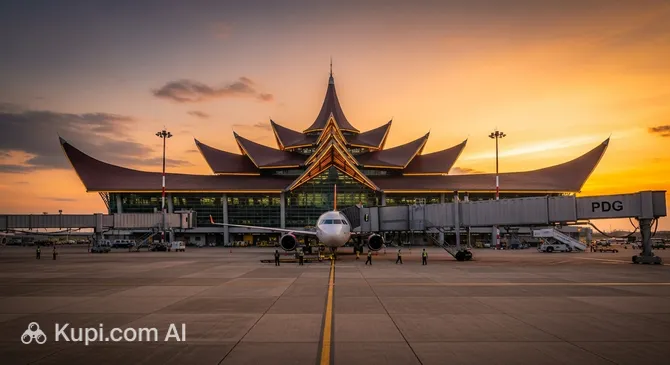
Minangkabau International Airport. Source: Kupi.com Binoculars

Minangkabau International Airport (BIM) is not merely a modern transport hub, but a true cultural gateway to the world of West Sumatra. It is the only airport in the world named after an ethnic group, and its terminal immediately immerses travelers in the local atmosphere thanks to its unique roof in the "bagonjong" style, resembling the buffalo horns of traditional Rumah Gadang houses. Located amidst tropical greenery away from the city bustle, it serves as the ideal starting point for those seeking to see picturesque lakes, volcanoes, and taste the legendary Padang cuisine.

IATA Code PDG
ICAO Code WIEE
City Padang (Ketaping)
Distance to center ~23 km
Status International
Passengers per year About 4.2 million people
Schedule Flight information can be found on the online display

Features and Advantages of the Airport:

  • Unique Architecture: The terminal building is designed with deep respect for local traditions. The pointed roofs, mimicking buffalo horns, make the airport one of the most recognizable structures in the region and an excellent background for your first vacation photos.
  • Transport Accessibility: The airport is connected to the city center by a modern railway line. The Minangkabau Express train allows you to get to Padang quickly and comfortably, bypassing traffic jams, which is a rarity for many regional airports in Indonesia.
  • Seismic Resistance: Given the geological features of the region, the airport's structure was developed using advanced earthquake-resistant technologies, ensuring high passenger safety.
  • Focus on Halal Tourism: The airport offers excellent conditions for Muslim travelers and serves as an important transit hub for pilgrims departing for Hajj, providing spacious prayer areas and appropriate service standards.

Contact Information

To contact airport representatives, get up-to-date flight information, or resolve any issues, you can use the following contact details:

  • Official Website: minangkabau-airport.co.id
  • Information Desk Phone: +62 751 819030
  • Address: Jl. Mr. Sutan M. Rasyid, Ketaping, Batang Anai, Kabupaten Padang Pariaman, Sumatera Barat, Indonesia
  • Email: ap_minangkabau@angkasapura2.co.id (managed by the operator Angkasa Pura II)
  • Social Media: The airport actively maintains its social media pages. For example, you can find them on Instagram under the username @minangkabauairport.
  • Lost Baggage Information: If you have lost your belongings or luggage, first contact your airline's representative office at the airport. You can also contact the airport's Lost & Found service.
  • Passenger Support Contacts: For prompt assistance and consultations, please approach the information desks located in the terminal building or call the general information desk phone number.

How to Get to the Airport

Getting to Minangkabau International Airport (PDG), located approximately 23 km north of the city center of Padang, is possible via several convenient methods. Depending on your budget, time, and preferences, you can choose between modern public transport or private transfer. When planning your trip, consider the traffic situation, as travel time may vary.

Train and Bus

One of the most reliable and modern ways to get to the airport is the dedicated Minangkabau Express train. It runs between the railway station in central Padang and the airport, allowing you to avoid city traffic jams. The journey takes about 40 minutes, offering comfortable conditions and a fixed schedule. For a more budget-friendly journey, you can use the DAMRI buses. They connect the airport with key points in the city, including the main Pasar Raya market. This is the most economical option, however, travel time can range from 60 to 90 minutes depending on traffic.

Taxi and Online Services

Taxis are a popular and convenient way to get to the airport. There are official taxi counters in the terminal that often operate on a fixed-rate or prepaid coupon system. Even more popular in Indonesia are ride-hailing apps such as Gojek and Grab. A trip through these apps usually costs less than a regular taxi. Besides cars (GoCar/GrabCar), for solo travelers with light luggage, the ultra-popular motorcycle taxi option (GoRide/GrabBike) is available, allowing you to quickly maneuver through traffic.

Car Rental and Parking

If you plan to actively explore the West Sumatra region, renting a car can be an excellent solution. Counters for several rental companies are located right at the airport. Important tip: due to chaotic local traffic and navigation specifics, many tourists prefer to rent a car with a driver. It is not much more expensive but significantly simplifies movement. For those arriving at the airport in their own or rented vehicle, there is secure parking with zones for short-term and long-term parking.

Terminals and Map

Minangkabau International Airport (PDG) is distinguished by a thoughtful and passenger-friendly structure. It consists of one main terminal that serves both domestic and international flights. The terminal building immediately attracts attention with its unique architecture, executed in the traditional Minangkabau style with a characteristic roof resembling buffalo horns (Rumah Gadang). This feature makes the airport not only functional but also a culturally significant object.

The airport layout is quite simple and intuitive. The terminal is divided into two main levels:

  • Upper Level — this is the departure area. Here you will find airline check-in counters, passport control points for international flights, and security screening. After completing formalities, passengers enter the secure area with waiting lounges and boarding gates.
  • Lower Level is designed for arriving passengers. Here are the baggage claim areas, customs control, and the exit to the public area, where you can find taxis, car rental counters, and meet guests.

Since there is only one terminal, transitions between zones do not cause difficulties. Internal navigation is well organized: there are signs in Indonesian and English everywhere. The space inside the terminal is divided into domestic and international sectors, but movement between them is logical and does not require the use of shuttles or long walks. Everything is located within a single building.

The time for completing formalities at Padang airport is usually short due to its compactness. For check-in and screening on domestic flights, it is worth allowing about 1-1.5 hours, but during peak hours or holidays, it is better to arrive 2 hours before departure. For international flights, the standard recommendation is to arrive at the airport 2.5-3 hours before departure. In general, the airport is famous for its efficiency, and long queues are a rarity here.

Airport History

The history of Minangkabau International Airport (PDG) is inextricably linked with the development of the city of Padang and the entire West Sumatra province. Unlike many airports that have come a long way from military airfields, PDG is a modern project implemented from scratch in the 21st century to replace the old Tabing Airport.

The old Tabing Airport, which served the region for decades, faced serious limitations. It was located too close to the city and, more importantly, to the Bukit Barisan mountain range, which created risks for flight safety, especially for large aircraft. Expanding its runway was practically impossible. Consequently, a decision was made to build a new, safer, and more modern airport.

Construction began in 2002, and on July 22, 2005, Minangkabau International Airport was officially opened. This project became a landmark for all of Indonesia, as PDG became the first airport in the country built "from a clean slate" after gaining independence. Its location 23 kilometers from the center of Padang was chosen with safety in mind, including minimizing risks from tsunamis.

One of the most important moments in the airport's history was the powerful earthquake in Sumatra in 2009. Despite some infrastructure damage, the airport remained operational and turned into a vital center for delivering international humanitarian aid and conducting rescue operations. This event proved the strategic importance of the new airport for the entire region.

Since its opening, the airport has been constantly developing. Modernization and extension of the runway to 3000 meters were carried out, allowing it to receive wide-body aircraft, including the Boeing 747, to serve pilgrimage flights during Hajj. Work is underway to expand the passenger terminal to cope with the growing flow of tourists. An interesting fact: the architecture of the main building is inspired by the traditional houses of the Minangkabau people — Rumah Gadang, which gives the airport a unique cultural flavor.

Services and Amenities

Minangkabau International Airport (PDG) offers passengers all necessary services for a comfortable wait for their flight. The terminal has conditions for both short stays and long layovers, allowing travelers to relax and resolve organizational matters right on the spot.

For those who want a snack or to do some shopping, the airport has various cafes and restaurants where you can try both local Indonesian dishes and more familiar international snacks. The shops offer an assortment of souvenirs, travel goods, and Duty Free products, where you can purchase gifts and necessities.

Free Wi-Fi is available throughout the terminal, and special zones for charging electronic devices are equipped in the waiting halls. For passengers preferring increased comfort, lounges are open, including VIP lounges. Here you can relax in a quiet atmosphere and use additional services such as newspapers, snacks, and drinks.

Financial matters can be resolved at bank branches and currency exchange points; ATMs are also installed in the terminal. In case of need, passengers can contact the medical center for first aid.

The airport cares for passengers with special needs. For families with children, there are mother and child rooms. Passengers with limited mobility can count on an accessible environment: ramps, elevators, and specially equipped restrooms. Airport staff are always ready to provide necessary assistance.

For those who need to rest between flights, hotels of various comfort levels are located in the immediate vicinity of the airport. Business travelers can use basic business services, which are often provided in premium lounges.

Where to Eat

Minangkabau International Airport (PDG) offers passengers a wonderful opportunity to experience one of the most famous cuisines of Indonesia — Padang cuisine. Most catering establishments are concentrated in the main terminal, both in the public area (landside) and in the departure area after security control (airside), allowing you to have a snack both before check-in and while waiting for your flight.

For a full meal: Padang cuisine restaurants

The main gastronomic attraction of the airport is, undoubtedly, the restaurants offering `Nasi Padang`. This is not just a dish, but a whole ritual: you get a plate of rice and choose from a variety of ready-made dishes displayed in the window. We highly recommend trying `rendang` — beef slow-cooked in coconut milk and spices, recognized as one of the most delicious dishes in the world. Also popular are `ayam pop` (tender chicken) and various types of `gulai` (curry). Such restaurants are the ideal choice for a hearty and authentic lunch or dinner. They are located in both the public area and the departure zone.

For a quick snack: cafes and eateries

If time is limited, there are several cafes and small eateries in the airport. Here you can drink coffee, tea, and eat fresh pastries. This is a great option for a light breakfast or snack. Also in small shops, you can find local snacks, for example, `keripik balado` (spicy cassava chips), which make for an excellent edible souvenir.

Dietary preferences and prices

It is important to note that the overwhelming majority of dishes at the airport are `Halal`, which aligns with local traditions. Vegetarians should pay attention to dishes with tofu (`tahu`), tempeh (`tempe`), and vegetable curries (`gulai sayur`), however, it is better to check with the staff if meat broth or shrimp paste was used in preparation. Prices in airport establishments are higher than in the city but remain moderate by international standards. Most cafes and restaurants operate from early morning until the departure of the last flight.

Travel Tips

When planning a trip through Minangkabau International Airport (PDG), located in the city of Padang, use these tips to make your journey as comfortable as possible and avoid unpleasant surprises. This modern airport serves both domestic and international flights, acting as a key transport hub for exploring the island of Sumatra in Indonesia.

Arrival at the airport and check-in. To avoid rushing, arrive at the airport at least 2 hours before departure for domestic destinations and 3 hours before international flights. This will give you enough time to complete all formalities. To save time, take advantage of the online check-in option offered by most airlines. Be ready to present your passport and boarding pass at check-in counters and during security control.

Hand luggage and seat selection. Remember the general rules for carrying hand luggage: all liquids must be in containers of no more than 100 ml and packed in a transparent bag. It is forbidden to carry sharp objects and high-power lithium batteries in the cabin. When choosing a seat on the plane, consider your preferences: a window seat will give you picturesque views of the Sumatra coast during takeoff and landing, while an aisle seat will ensure more legroom and quick access to the exit.

Connecting passengers and customs. If you have a connecting flight, clarify in advance whether you need to collect your luggage and check it in again. Ensure you have enough time between flights, especially if they are operated by different airlines. Customs control upon arrival usually does not take much time. Do not forget to declare goods exceeding the duty-free limit and large amounts of cash.

Savings and unforeseen situations. To save money, bring an empty water bottle with you and fill it after passing security control at special water fountains. Prices for food and drinks at the airport may be higher than in the city. In case of a flight delay or cancellation, immediately contact your airline representative for information on further actions, possible compensation, and provision of meals or a hotel.

Reached the end of the page?

That means the route is fully explored