Support

Muara Bungo

Airports in the city

About the Airport

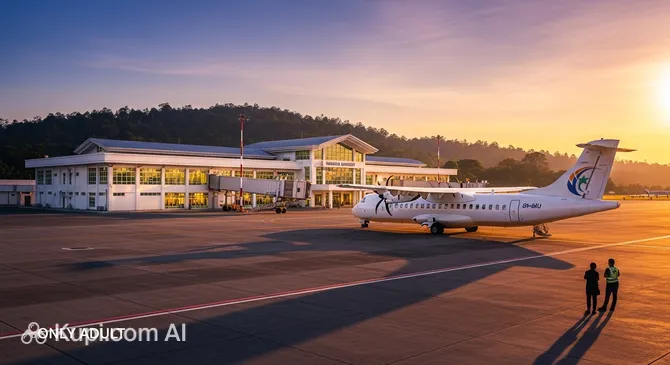
Muara Bungo. Source: Kupi.com Binoculars
Muara Bungo Airport serves as the air gateway to the dynamically developing Bungo Regency, located in the very heart of Jambi province. This compact yet modern aviation hub plays a crucial role for the region, saving travellers from exhausting multi-hour journeys along the land routes of Sumatra island. A calm and friendly atmosphere prevails here, allowing guests to avoid the hustle and bustle of major metropolitan hubs and comfortably begin their acquaintance with the authentic culture of Indonesia. Thanks to its strategic location, the airport is an ideal starting point for both business trips and for those seeking to explore the natural treasures of the western part of Jambi.
IATA Code BUU
ICAO Code WIJB
City Muara Bungo
Distance to Centre 13 km (approx. 20 min)
Status Domestic
Annual Passengers Around 30,000
Schedule Online board
**Airport Features and Advantages:** * **Strategic Convenience:** The airport significantly reduces travel time for those heading to the western districts of the province, allowing them to avoid the long road journey from Jambi City or Padang. * **Modern Infrastructure:** Following reconstruction, the runway was extended to 2,100 metres, enabling it to accommodate jet aircraft such as the Boeing 737, ensuring reliable connections with the country's capital. * **Comfort and Speed:** The small size of the terminal guarantees rapid passage through all pre-flight formalities without the queues typical of large airports. * **Transport Accessibility:** The city centre can be easily reached from the terminal by taxi or rental car in just 20 minutes.

Contact Information

To assist with travel planning and organisational matters, the contact information for Muara Bungo Airport is provided below. Given that this is a small regional hub, the most up-to-date flight information is often obtained via social media or directly from the air carriers.

  • Official Airport Website: The airport does not have its own dedicated website. Official information is posted on the portal of the Directorate General of Civil Aviation of Indonesia (Hubud) or the Ministry of Transportation.
  • Inquiry Service Phone: +62 811-7400-077 (Administration/Office). Please note: staff may not be fluent in English; using airline apps is more reliable for checking flight status.
  • Airport Address: Jl. Soekarno-Hatta, Kelurahan Sungai Buluh, Kecamatan Rimbo Tengah.
  • Email: muarabungo_airport@yahoo.co.id (For official enquiries).
  • Social Media: The airport publishes news and updates on Instagram (account @bandaramuarabungo). This is one of the most reliable ways to find out about current changes in terminal operations.
  • Lost & Found Information: The Lost & Found counter is located in the terminal arrivals area. In case of lost or damaged items, you must immediately contact a representative of your airline (e.g., Nam Air or Wings Air) before leaving the sterile area.
  • Passenger Support Contacts: The airport administration office (UPBU) operates during standard office hours. At other times, assistance can be sought from aviation security staff or at the check-in counters.

How to Get to the Airport

The transport infrastructure around Muara Bungo Airport is quite simple, which is explained by the small size of the city and the terminal itself. The airport is located in the Rimbo Tengah district, just 13–15 kilometres from the central part of the city (Pasar Muara Bungo). In the absence of traffic jams, the journey takes approximately 20–25 minutes. Below are the main ways to get to the departure point or reach the city after landing.

Taxi and Transfer

The most convenient and common method of transport for tourists with luggage is a taxi. Since public transport is poorly developed, a car remains the priority choice.

  • Official Taxi: Local taxi drivers are usually on duty in the arrivals area. Cars are often not equipped with meters, so it is recommended to negotiate the fare in advance, before getting into the car. The estimated price of a trip to the city centre ranges from 70,000 to 100,000 Indonesian Rupiah (IDR).
  • Online Aggregators: Apps popular in Indonesia (Grab or Gojek) operate in the region, however, vehicle arrival times may be longer due to fewer drivers compared to major metropolises. This is a more reliable option in terms of price fixing.
  • Motorbike Taxi (Ojek): For solo travellers with a light backpack, a motorbike ride is an option. This is the fastest and most budget-friendly way (around 30,000 – 50,000 IDR), allowing you to breeze to your hotel.
  • Hotel Transfer: Many hotels in Muara Bungo (e.g., Amaris or Semagi) offer free or paid transfer services. It is recommended to order this service when booking your room — the driver will meet you with a sign right at the exit.

Public Transport

In the sense familiar to Europeans (metro, city buses with a strict schedule), public transport is absent here. There is no rail connection to the airport.

  • Minibuses (Angkot): Small minibuses run along the main road (Jalan Lintas Sumatera), which passes near the airport. However, they do not enter the terminal grounds. You would have to walk about 1–1.5 km from the highway to the airport entrance, which is extremely inconvenient with suitcases and in the hot climate.

Car Rental

There are no international car rental brand counters in the arrivals hall. Car rental in Muara Bungo usually implies renting a car with a driver. This is due to the specifics of local traffic and complex navigation. You can arrange a rental through your hotel administration or at local travel agencies in the city. The cost of renting a car with a driver for a day starts from 500,000 – 700,000 IDR (including fuel).

Airport Parking

An open-air parking lot for cars and motorcycles is equipped in front of the terminal building. It is within walking distance of the entrance.

  • Capacity: The area is small, but there is usually enough space for everyone, as traffic is low.
  • Cost: Rates are affordable. Parking a motorcycle will cost approximately 2,000 – 5,000 IDR, and a passenger car from 5,000 to 10,000 IDR for short-term parking.
  • Details: Payment is made in cash upon exit.

Alternative Routes via Neighbouring Airports

Since flights to Muara Bungo can be seasonal or infrequent, travellers often choose to fly to larger transport hubs and then reach the Bungo region by land transport (buses or rented "Travel" type minivans).

Terminals and Map

The infrastructure of Muara Bungo Airport (BUU) is characterised by extreme compactness and functionality, which is typical for regional air harbours in Indonesia. The airport complex consists of one general passenger terminal, which serves exclusively domestic flights. Thanks to the small scale of the building, it is practically impossible to get lost here, and all necessary zones are in direct line of sight of each other.

Airport Map and Navigation

The terminal is a single-storey (partially two-storey in some zones) building with simple and intuitive zoning. Navigation inside is extremely simple: the flow of passengers is organised linearly, so travellers do not require special maps or diagrams for orientation. Signs are duplicated in English, although most procedures are understandable without translation.

Departure Zone

The entrance to the departure zone is equipped with a primary baggage and hand luggage screening point. Immediately behind it is a hall with several check-in counters. Given the small number of flights (often no more than 1–2 per day), large queues rarely form here. After receiving a boarding pass, passengers pass through a second security checkpoint into the "sterile area".

The Boarding Lounge is a small but air-conditioned space with rows of seats. There are panoramic windows overlooking the apron, allowing you to watch the aircraft being prepared. A small kiosk with drinks and snacks usually operates in the lounge, and there are restrooms and a Musholla (prayer room), which is mandatory for Indonesian public places.

Arrival Zone

Arrival at Muara Bungo Airport has its own specifics. Since there are no aerobridges, passengers descend via the aircraft stairs and walk to the terminal building across the airfield (the distance is only a few dozen metres). The baggage claim area is equipped with one conveyor belt. The process of retrieving items is quite fast, as unloading begins almost immediately after the aircraft engines stop.

Transfers Between Terminals

As the airport has only one terminal, there is no need for transfers or shuttles. The arrival and departure zones are located in the same building but are separated by partitions to comply with security requirements. The exit to the city is located literally 20 metres from the baggage claim area.

Processing Times

The main advantage of Muara Bungo Airport is the speed of service. Nevertheless, the administration recommends adhering to standard rules:

  • Recommended arrival time at the airport: 60–90 minutes before departure. This time is ample for security screening and check-in.
  • Check-in counters usually close 30–45 minutes before flight departure.
  • Passing through pre-flight security rarely takes more than 5–10 minutes.

Recommendations for Navigation and Comfort

Passengers should note that the range of services in the terminal is limited. There are no full-service restaurants, Duty Free shops, or ATMs in the "clean" zone (it is better to look for an ATM in the public zone or in the city). If you have a long wait ahead, it is recommended to arrange snacks in advance. Wi-Fi may work intermittently, so it is better to have a SIM card with mobile data.

Airport History

The history of Muara Bungo Airport (BUU) is relatively young but filled with dynamic events reflecting the rapid economic growth of the region. Unlike many old airfields in Indonesia built during the colonial era, this air port is a product of the modern era and strategic planning by local authorities.

Inception and Opening

The idea of building an airport emerged in the mid-2000s as a response to the difficult transport accessibility of the Bungo Regency. The road to the provincial capital, Jambi City, took more than 5–6 hours along winding roads. Construction began in the early 2010s with active support from the regional government (APBD Bungo). Officially, the airport began operations in November 2012. At that time, it was a modest airfield with a short runway intended for small aircraft.

Era of "Pioneer" Flights

During its first years of existence (2012–2014), the airport served so-called "pioneer flights", subsidised by the state to connect remote areas. The first carrier was Susi Air, using small 12-seater Cessna Grand Caravan aircraft. These flights connected Muara Bungo with Jambi and other nearby cities, laying the foundation for future passenger traffic.

Large-scale Reconstruction and Arrival of Major Players

The key stage of development was the period from 2014 to 2016. The administration understood that for an economic breakthrough, it was necessary to accommodate larger vessels. A phased modernisation of the runway began:

  • First, the runway was extended from the original 1,350 metres to 1,800 metres, which allowed regular flights on ATR 72-500/600 turboprop aircraft. This attracted Wings Air (Lion Air Group), which opened direct routes.
  • The second phase of expansion brought the runway length to 2,100 metres. This was a turning point in the harbour's history, as it allowed for the accommodation of jet liners.

Historic Moment: Landing of the First Boeing

A significant milestone in the airport's history is considered the day when a Boeing 737-500 jet aircraft of Sriwijaya Air (later the route was transferred to the subsidiary NAM Air) first landed on the concrete runway of Muara Bungo. This event marked the airport's entry to a new level: now residents and guests of the region could fly directly to Jakarta without transfers, which previously seemed impossible for such a small city.

Interesting Facts from History

  • Speed of Development: Muara Bungo is one of the few district-level (Kabupaten) airports in Indonesia that went from receiving single-engine aircraft to serving jet liners from the capital in just 5 years.
  • Political Will: The construction and rapid expansion of the airport are often cited as a successful case of using the local budget to create infrastructure of federal importance.
  • Visits by Dignitaries: The airport has repeatedly hosted government delegations, including visits by Indonesian President Joko Widodo, which underscores the importance of this transport hub for the development of Sumatra.
  • Name: Although the airport is widely known as "Muara Bungo", locals sometimes refer to it as "Bandara Muara Bungo - Rimbo Tengah" after the name of the district where it is actually located.

Services and Facilities

Muara Bungo Airport is a small regional air hub, so passengers should not expect a wide range of premium services or the extensive infrastructure typical of international hubs. Nevertheless, the terminal is equipped with everything necessary for a short and comfortable stay before departure. Services here are basic but functional.

Restaurants, Cafés and Shops

Gastronomic options at the airport are limited. There are no full-service restaurants with hot meals in the sterile area. Passengers have access to:

  • Small cafeterias and kiosks: Located both in the public area and in the departure lounge. Here you can purchase bottled water, hot tea or coffee, as well as light snacks (chips, biscuits, traditional pastries).
  • Shops: Duty Free zones are absent, as the airport serves only domestic flights. There are small retail outlets selling daily necessities, newspapers, and sometimes local souvenirs from Jambi province.

Lounges and VIP Services

The main part of the terminal is occupied by the general waiting area (Boarding Lounge). This is a clean, air-conditioned room with rows of standard seats. There are no specialised business lounges of international networks (like Priority Pass) or airline lounges at Muara Bungo Airport. There is a small VIP room, which is used primarily for receiving government delegations and officials, and is usually inaccessible to ordinary passengers.

Wi-Fi and Charging Stations

  • Internet: A free Wi-Fi network may operate in the terminal, however, the signal is often unstable or weak. It is recommended to rely on your own mobile internet (Telkomsel or XL Axiata networks have strong coverage here).
  • Device Charging: A limited number of power outlets for charging phones and laptops are provided in the waiting hall. They are usually located near columns or in certain blocks of seats, so they may be occupied during peak hours.

Banking Services and Currency Exchange

Since the airport is not an international entry point, there are no currency exchange counters (Money Changers) here. Foreign tourists need to stock up on Indonesian Rupiah in advance (for example, in Jakarta or Jambi City).

  • ATMs: An ATM from one of the national banks (e.g., Bank Jambi, BNI, or BRI) is usually installed in the public area of the terminal (before security), where cash can be withdrawn from international cards.

Medical Services

A first aid station (Health Quarantine / P3K) operates in the airport building. Qualified personnel are ready to provide emergency assistance to passengers who feel unwell. In case of serious health problems, the patient will be transported to the Muara Bungo city hospital.

Services for Passengers with Children

The airport strives to maintain friendly environment standards. The terminal provides a mother and child room (Ruang Menyusui), where you can feed or change a baby in privacy. There are no play areas for older children in the building.

Accessible Environment

The terminal is single-storey, which facilitates the movement of passengers with reduced mobility.

  • Entrances and exits are equipped with ramps.
  • Specialised restrooms are available.
  • Wheelchairs are provided upon prior request through the airline. Ground staff assist with boarding and disembarking from the aircraft using an ambulift or ramp if available, or provide physical assistance.

Hotels and Accommodation

There are no hotels within the airport territory itself or within walking distance. Capsule hotels or rest rooms for long sleep inside the terminal are also absent. Passengers needing an overnight stay should head to the city of Muara Bungo (20 minutes drive). Popular accommodation options:

  • Amaris Hotel Muara Bungo: A modern budget hotel with good service standards.
  • Semagi Hotel: A higher-class hotel, often chosen by business travellers.
  • Merlyn Garden Hotel: An option with green grounds.

Conference Rooms and Business Services

Business centres, meeting rooms, or printing/photocopying services are absent at the airport. For conducting business meetings or working with documents, it is recommended to use the infrastructure of city hotels.

Dining

The gastronomic infrastructure of Muara Bungo Airport (BUU) corresponds to its status as a small regional hub. You will not find familiar food courts with international brands, fine dining restaurants, or bars here. Dining in the terminal is organised on the principle of "necessary and sufficient": passengers are offered basic options for a quick snack before a short flight.

Cafés and Food Points in the Terminal

The dining area is represented by individual kiosks and small buffets that serve both greeters and departing passengers.

  • Landside (Public Area): Before passing pre-flight security, in the terminal hall or near the entrance, small stalls usually operate. Here you can drink a cup of hot tea or instant coffee, as well as buy water for the road.
  • Airside (Departure Zone): In the waiting lounge ("sterile area"), a small kiosk-cafeteria functions. The assortment here is limited to long-shelf-life products and drinks. This is the only place where you can refresh yourself after passing security control.

Menu and Local Features

Since there is no full kitchen in the terminal, the range of dishes consists mainly of packaged snacks. Hot food prepared "on the spot" (such as fried rice or soups) is most often not found inside the departure zone. Main offers:

  • Pop Mie: The most popular hot snack option in Indonesian airports — instant cup noodles. The kiosk staff will kindly provide boiling water.
  • Pastries and Snacks: Sweet buns, crackers, chips, nuts, and chocolate bars are usually available.
  • Drinks: Bottled mineral water, sweet iced tea (Teh Botol), juices, as well as hot Indonesian coffee (usually instant "3 in 1" or simple black).

Dietary Preferences and Halal

Jambi Province is a region with a predominantly Muslim population, so Halal compliance is standard here.

  • Halal: Absolutely all food and beverages sold at the airport are Halal. Pork and alcohol are completely absent from the menu.
  • Vegetarian and Vegan: There are no specialised dishes, but vegetarians can choose vegetable-flavoured noodles (check ingredients), biscuits, nuts, or fruit chips.
  • Gluten-Free: Finding guaranteed gluten-free products will be difficult. Travellers with a strict diet are strongly advised to bring food with them.

Prices and Opening Hours

The pricing policy at Muara Bungo Airport is quite democratic and only slightly exceeds city prices.

  • Average Check: A light snack (noodles + water or coffee) will cost approximately 25,000 – 40,000 IDR (Indonesian Rupiah).
  • Opening Hours: Outlets open about an hour before the first departure and close shortly after the departure of the last flight. There are no 24-hour establishments in the terminal.

Recommendations for Passengers

If your journey falls during lunch or dinner, Muara Bungo Airport is not the best place to satisfy strong hunger.

  • For a Full Meal: It is recommended to eat in the city before leaving for the airport. In the centre of Muara Bungo or at your hotel, the choice of dishes will be significantly wider and of better quality.
  • For a Quick Snack: The terminal's capabilities are sufficient to buy water, snacks, or curb your appetite with a cup of noodles while waiting for boarding.

Travel Tips

Travelling through small regional airports in Indonesia has its own specifics, distinct from the experience in major international hubs. Muara Bungo Airport is no exception. To ensure your departure or arrival goes as smoothly as possible, we have compiled a number of practical tips based on the features of this terminal.

Optimal Arrival Time

Despite the compactness of the airport, you should not arrive at the last minute. The recommended arrival time is 90 minutes before departure.

  • Check-in and baggage drop usually take no more than 15–20 minutes, but in the case of two flights departing simultaneously (which is rare but possible), counters may be busy.
  • If you are travelling with hand luggage only and have already checked in online, arriving 60 minutes prior will be comfortable.
  • Remember that check-in for flights closes strictly 30 minutes (for ATR) or 45 minutes (for Boeing) before departure.

Screening and Security Nuances

Indonesian airports operate a double screening system (Security Check Points — SCP).

  • First Control (SCP1): Conducted at the entrance to the terminal building. All baggage and hand luggage are X-rayed here. Tickets are not always checked at this stage, but it is better to keep documents (passport) handy.
  • Second Control (SCP2): Conducted before entering the clean zone (waiting lounge). Requirements here are stricter: you must remove your belt, watch, take metal objects out of pockets, and remove laptops from bags.
  • Footwear: In Muara Bungo, you are generally not required to remove shoes unless they have high soles or metal inserts, but be prepared for this request.

Seat Selection on the Plane

Flying over the island of Sumatra is a distinct visual pleasure.

  • For Best Views: Choose a window seat. When departing towards Jakarta, the left side often offers views of the Barisan mountain range and dense tropical forests, while the right side offers views of winding rivers and palm oil plantations.
  • Aircraft Type: If you are flying on a turboprop ATR 72, remember that boarding is via the rear of the aircraft. Seats in the tail ensure a quicker exit upon arrival, but it may be slightly noisier from the engines there.

Hand Luggage: Do's and Don'ts

Carry-on rules are standard for international aviation, but there are important local specifics:

  • Strict Ban on Durian: Even if you have packed this fruit in ten layers of film and a container, bringing it into the cabin (or checking it in luggage) is strictly forbidden due to the pungent smell.
  • Power Banks: External batteries can only be carried in hand luggage. Their nominal capacity must not exceed 20,000 mAh (100 Wh). The device must have a clear factory marking of the capacity; if the label has worn off, security may not be convinced, and the device will be confiscated.
  • Lighters: Usually, one ordinary lighter is permitted on your person, but in regional airports, staff may sometimes ask you to leave it at the checkpoint.

Tips for Transit Passengers

Muara Bungo is a final destination, not a transit hub. If you have a connecting flight in Jakarta (Soekarno-Hatta):

  • Allow Time: Leave a minimum of 3–4 hours for the transfer in Jakarta. Flights from small airports may be delayed due to weather conditions.
  • Baggage: If you are flying with different airlines (e.g., arrived with Nam Air, and flying on with Garuda Indonesia), you will have to claim and re-check your baggage. Through-check of baggage does not always work, so verify this at the counter in Muara Bungo.

Customs and Documents

Since the airport serves only domestic lines, there is no customs or passport control in the classical sense.

  • Identity Check: During check-in and boarding, staff verify the name on the ticket against identification. For foreigners, the original passport is mandatory. Copies or photos on a phone may not be accepted.

How to Save Time and Money

  • Cash: Prepare small bills (10,000 – 50,000 IDR) in advance. They will be needed to pay for taxis, parking, or buying water, as drivers do not always have change for large notes, and card payment terminals may not work.
  • Bring Food: Given the limited choice and mark-up at the airport, buy snacks at a regular supermarket (Indomaret or Alfamart) in the city before the trip.
  • Transfer: When negotiating with a taxi driver in the arrivals area, bargain or immediately show the price in the Grab/Gojek app on your phone as a benchmark. This will help avoid the "tourist mark-up".

In Case of Flight Delay

Flight delays in this region are most often related to weather (heavy downpours or haze from forest fires in the dry season).

  • Entertainment: There are no TVs with entertainment channels in the waiting lounge, and Wi-Fi can be slow. Download movies, music, or books to your device in advance.
  • Air Conditioning: The cooling system in the waiting lounge works at full power. If the flight is delayed, sitting for a long time under the AC in light clothing can be uncomfortable — bring a light jacket or shawl.
  • Information: Listen to voice announcements (they are duplicated in English, but with a strong accent) or track flight status via the airline's app, as information boards may update with a delay.

Reached the end of the page?

That means the route is fully explored