Support

Rumah Budaya Sumba

Nearby attractions

About

On the exotic island of Sumba, in the quiet town of Tambolaka, lies a unique place — the Sumba Cultural House (Rumah Budaya Sumba). This is not just a museum, but the living heart of the region, created to preserve and promote the traditional values of the local people. Located in the beautiful country of Indonesia, this center serves as a bridge between the past and the future, protecting ancestral heritage from the influence of globalization.
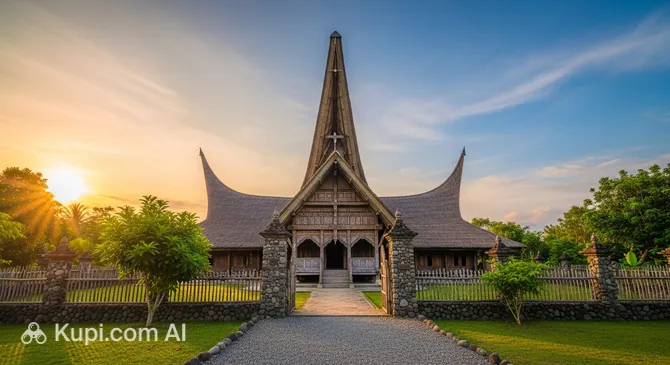
Sumba Cultural House
Sumba Cultural House. Иллюстрация. Источник: Kupi.com AI

The architecture of the complex immediately catches the eye: the buildings are designed in the Uma Bokulu style — traditional Sumbanese houses with characteristic high roofs that symbolize the connection between earth and sky. Spanning about 3 hectares, the grounds house exhibition halls, a gallery, and workshops where the life of the region is presented in all its diversity.

The museum's collection is impressive in its scale, containing over 5,750 historical artifacts. Visitors can see ancient menhirs, totems, traditional weapons, jewelry, and household items made from bamboo and clay. A special place is held by the photo archive, documenting the sacred rituals and festivals that are still held on the island today.

Contacts

For those planning a visit to the Sumba Cultural House, it is helpful to save the coordinates of this important educational center in advance. It is easily found in the Southwest Sumba Regency, near the region's key transport hubs.

How to contactContact
AddressJl. Rumah Budaya No.212, Kalembu Nga, bangga Weetebula, Kabupaten Sumba Barat Daya, Nusa Tenggara Tim., Индонезия

What to Do

The best way to start your journey here is in the main gallery, where a panorama of island life unfolds before you. Here you can examine antique weaving looms, weapons of Sumba warriors, and intricate musical instruments. Informative descriptions help you understand the role each item played in traditional ceremonies and daily life.

Be sure to stop by Rumah Tenun — a specialized textile museum that houses the finest examples of the famous Sumba ikat. You can trace how patterns and dyeing techniques change depending on the region of the island. For visual art lovers, the photo gallery will be a true discovery, capturing moments of grand festivals and sacred rites.

In addition to viewing the exhibits, the Cultural House offers a chance to see young people being trained in traditional crafts, dance, and music. This is a wonderful opportunity to witness how ancient skills are passed down to the new generation. Before leaving, visit the souvenir shop to purchase authentic handmade products, which will serve as a truly valuable reminder of your trip.

Getting There

The journey to the cultural center is quick and pleasant, as the site is located just 6.5 kilometers from Tambolaka Airport (Bandara Tambolaka). The trip by car or motorbike takes about 10 minutes along a high-quality paved road that passes through picturesque rural landscapes.

If you are arriving by sea, the distance from the port of Waikelo is approximately 9 kilometers. It is most convenient to use a taxi or pre-book a transfer with local operators. Renting your own transport is also a popular option, allowing you to freely explore the surroundings of Waitabula.

Although public transport in this part of the island is not very extensive, getting to the site is easy due to its fame among locals. There is spacious parking available on-site for all types of vehicles.

Ближайший город: Tambolaka

History & Facts

The creation of this place is thanks to the initiative of Robert Ramone, a Catholic priest and passionate ethnographer who dedicated his life to preserving the heritage of his native island. Back in 2004, he began compiling a massive photo archive, documenting the rituals and daily life of the Sumbanese people to protect their culture from being forgotten in the age of globalization.

The active construction phase of the complex began in March 2010 with the support of the Tirta Utomo Foundation. The official opening of the Sumba Cultural House took place on October 22, 2011. Father Robert personally put in enormous effort to assemble the collection, which today includes thousands of unique exhibits, many of which were donated by traditional Adat houses.

Today, the center is recognized as an important institution for cultural research. Over the years, it has evolved from a private project into a national treasure of Indonesia, attracting scholars and photographers from around the world. Its photo archive has even been featured in exhibitions in Europe, significantly raising international interest in the traditions of the Sumba people.

Time Needed

To fully explore the exhibitions, it is recommended to set aside 2 to 3 hours. This is quite enough time to leisurely study the main gallery, examine the details of traditional costumes, and immerse yourself in Father Robert Ramone's photo archive.

If your plans include visiting the Atma Hondu textile museum and choosing authentic souvenirs at the local shop, your visit may take longer. The place invites thoughtful contemplation, so allow extra time for resting and walking around the complex grounds.

Working Hours

The facility's operating hours may vary depending on the season and local holidays. According to official data, the center's doors are open to visitors daily from 8:00 AM to 5:00 PM local time (WITA).

While some digital maps may indicate 24-hour operation, it is recommended to stick to standard daytime hours. For the most up-to-date information on possible schedule changes, it is worth checking the official website or confirming details with museum staff upon arrival in the city.

Круглосуточно

Nearby

Exploring the surroundings of the Cultural House will help visitors get a fuller picture of the local flavor and lifestyle. Nearby, you will find both authentic villages and cozy establishments where you can relax after a busy tour.

NameDistance
Talasi Estate0.3 km
Makan Dulu3.3 km
Warung Gula Garam3.6 km

Reached the end of the page?

That means the route is fully explored