Support

Adisutjipto International Airport

About the Airport

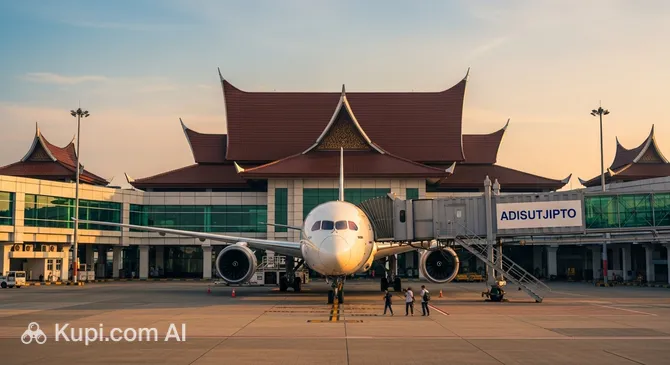
Adisutjipto International Airport. Source: Kupi.com Binoculars

Adisutjipto International Airport is not just a transport hub, but a true legend that preserves the atmosphere of old Java. For a long time, it was the region's main air gateway, but after the opening of the new giant hub (YIA), its role has changed, becoming more intimate and cosy. Now, it is the ideal choice for travellers who value time: the airport is located practically within the city limits, allowing you to reach the centre and the famous Malioboro Street in just 20–30 minutes.

Here, there are no endless corridors or the hustle and bustle typical of metropolises. Passengers are welcomed by a compact terminal, offering perhaps the most picturesque runway view in Indonesia — the majestic Mount Merapi on the horizon. Today, Adisutjipto primarily serves short flights on small propeller aircraft, turning an ordinary flight into a fascinating aerial excursion over the island's green landscapes.

IATA Code JOG
ICAO Code WAHH
City Yogyakarta
Distance to Centre Approx. 9 km
Status Domestic (Regional)
Annual Passengers ~1.4 million (after transfer of main flights)
Schedule Airport Official Website

Airport Features and Advantages

Despite the fact that most major flights have moved to the new airport (YIA), Adisutjipto retains a number of unique advantages that make it attractive for certain routes.

Main benefits for the tourist:

  • Proximity to the city: This is its main asset. The trip to the tourist centre takes 3–4 times less time than from the new Kulon Progo airport, which is critical for short trips.
  • Integration with the railway: The airport is connected by a direct walkway to Maguwo station. You can board a commuter train (KRL) and reach Yogyakarta Central Station or the city of Solo quickly and cheaply, bypassing traffic jams.
  • Speed of procedures: Thanks to the small flow of passengers, security checks and baggage claim take mere minutes.

Nuances worth knowing:

  • Limited flight geography: Mainly turboprop aircraft (ATR-72) from airlines like Citilink and Wings Air fly here. Flights are operated from neighbouring cities such as Surabaya, Bandung, or Denpasar (Bali).
  • Absence of aerobridges: Boarding and disembarking are done on foot across the apron, which, however, adds local colour to the journey and allows for beautiful photos with the aircraft and mountains in the background.

Contact Information

To ensure your journey to Yogyakarta is as comfortable as possible, we have compiled key contacts for Adisutjipto International Airport (JOG). Before travelling, we advise checking the official resources for up-to-date data.

  • Official Website: www.adisutjipto-airport.co.id. Here you can find the flight schedule, terminal maps, and information about services.
  • Information Desk Phone: The main airport number is +62 274 484 261. There is also a unified contact centre number for the airport operator Angkasa Pura I: 172.
  • Airport Address: Jl. Raya Solo KM.9, Maguwoharjo, Kecamatan Depok, Kabupaten Sleman, Daerah Istimewa Yogyakarta 55282, Indonesia.
  • Email: For general enquiries, you can contact the management company's contact centre via email: cc172@ap1.co.id. For urgent communication, using the telephone is recommended.
  • Social Media: Follow updates and news on the airport's official accounts, for example, on Instagram (@adisutjipto_ap1).
  • Lost Luggage Information: Important point: for issues regarding lost or damaged luggage, you should contact your airline's representative directly. If you have left personal items in the terminal building, contact the Lost and Found service.
  • Passenger Support Contacts: For all questions arising during your stay at the airport, you can approach the information desks in the terminal or call the information service number.

Getting to the Airport

Getting to Adisutjipto International Airport (JOG) from Yogyakarta and back is quite simple thanks to a well-developed transport network. The airport is located relatively close to the city centre, and the trip usually takes from 30 to 45 minutes, although this time may increase due to heavy traffic. Travellers can choose the most convenient option based on their budget and preferences.

Public Transport is the most economical method. Right at the airport terminal, there is a stop for the TransJogja bus network. This is a modern system of rapid buses running on dedicated lanes. Routes No. 1A, 1B, and 3A directly connect the airport with the main districts of the city, including Malioboro Street and Tugu Railway Station. Another unique feature of the airport is its direct integration with Maguwo railway station. From here, the Prambanan Express (Prameks) commuter train departs, allowing you to reach the centre of Yogyakarta or even the neighbouring city of Solo quickly and without traffic jams.

Taxis and Transfers are the optimal choice for the balance of price and comfort. In the arrivals area, you will find counters for official taxi services. However, many tourists and locals prefer to use mobile ride-hailing apps, such as Grab or Gojek, which are very popular in Indonesia. This allows you to see the fixed cost of the trip in advance. For maximum convenience, especially if you are travelling with family or a large amount of luggage, you can pre-book a private transfer that will meet you right at the terminal exit.

Car Rental and Parking. For those who desire maximum freedom of movement to explore the region, offices of several local and international rental companies operate at Adisutjipto Airport. This is an excellent option if you are confident in your driving skills amidst Asian traffic conditions. For those arriving in their own or rented vehicles, short-term and long-term parking zones are provided on the airport grounds.

Terminals and Map

Adisutjipto International Airport (JOG) has a compact and clear structure, making navigation through it quite simple. It is important to note that after the opening of the new Yogyakarta International Airport (YIA), the majority of commercial flights were transferred there. Adisutjipto now mainly serves domestic flights on turboprop aircraft (for example, Citilink and Wings Air airlines) and is also used as an Indonesian Air Force base.

The airport consists of two main passenger terminals located in immediate proximity to each other:

  • Terminal A: Historically used for international and some domestic flights of major airlines. Now its role has changed significantly, and it primarily serves flights for Garuda Indonesia and other carriers operating ATR-type aircraft.
  • Terminal B: Previously served budget airlines. Today, it is the main terminal for most of the remaining domestic flights at JOG operated on turboprop liners.

The airport layout is very simple. Terminals A and B are side by side, and the transfer between them takes just a few minutes on foot via a covered corridor. You will not require special transport. Departure zones are located on the upper level, and arrival zones on the lower level. Signs are sufficiently clear, although they are primarily in Indonesian and English.

Check-in and security procedures at Adisutjipto Airport usually proceed faster than in major hubs due to the lower passenger flow. Nevertheless, it is recommended to arrive at the airport at least 1.5-2 hours before the departure of a domestic flight. This time will be enough to check in luggage without rushing, pass security control, and find your boarding gate. For navigation, simply follow the standard signs "Keberangkatan" (Departure) and "Kedatangan" (Arrival).

Airport History

The history of Adisutjipto International Airport is closely intertwined with key events in the life of Yogyakarta and all of Indonesia. Its journey began in the 1930s when the Dutch colonial administration established a military airfield here called Maguwo. Initially, it was a simple airstrip intended for military aviation needs.

During World War II, the airfield was captured by Japanese forces, and after the proclamation of Indonesia's independence, it played a crucial role as the main airbase of the young republic. The airport acquired special significance during the period when Yogyakarta was the temporary capital of the country. In 1952, the airfield was officially renamed in honour of Agustinus Adisutjipto, one of the pioneers of Indonesian aviation and a national hero who tragically died in 1947.

With the development of civil aviation, Adisutjipto Airport began accepting commercial flights. In the 1970s and 1980s, it underwent several stages of modernization, including lengthening the runway and building a new terminal to accommodate growing passenger traffic and receive jet aircraft. For decades, it was the main airport serving Yogyakarta and its surroundings, popular with tourists due to the proximity to the Borobudur and Prambanan temples.

By the early 2010s, the airport faced a serious problem — its capacity was significantly exceeded, leading to congestion and delays. This prompted the construction of a new, larger international airport. With the full commissioning of the new Yogyakarta International Airport (YIA) in 2020, Adisutjipto's role changed. Today, it continues to function but mainly serves turboprop aircraft on domestic routes and charter flights, while remaining an important base for the Indonesian Air Force and a flight training centre.

Services and Facilities

Adisutjipto International Airport (JOG) offers passengers all necessary services for a comfortable wait for their flight. In the terminal, you will find various dining outlets: from cafes serving local Indonesian cuisine to fast-food restaurants. Shops are also at your service, where you can purchase souvenirs, travel goods, and products in the Duty Free zone.

For those who value enhanced comfort, the airport provides waiting lounges and VIP lounges where you can relax in a quiet atmosphere, enjoying snacks and beverages. Free Wi-Fi is available throughout the terminal, and numerous gadget charging stations will allow you to stay connected at all times.

Financial matters can be easily resolved at the airport thanks to the presence of bank branches, ATMs, and currency exchange points. In case of unforeseen situations or feeling unwell, a medical station operates, ready to provide first aid.

Travellers with children can use specially equipped mother and child rooms. For passengers with reduced mobility, a barrier-free environment has been created, and assistance services are provided. It is recommended to notify the airline in advance regarding the need for special assistance.

If you have a long layover or an early departure, several hotels are located in the immediate vicinity of the airport. For business travellers, conference rooms and business centres may be available, allowing you to hold a meeting or work while waiting for a flight.

Dining

Adisutjipto International Airport (JOG) offers passengers an excellent opportunity to experience Indonesian cuisine before departure. Unlike many airports dominated by international chains, here you will find many establishments offering authentic local dishes at affordable prices.

The main portion of restaurants, cafes, and food courts is located in the public area (landside), before security and passport control. If you have time, it is best to eat here, as the selection is much wider. In the departure area (airside), after all formalities, the number of establishments is limited; these are mainly small coffee shops and kiosks with snacks, ideal for a quick bite before boarding.

Be sure to try Yogyakarta's signature dishes. The main culinary hit is, of course, Gudeg, a sweet stew made from young jackfruit, served with rice and chicken. Also popular are Nasi Goreng (fried rice), Soto (aromatic soup with turmeric), and Bakso (meatball soup). This is a great chance to enjoy local flavours one last time.

For a full lunch or dinner, look for restaurants in the landside zone serving Javanese-style set meals (Nasi Campur), allowing you to try several dishes at once. For a quicker option, numerous cafes and coffee shops offering both Indonesian coffee and pastries are suitable. Of course, familiar international fast-food brands are also present here.

Special dietary preferences are well catered for. Since Indonesia is a predominantly Muslim country, almost all food at the airport is Halal. Vegetarians and vegans should pay attention to dishes with tofu and tempeh, as well as Gado-gado (vegetable salad with peanut sauce), asking for shrimp crackers not to be added. Gluten-free options may be more challenging, so it is better to stick to rice and vegetable-based dishes, checking the ingredients with staff.

The price range at Adisutjipto Airport is very democratic, especially in establishments serving local cuisine. Most cafes and restaurants operate according to the flight schedule, opening early in the morning and closing late at night. Some outlets with drinks and snacks may operate around the clock.

Travel Tips

To ensure your journey through Adisutjipto International Airport goes smoothly and without unnecessary stress, use these proven tips. A thoughtful approach will help save time, money, and nerves.

Arrival Time: For international flights, it is recommended to arrive at the airport 2.5-3 hours before departure, and for domestic flights within Indonesia — at least 1.5-2 hours. Take into account possible traffic jams on the roads leading from the city of Yogyakarta, especially during peak hours.

Check-in and Security: To speed up the process, use online check-in if your airline provides such an option. At check-in counters and when passing security control, keep your passport, boarding pass, and other necessary documents ready. Be prepared for standard hand luggage screening procedures.

Seat Selection: If you want to enjoy views of the Merapi and Merbabu volcanoes during takeoff or landing, choose a window seat. For greater comfort and the ability to move freely during the flight, aisle seats are more suitable.

Hand Luggage: Standard rules prohibit carrying liquids in containers larger than 100 ml, as well as sharp, piercing, and flammable items. Pay attention to the rules for carrying power banks — their capacity may be restricted, and they usually need to be presented separately from other items during screening.

Connecting Passengers: If you have a connecting flight, check in advance whether you need to collect your luggage and check it in again, especially when transferring from an international to a domestic flight. Leave a sufficient time margin between flights in case of unforeseen delays.

Customs Control: Upon arrival, if you have no goods to declare, proceed through the "Green Channel". In case of doubt, it is better to choose the "Red Channel" and consult with a customs officer. The import of narcotics, weapons, and certain types of agricultural products is strictly prohibited.

Saving Time and Money: Book a taxi at the official counter in the arrival hall or via popular local apps (e.g., Grab) to avoid inflated prices. You can also have a snack at one of the numerous cafes outside the airport — prices there are usually lower.

In Case of Flight Delay: If a flight is delayed or cancelled, contact your airline representative immediately. They will provide up-to-date information and explain possible compensation (vouchers for food, drinks). The airport has cafes, shops, and Wi-Fi access to make the wait more comfortable. Having travel insurance will help cover unforeseen expenses.

Reached the end of the page?

That means the route is fully explored