Support

Yogyakarta International Airport

About the Airport

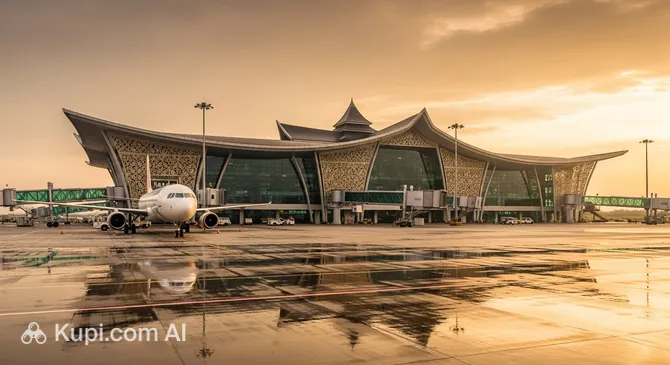
Yogyakarta International Airport (YIA) is not merely an air gateway to the cultural capital of Indonesia, but a true symbol of modern Javanese architecture and engineering.

Yogyakarta International Airport. Source: Kupi.com Binoculars
Opened in 2020, it replaced the old airport, offering travellers an ultra-modern space where technology harmoniously blends with local cultural motifs. The terminal design, inspired by traditional art, and its unique structure capable of withstanding strong earthquakes, make it one of the most advanced and safe airports in the region. Located in the Kulon Progo Regency, it serves as the starting point for exploring the treasures of Central Java.

IATA Code YIA
ICAO Code WAHI
City Yogyakarta
Distance to centre approx. 45 km
Status International
Annual Passengers over 2.9 million (2022)
Popular Airlines Garuda Indonesia, Lion Air, Citilink
Schedule Online Board "Yogyakarta International Airport"

One of the key features of the airport is its well-planned transport accessibility. A special express train connects the terminal with the centre of Yogyakarta, allowing you to reach the city in just 35-40 minutes, bypassing traffic jams. For the convenience of passengers, comfortable DAMRI buses also operate. The YIA terminal is spacious and bright, its interiors decorated with works by local artists, allowing you to immerse yourself in the atmosphere of Javanese culture immediately upon arrival. The airport is fully equipped for the needs of passengers with disabilities, offering ramps, special restrooms, and escort services, making it convenient for all categories of travellers.

Contact Information

  • Official Website: To view flight schedules, services, and the terminal map, please visit the official website yia.ap1.co.id.
  • Information Desk Phone: For information, you can call the unified contact centre of the operator Angkasa Pura I on the short number 172 (for calls within Indonesia).
  • Address: Yogyakarta International Airport (YIA), Jalan Wates - Purworejo Km. 40, Kulon Progo, Special Region of Yogyakarta, 55654, Indonesia.
  • Email: For general enquiries, you can use the contact centre email: cc172@ap1.co.id.
  • Social Media: Current news and updates are published on the airport's official social media pages, for example, on Instagram (@bandarayogyakarta) and X (formerly Twitter) (@bandarayia).
  • Lost Luggage Information: In case of lost luggage during a flight, you must first contact your airline's representative. If you left items inside the terminal building, contact the airport's Lost and Found service.
  • Passenger Support Service: Information counters are located within the terminal, where staff are ready to answer your questions. You can also use the internal intercom phones to contact staff.

How to Get to the Airport

There are several ways to get to Yogyakarta International Airport (YIA), located in the Kulon Progo Regency. It is important to consider that the airport is located at a significant distance from the city centre of Yogyakarta (about 45 km), so allow sufficient time for the journey — on average from 1 to 1.5 hours depending on transport and traffic conditions.

Train. One of the fastest and most reliable ways to get to the airport is the special express train (KA Bandara YIA). It departs from Tugu Railway Station in the city centre and travels directly to the airport terminal in approximately 40-50 minutes, bypassing all traffic jams. This is a comfortable and time-predictable option; tickets can be purchased online or at the station ticket office.

Bus. A more budget-friendly option is the DAMRI buses. They operate on several routes, connecting the airport not only with the centre of Yogyakarta but also with other key points, such as the old Adisutjipto Airport and neighbouring cities. The bus journey will take longer than the train, but it is an excellent choice for economical travellers.

Taxi and Transfers. Official taxi counters operate at the airport, and you can also use popular ride-hailing apps in Indonesia, such as Grab or Gojek. This is a convenient "door-to-door" option, especially if you are travelling with heavy luggage or family. The cost will be higher than public transport but remains quite affordable. You can also book a private transfer in advance.

Car Rental. For those who value independence and plan to actively explore the surroundings, car rental is suitable. Many companies offer car rental services with a driver, which can be very convenient given the local traffic conditions. YIA Airport provides both short-term and long-term parking for private vehicles.

Terminals and Map

Yogyakarta International Airport (YIA) is a modern and well-organised complex consisting of one large passenger terminal. Thanks to this, travellers do not need to worry about transfers or moving between different buildings — all flights, both domestic and international, are serviced under one roof.

The terminal layout is intuitive. The building is divided into two main zones: for domestic and international flights, which helps passengers navigate easily. The departure zone is located on the upper floor, and the arrival zone is on the lower (ground) floor. Navigation is significantly simplified thanks to clear signs in Indonesian and English, which will guide you from the check-in counters to the boarding gates.

Despite its impressive size, the airport is designed efficiently. Check-in and security procedures generally proceed quite quickly. Nevertheless, it is recommended to arrive at the airport in advance: 2-2.5 hours before a domestic flight departure and at least 3 hours before an international one. This time will be sufficient to complete all formalities, check in luggage, and find your boarding gate without rushing, especially during peak hours.

For comfortable navigation, simply follow the signs to your section (Domestic for domestic flights or International for international flights). Spacious halls, a clear structure, and friendly staff make the stay at YIA Airport pleasant and help avoid pre-flight stress. This airport is a fine example of modern transport infrastructure in Indonesia, focused on passenger convenience.

Airport History

Yogyakarta International Airport (YIA) is one of the newest and most modern transport hubs in Indonesia, with a history that exemplifies rapid development and a focus on safety. Its creation was a direct response to the limitations of the old Adisutjipto Airport (JOG), which could no longer cope with the constantly growing flow of tourists to the cultural capital of Java, Yogyakarta.

Construction of the airport began in 2017, and its full official opening took place on 29 March 2020. From that moment, all international and most domestic flights were transferred to the new complex. This project became a landmark for the entire country, as it was completed in an impressively short time. The new airport, located in the Kulon Progo Regency on the coast, was designed with a long runway capable of accommodating the largest passenger aircraft, including the Airbus A380.

The main achievement and unique feature of YIA is its structure, designed to withstand natural disasters. Located in a seismically active zone, the airport is engineered to withstand earthquakes with a magnitude of up to 8.8 on the Richter scale and tsunami waves up to 12 metres high. This makes it one of the safest airports in the world in a coastal zone and demonstrates the highest level of engineering.

Among interesting facts, it is worth noting that the architecture and design of the terminal are inspired by local Javanese culture. The interior decoration uses motifs of traditional Batik and patterns characteristic of the palace complexes of Yogyakarta. Thus, the airport introduces travellers to the rich cultural heritage of the region from their very first steps. Following the opening of YIA, the old Adisutjipto Airport continues to function, serving primarily turboprop flights, as well as private and military aviation.

Services and Amenities

Yogyakarta International Airport (YIA) offers passengers modern infrastructure and a wide range of services to make waiting for a flight as comfortable as possible. In the terminal, you will find numerous restaurants and cafés where you can try both Indonesian dishes and familiar international food. For shopping enthusiasts, there are shops with souvenirs, local handicrafts, as well as duty-free zones.

For those who value enhanced comfort, the airport provides premium waiting lounges. Here you can relax in a quiet atmosphere and enjoy snacks and drinks. Free Wi-Fi is available throughout the terminal, and numerous charging stations for gadgets will allow you to always stay connected.

Financial matters can be easily resolved at the airport: bank branches, ATMs, and currency exchange points are at your service. In case of unforeseen situations or feeling unwell, a medical centre operates in the terminal, ready to provide first aid.

Travellers with children will appreciate the presence of mother and child rooms and play areas where young passengers can have a fun time before the flight. The airport is fully equipped for the needs of passengers with disabilities: there are ramps, special toilets, and escort services available.

Although there are no hotels directly inside the airport building, several hotels are located in the immediate vicinity, which can be quickly reached by taxi. For business travellers, conference rooms and business centres may be available, allowing you to hold a meeting or work in a quiet environment. Thus, Yogyakarta Airport is thought out to the smallest detail to satisfy the needs of every guest.

Where to Eat

Yogyakarta International Airport (YIA) offers passengers a wide selection of establishments where you can have a snack before departure or a full lunch. Gastronomic options here are diverse and designed for any taste and budget, from fast food kiosks to cosy restaurants.

Once at the airport, do not miss the opportunity to enjoy authentic dishes of the island of Java. Many establishments specialise in local cuisine, offering hits such as Gudeg (young jackfruit stewed with coconut milk and spices) — the calling card of Yogyakarta, or aromatic Soto soup. This is a wonderful chance to try or once again enjoy Indonesian cuisine before departure.

Most cafés and restaurants are concentrated in the main terminal area. In the public area (landside), before security control, there is a food court with a large selection of dishes, which those seeing you off can also visit. In the sterile area (airside), after passport control and screening, there are also many coffee shops, snack bars, and restaurants where you can comfortably spend time waiting for your flight.

For those looking for a quick snack, numerous coffee shops and bakeries offering fresh pastries, sandwiches, and drinks are ideal. If you have time for a leisurely lunch, pay attention to full-service restaurants. Since Indonesia is a Muslim country, finding Halal food will not be difficult; it is available almost everywhere. Vegetarians should look for dishes based on rice and vegetables (for example, Gado-gado or Nasi Campur without meat), however, it is better to check the ingredients with the staff.

The price range at the airport is generally higher than in the city but quite moderate by international airport standards. You can find both budget options in fast-food establishments and more expensive dishes in restaurants. Most food outlets operate according to the flight schedule, and some coffee shops in the departure zone may be open around the clock or until the last flight.

Travel Tips

To ensure your journey through Yogyakarta International Airport goes as comfortably and hassle-free as possible, use these proven tips. They will help you orient yourself on-site, save time, and avoid common mistakes.

Arrival Time: For domestic flights within Indonesia, it is recommended to arrive at the airport 2-3 hours before departure. If you have an international flight, it is better to arrive 3-4 hours in advance. This will give you a sufficient buffer of time in case of traffic jams on the way, check-in, baggage drop-off, and security control without haste.

Check-in and Screening: To avoid queues at the counters, complete online check-in on your airline's website. This can be done 24-48 hours before departure. At the airport, keep your passport and boarding pass ready. During screening, be prepared to remove laptops and other large gadgets from your hand luggage, as well as take off outerwear and belts.

Seat Selection: Want to admire the clouds and views upon landing? Choose a window seat. Prefer to be able to stand up freely and stretch your legs without disturbing neighbours? Your choice would be an aisle seat. Seats at emergency exits usually offer more legroom but may cost more and have restrictions.

Hand Luggage: Be sure to take all valuables into the aircraft cabin: documents, money, electronics, prescription medicines. Remember the standard restriction on liquids — all containers must be no more than 100 ml in volume and packed in one transparent bag. Sharp objects, weapons, and flammable substances are prohibited.

Transit Passengers: If you have a connecting flight, follow the "Transit/Transfer" signs. Check with your airline in advance whether your luggage will be automatically transferred to the next flight or if you will need to collect it and check it in again.

Customs Control: Upon entering the country, you will need to pass customs control. Declare all goods subject to duty. To speed up the process, you can fill out the Electronic Customs Declaration (e-CD) in advance if it is available for your flight.

Saving Time and Money: Bring an empty reusable bottle with you and fill it with drinking water at special fountains after passing security control — this is cheaper than buying expensive water. Research airport transfer options in advance: often shuttle buses or online taxi booking services turn out to be more economical than taxis at the terminal.

Flight Delay: In case of a flight delay or cancellation, first contact your airline representative for information on further actions, provision of meals, or accommodation. Having travel insurance covering such cases can significantly simplify the situation and compensate for expenses.
Reached the end of the page?

That means the route is fully explored