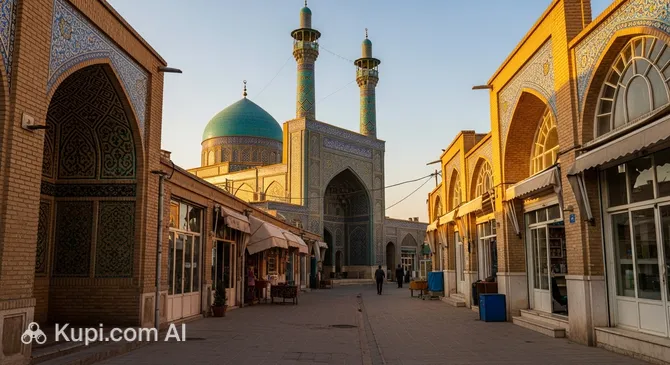
Khomeyni Shahr is a lively and dynamic city in central Iran, located in the Isfahan Province. As the third-largest settlement in the region, it offers a unique blend of industrial rhythm and traditional Persian hospitality. The city is nestled in a picturesque mountainous area at an altitude of nearly 1,600 meters above sea level, which gives its landscapes a distinct character.
Khomeyni Shahr. Illustration.
Source: Kupi.com AI
The rich history of the city is closely linked to ancient settlements that emerged at the crossroads of important caravan routes. Formerly known as Sedeh and Homayunshahr, today it is an important administrative and residential center with a population of about 247,000 people. Although the city is not considered a classic tourist metropolis, its authentic atmosphere allows travelers to see the real Iran, not hidden behind the facades of popular resorts.
Visitors are drawn to the central squares and colorful oriental markets, where everyday life is in full swing. Due to its proximity to the cultural monuments of Isfahan, the city often serves as a convenient base for those who want to explore the region while enjoying a calmer and more relaxed environment. We invite you to discover this hardworking and original city to feel the authentic spirit of the Persian province.
Weather Overview
The climate in Khomeyni Shahr is characterized as semi-arid, which is typical for the Iranian plateau. Due to its location in a mountainous area at an altitude of 1,591 meters, the air here is slightly fresher than in neighboring lowland areas; however, the overall weather pattern remains consistently predictable. Expect truly hot summers with temperatures sometimes reaching +40°C, and moderately cold winters when the thermometer can drop to zero.
Precipitation in the region is a rare occurrence, with annual amounts usually not exceeding 200 mm. Most of the rain falls during the winter months and early spring, while the summer remains completely dry. If you are planning a trip, keep in mind that the most comfortable city's climate is observed in April–May and October, when the heat recedes, giving way to pleasant warmth.
The dry air and high intensity of solar radiation require travelers to pay attention to skin protection and sufficient water consumption. Evening hours, even in summer, bring long-awaited coolness, while in winter, nighttime temperatures can be quite harsh, so a light jacket will not be superfluous in your wardrobe even with a warm daytime forecast.
Average monthly temperature
Average monthly precipitation
Interesting Facts
Khomeyni Shahr has changed names several times over the last century: until the 1930s it was called Sedeh, then it was renamed Homayunshahr, and it received its current name after 1979.
The city ranks 32nd in terms of population in all of Iran, making it a significant administrative hub for the country.
Due to its location at an altitude of 1,591 meters above sea level, the air here is often fresher than in the lowland areas of the province, even though the city is surrounded by mountains.
The name "Sedeh" translates to "three villages" (or, according to another version, "one hundred villages"), indicating the city's historical origin from the merger of several ancient settlements.
Khomeyni Shahr is an important agricultural center of the region, utilizing the fertile lands at the foot of the mountains that have fed locals and caravan members for centuries.
How to Get There
The transport accessibility of Khomeyni Shahr is largely determined by its close connection with the major regional hub—Isfahan. Since the city is only 15–20 kilometers away, most travelers arrive here via this neighboring metropolis. The main flow of passengers is provided by bus services and taxis that run between the cities almost continuously, and travel time is usually between 20 to 40 minutes.
The city does not have its own airport, so the region's air gateway is Isfahan International Airport. From there, the most convenient way to reach Khomeyni Shahr is by taxi, a trip that takes about an hour. For those planning a trip from the capital, a good option is the route to the city via Isfahan, which can be reached by comfortable intercity bus or train from Tehran.
There is no direct rail connection to Khomeyni Shahr, but the nearest major station is very close by. It is important to note that during morning and evening hours, traffic jams often occur on the roads connecting the city with Isfahan due to the heavy flow of commuters, so it's worth planning your time with a small margin.
Station
Passenger traffic
Distance
Isfahan Railway Station
6
22 km
Isfahan Railway Station
6
22 km
Kashan railway station
3
144 km
Qom Railway Station
7
226 km
Yazd Railway Station
2
280 km
Main Attractions
Khomeyni Shahr is primarily a city for living and working, so you won't find grandiose monuments of global significance here. However, for the curious tourist, the very structure of the city, which arose on the site of ancient caravan hubs, is of interest. A walk through the central districts allows you to see how modern industrial and residential quarters are interwoven with traditional oriental customs.
Special attention should be paid to the local markets and shopping centers. This is the heart of city life, where you can watch the trade of fabrics, food, and products made by local craftsmen. Unlike the tourist bazaars of large cities, everything here is oriented towards locals, which guarantees fair prices and the absence of the hustle and bustle typical of popular attractions.
The city's central squares serve as the main places for public gatherings and walks. These are excellent points to begin your acquaintance with the architecture of modern Iran and feel the rhythm of life in the province's third-largest city. Despite the absence of famous landmarks, Khomeyni Shahr charms with its sincerity and the simplicity of everyday life.
Local Cuisine
The gastronomic scene of Khomeyni Shahr is a classic of central Iran, where every dish is filled with the aromas of spices and centuries-old traditions. The basis of the local diet consists of dishes made from rice, lamb, and fresh vegetables. You should definitely try various types of kebabs: from the classic chicken joojeh kebab to the aromatic kabob koofteh, which is prepared here according to traditional recipes.
Thick ash soups, made from legumes with the addition of noodles and fresh herbs, occupy a special place in the local cuisine. This hearty dish is perfect for cool evenings in the foothills. As an accompaniment to the meal, doogh (a refreshing yogurt drink) or freshly squeezed fruit juices, which are particularly rich in Iran, are usually served.
For those with a sweet tooth, Khomeyni Shahr offers traditional desserts from the Isfahan province. Don't miss the chance to taste faloodeh—a unique frozen treat with syrup—or the famous gaz nougat. The food culture here is concentrated in simple but very soulful kebab shops and tea houses, where the food is always fresh and the portions are generous, making a gastronomic introduction to the city truly pleasant.
Travel Tips
When planning a visit to Khomeyni Shahr, check out these practical tips to help make your trip comfortable and avoid misunderstandings.
Clothing and Dress Code: Remember to observe local norms—clothing should be modest, covering shoulders and knees. A headscarf is mandatory for women. For walks in mountainous areas, choose comfortable closed shoes.
Transport: The best way to get around is by taxi. Install the Snapp app (the local equivalent of Uber) for convenience and price transparency. For trips to Isfahan, use buses or shared taxis.
Finance: Visa and Mastercard do not work in Iran. Bring cash in Euros or Dollars and exchange them for Iranian Rials at official exchange offices. Remember the difference between the Rial and the Toman (1 Toman = 10 Rials).
Health and Safety: The city is generally safe, but due to the dry climate, always keep a supply of water with you. Pharmacies are easy to find in central areas by the green cross.
Communication: The main language is Persian. English is not widely spoken, so learn a couple of basic phrases: "Salam" (hello) and "Merci" (thank you). Wi-Fi is available in hotels, but it is better to buy a local SIM card.
Etiquette: Iranians are very hospitable. Be prepared for "taarof"—a complex system of politeness where you might be offered something for free several times (in this case, it is worth politely declining until the offer becomes insistent).
What to Avoid: Do not photograph government buildings and military facilities. Avoid public displays of affection and political discussions.
Additional Tip: Plan your trips to neighboring Isfahan for weekdays, as on weekends (Thursday and Friday), transport and parks can be overcrowded with locals.
May your acquaintance with this city be filled only with pleasant impressions and interesting discoveries!
Entertainment & Nightlife
Nightlife in Khomeyni Shahr reflects the traditional way of life of Iranian society. You won't find noisy nightclubs or bars here, as entertainment in the city is oriented towards family vacations and quiet pastimes. In the evening, life moves to cozy traditional tea houses and small cafes, where locals gather for conversation over a cup of strong tea with oriental sweets.
The main centers of attraction in the evening are the city parks and busy shopping streets. Strolling through the evening markets is a popular leisure activity once the daytime heat subsides. The atmosphere here is very friendly and safe, allowing tourists to feel comfortable during late walks through the central districts.
For those looking for a more diverse cultural program, theaters, or cinemas, residents often head to neighboring Isfahan, located just a 20-minute drive away. In Khomeyni Shahr itself, leisure is focused on home gatherings and visiting sports halls, making the city an ideal place for those who want to take a break from the hustle and bustle and immerse themselves in the steady rhythm of provincial life.
Parks & Museums
Although Khomeyni Shahr cannot boast an abundance of large museums or galleries, it offers its guests pleasant areas for relaxation and walks. The greenery system here is typical of Iranian cities: neat small parks and squares scattered throughout residential quarters. They serve as the main meeting places for citizens, especially in the evening hours when families gather for traditional open-air picnics.
The park areas in the city center, despite their compact size, are well-maintained and provide necessary coolness on hot summer days. The mountainous terrain surrounding Khomeyni Shahr is a natural attraction in itself: fans of light trekking can enjoy walks along the slopes, which offer panoramic views of the urban landscape and neighboring settlements.
For those seeking a serious immersion into art or history, the best solution would be a short trip to Isfahan, where the country's best museums are concentrated. In Khomeyni Shahr itself, it is worth focusing on contemplating everyday architecture and visiting public spaces that allow you to feel the true spirit of a city living its usual rhythm without regard for tourist trends.
Getting Around
The public transport system in Khomeyni Shahr is oriented towards providing connections within the city and with the neighboring regional center. The main types of transport here are buses and minibuses. The route network covers all main residential and industrial areas, allowing for fairly budget-friendly movement around the city. However, tourists should take into account that transport can be crowded during peak hours.
Taxis are available everywhere in the city and are the most convenient way for travelers to get around. You can use traditional yellow taxis as well as ride-hailing apps popular in Iran (such as Snapp), which allow you to see the cost of the trip in advance. Shared taxis (savari) are another common way to get to Isfahan, where you share the cost of the trip with other passengers.
Despite the absence of a metro, the city transport network handles the needs of residents quite well, although traffic jams on main highways during morning and evening hours are common. For short distances in the city center, walking is quite suitable, but it is worth remembering the mountainous relief, which requires a certain level of physical fitness. Bus tickets are usually purchased at special kiosks or paid to the driver upon entry.
Accommodation
The choice of accommodation options directly in Khomeyni Shahr is quite limited, as the city is primarily focused on local residents and business trips. Simple guesthouses and apartments designed for long-term stays predominate here. This accommodation belongs to the budget segment and offers a basic set of amenities without frills.
For tourists who value comfort and a wide choice of services, it is often recommended to book hotels in neighboring Isfahan. Thanks to the short distance and accessible transport, you can easily reach Khomeyni Shahr during the day and rest in higher-class hotels in the evening.
If you do decide to stay in the city itself, we advise choosing accommodation in the central districts. This will provide better access to local cafes and transport stops. Remember that due to the specifics of the region, online booking through common global aggregators may be difficult, so it is worth checking the contact details of accommodation sites in advance or using local services.
Nearby Cities
Khomeyni Shahr is an excellent starting point for exploring the central part of the country, as it is surrounded by many interesting places that are easily accessible within minutes. The main neighbor and cultural giant of the region is, of course, the majestic Isfahan. In just half an hour, you will find yourself among its legendary squares, bridges, and mosques, which are included in the UNESCO World Heritage list.
For shorter trips, small neighboring towns such as Kushk and Goldasht are perfect. They allow you to see the steady life of the Iranian province and enjoy the views of the foothills. It is also worth paying attention to Abrisham and Gahderijan, which are in close proximity and interesting for their agricultural way of life.
The region around the city offers travelers a unique opportunity to see the contrast between the dynamic development of the suburbs and the ancient grandeur of historical centers. Exploring the surroundings of Khomeyni Shahr will give you a complete picture of life in the Isfahan province and make your journey through Iran more rich and multifaceted.
Shopping & Souvenirs
Shopping in Khomeyni Shahr is primarily an introduction to traditional Iranian life through its markets. Here you won't find huge shopping malls with global brands, but you can visit authentic bazaars. The central shopping streets are filled with small shops selling everything from high-quality textiles and clothing to basic necessities and kitchenware.
The main treasures to bring back from this region are traditional Iranian goods. Pay special attention to spices and tea—their aroma at the local stalls is simply mesmerizing. You can also find high-quality carpets and copperware, which are famous throughout the Isfahan province. Shopping at local markets requires the ability to bargain, which is part of the national culture and only makes the process more interesting.
Shops are usually open from morning until late evening with a break for the afternoon siesta (approximately from 1:00 PM to 4:00 PM). Payment is most often made in cash in the local currency, although large shops may accept local bank cards. If you want a more large-scale modern shopping experience, city residents usually head to the shopping centers of neighboring Isfahan, where the choice of goods is significantly wider.