Support

Catania-Fontanarossa Airport

About the Airport

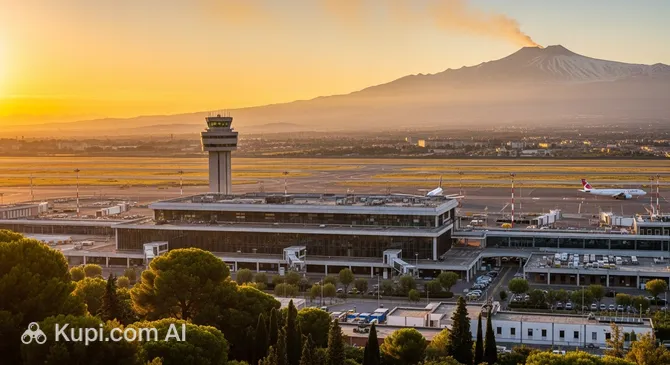
Catania-Fontanarossa Airport. Source: Kupi.com Binoculars

Catania-Fontanarossa Airport is not merely a transport hub, but a true gateway to sunny Sicily, where adventures begin right on the runway. Aircraft often approach from the Ionian Sea, offering passengers a breathtaking view of the majestic and occasionally smoking Mount Etna, at the foot of which the city is located. This air harbour, named after the great composer Vincenzo Bellini, instantly immerses travellers in an atmosphere of southern hospitality and the anticipation of a vibrant Italian holiday.

IATA Code CTA
ICAO Code LICC
City Catania
Distance to City Centre ~5-7 km
Status International
Annual Passengers Over 12.3 million (2024)

Features and Advantages of the Airport:

Catania-Fontanarossa stands out among other Italian airports for its local charm and strategic location. Here are a few reasons why travellers value this hub:

  • Unique Location: The main highlight of the airport is its proximity to Mount Etna. In clear weather, a view of the snow-capped peak or plumes of smoke opens up right from the terminal windows, creating a unique backdrop for your first photos on the island.
  • Transport Accessibility: The airport is located remarkably close to the city. You can reach the centre of Catania in just 15–20 minutes by the Alibus bus or taxi, allowing you not to waste precious holiday time on long transfers.
  • Sicilian Gastronomy: Even if you have just arrived or are waiting for departure, you can start your acquaintance with the local cuisine. Terminal cafes serve famous Sicilian cannoli with ricotta, arancini, and excellent espresso.
  • Convenient Start for Road Trips: A huge selection of rental agencies is available in the arrivals area. This is the ideal starting point for those planning to drive around the island, heading to Taormina, Syracuse, or the Valley of the Temples in Agrigento.

Contact Information

If you need to contact representatives of Catania-Fontanarossa Airport, please use the following contact information. We recommend checking the official website for the most up-to-date data, especially before your trip.

  • Official Website: www.aeroporto.catania.it — here you will find the latest information on flights, services, and airport regulations.
  • Information Service Phone: +39 095 723 9111 (charges may apply according to your operator's tariffs).
  • Address: Via Fontanarossa, 95121 Catania CT, Italy.
  • Email: For general inquiries, you can use the address info@aeroporto.catania.it.
  • Social Media: The airport is active on social networks. Look for official pages on Facebook, X (formerly Twitter), and Instagram for operational news.
  • Lost Luggage Information: In case of loss of checked baggage, you must immediately contact your airline's Lost & Found service in the arrivals area. If you have lost personal items within the terminal, contact the airport's lost property office.
  • Passenger Support Service: For most questions, you can call the general information service number. For passengers with reduced mobility, separate counters and special assistance are provided, which is recommended to be booked in advance through the airline.

How to Get to the Airport

Getting to Catania-Fontanarossa Airport (CTA) from the centre of Catania or other cities in Sicily is quite simple thanks to a well-developed transport network. The airport is located just a few kilometres south of the city, making the journey fast and convenient. The choice of transport depends on your budget, amount of luggage, and personal preferences.

The most popular and budget-friendly option is the special AMT Alibus. It runs every 20-25 minutes from early morning until late at night, connecting the airport with key points in the city, including the central railway station (Catania Centrale) and the historic centre. The journey takes about 20-30 minutes depending on traffic. The ticket costs slightly more than a regular city bus fare, but it is valid for 90 minutes on other AMT routes, which is very convenient for further transfers.

For travellers arriving from other regions of Italy, the train can be a convenient solution. Not far from the terminal is the Catania Aeroporto Fontanarossa railway station, which is connected to the airport by a free shuttle. Trains depart from here to cities such as Syracuse, Taormina, and Messina, allowing you to get to the airport bypassing city traffic jams.

If you value comfort and are travelling with heavy luggage, a taxi or a pre-booked transfer will be the best choice. The trip from the centre of Catania will take about 15-20 minutes. The cost of a taxi ride is usually between 25 and 40 Euros, but it is always recommended to confirm the price with the driver before starting the journey or ensure the meter is switched on. Pre-booking a transfer can guarantee a fixed price and timely car arrival.

If you plan to travel actively around Sicily, it makes sense to rent a car. You can rent a car in the city and return it directly at the airport before departure. Offices of all major international and local rental companies are present at Catania Airport. The road to the airport is well signposted, and it is easily accessible from the main ring road (Tangenziale di Catania).

For those arriving at the airport in their own or rented car, parking facilities are provided. There are options for both short-term parking (P1, P2), located directly opposite the terminals, and long-term parking (P4), which offer more favourable rates and are a few minutes' walk from the airport building. This is convenient if you are leaving the car for the duration of your trip.

Terminals and Map

Catania-Fontanarossa Airport (CTA) consists of two passenger terminals: Terminal A and Terminal C. Despite its compactness, the airport has a clear division of functions, making navigation quite simple for travellers.

Terminal A is the main and largest building of the airport. It serves the majority of airlines operating both domestic and international flights (including Schengen and non-Schengen destinations). The terminal structure is classic: the arrivals area with baggage claim and car rental desks is located on the ground floor, while the departures area with check-in, security control, and shops is on the first floor. The main infrastructure is concentrated here: cafes, restaurants, Duty Free shops, and business lounges.

Terminal C is a newer and more compact terminal, opened specifically to serve easyJet flights. It is located in a separate building, slightly away from the main one. Its main advantage is the accelerated completion of pre-flight formalities. There is less hustle and fewer queues here, but the choice of services, such as shops and cafes, is more limited. Terminal C is focused on efficiency and rapid passenger processing.

Moving between terminals is not difficult — they are located within a few minutes' walk of each other, and the path is well signposted. Public transport and taxis stop in the immediate vicinity of both buildings. Before travelling to the airport, be sure to check your ticket to know exactly which terminal your flight departs from.

It is recommended to arrive at the airport in advance to complete check-in and security screening. The standard recommendation is 2 hours before a domestic or Schengen flight and 3 hours before an international one. During the peak tourist season (from June to September), queues for security control can be longer, so it is worth allowing extra time. Overall, navigation through the airport is intuitive thanks to clear signs in Italian and English.

Airport History

The history of Catania-Fontanarossa Airport (CTA) begins in May 1924, when the first airfield was opened in the district of the same name. Initially, it was used as a military base and a stopover point for seaplanes, becoming one of the pioneers of aviation in Sicily. This early stage laid the foundation for the future development of civil transport in the region.

After World War II, a new chapter in the airport's history began. In the late 1940s, it opened its doors to commercial aviation, and the first scheduled flights connected Catania with major cities in Italy. As Sicily's tourist appeal grew in the 1960s, it became obvious that the existing infrastructure could not cope with the increasing number of travellers, prompting plans for large-scale expansion.

Significant modernization occurred in 1981 with the construction of a new, larger terminal. However, the real breakthrough happened in the 21st century. In May 2007, a modern and spacious terminal was put into operation, designed to meet all the requirements of growing passenger traffic. This event allowed the airport to become the busiest on the island and one of the key ones in the country.

Interesting fact: The airport is officially named after the great opera composer Vincenzo Bellini, who was born in Catania. Its operation is inextricably linked to its proximity to Mount Etna. From time to time, eruptions and volcanic ash emissions cause adjustments to flight schedules, requiring the highest level of coordination and readiness for non-standard situations from airport services.

Services and Amenities

Catania-Fontanarossa Airport (CTA) offers passengers a wide range of services to make waiting for a flight as comfortable and productive as possible. Regardless of the purpose of your trip, you will find everything you need here.

Restaurants and Shops: The terminal features a large selection of cafes, bars, and restaurants where you can enjoy both authentic Sicilian cuisine and classic international dishes. After passing security control, passengers will find a Duty Free zone with perfumes, beverages, and tobacco products, as well as shops offering local delicacies, souvenirs, and fashion apparel.

Comfort and Connectivity: Free Wi-Fi is available throughout the airport, allowing you to stay connected or work. Numerous sockets and USB ports are provided for charging gadgets. For those who prefer privacy and exclusive service, the SAC Lounge VIP hall operates, offering comfortable seating, snacks, drinks, and press in a quiet atmosphere.

Financial and Medical Services: Catania Airport houses bank branches, currency exchange points, and ATMs, available in both the arrivals and departures areas. In case of unforeseen health situations, a first aid station operates around the clock in the terminal.

Services for Special Categories of Passengers: For travellers with small children, mother and child rooms equipped with changing tables are available. Passengers with reduced mobility are provided with comprehensive assistance (PRM service), including escort through the airport territory. It is recommended to book this service through the airline at least 48 hours before departure.

Business and Accommodation: There are no hotels directly within the airport building, however, many hotels are located a few minutes' drive away, easily accessible by shuttle or taxi. For business travellers, business centre services and conference room rentals for meetings are available at the airport.

Where to Eat

At Catania Airport, you will not go hungry, whether you are looking for a quick snack before departure or a full meal. Most dining establishments are concentrated in the main terminal, both in the public area (landside) and in the passenger area after security control (airside).

In the arrivals area and the general departures hall (before control), you will find several cafes where you can have coffee with a croissant or grab a sandwich. These places are great for those seeing someone off or if you have plenty of time before check-in. However, the main selection awaits passengers in the airside zone. Bars, cafes, and restaurants offering both Italian and international cuisine are located here.

Once in Italy, or rather in Sicily, do not miss the last opportunity to enjoy local delicacies. Be sure to try arancini (stuffed rice balls), fresh cannoli, or a slice of pizza. Some establishments even offer classics of local cuisine — Pasta alla Norma. This is a great way to deliciously end your Sicilian journey. For those who want a full lunch, a self-service restaurant is usually available, where you can find pasta, meat and fish dishes, as well as fresh salads.

Regarding special dietary needs, vegetarian options, such as pasta with tomato sauce, vegetable salads, and cheese sandwiches, are quite easy to find. With vegan and gluten-free dishes, it may be more difficult, although the selection is gradually expanding. We recommend studying the menu carefully or asking the staff for assistance.

Prices at the airport are expectedly higher than in the city: a cup of espresso and a pastry will cost approximately 5-8 Euros, while a hot meal with a drink will cost around 15-25 Euros. Most establishments open early in the morning and operate until the last flights depart, so you will always have the opportunity to have a snack before your flight.

Travel Tips

To ensure your journey through Catania-Fontanarossa Airport (CTA) goes as smoothly as possible, use our tips. A little preparation will help save time, money, and nerves, leaving only pleasant impressions of your trip to Sicily.

To avoid rushing, arrive at the airport well in advance. For international flights, it is recommended to be on-site 2.5–3 hours before departure, and for domestic flights within Italy — 1.5–2 hours. In summer and on national holidays, the airport can be heavily congested, so it is better to add another 30–40 minutes to this time for unforeseen queues.

Check in for your flight online — this is the easiest way to avoid queues at check-in counters. Security checkpoints in Catania can be crowded, especially in the morning hours. Prepare your passport and boarding pass in advance, and remove liquids in a transparent bag and all electronic devices from your hand luggage. Being organised will significantly speed up the process.

Want to take a photo of Mount Etna from the window? When departing from Catania, try to choose a window seat on the left side of the aircraft (seats A), and when landing — on the right (seats F). Of course, the flight path depends on weather conditions and the runway used, but this tip often helps to catch the best angle.

Standard restrictions on carrying liquids apply in hand luggage — no more than 100 ml in one container, packed in a transparent bag with a volume of up to 1 litre. Note that some Sicilian delicacies, such as pesto sauce, pâtés, or soft cheeses, may also be classified as liquids. It is better to pack them in checked baggage in advance. Power banks and other batteries are allowed to be carried only in hand luggage.

The airport in Catania focuses mainly on direct flights, so the transit zone here is small. If you have a transfer planned, be sure to check if you need to collect your luggage and check in again, especially if you are flying with different airlines. Allow sufficient time between connecting flights.

Arriving from a non-Schengen country, you will have to go through passport control. Customs inspection follows the "green" and "red" channel system. If you have no goods to declare, feel free to go through the "green" channel. For travellers within the EU, customs formalities are generally absent.

To save money, get to the city centre by Alibus — it is significantly cheaper than a taxi. There are drinking fountains in the terminal, so you can bring an empty bottle and fill it after passing security. Souvenirs and local products are almost always cheaper to buy in the city itself rather than in airport shops.

If your flight is delayed, first contact your airline representative for the latest information. According to EU rules (Regulation 261/2004), for long delays, passengers are entitled to vouchers for food and drinks, and sometimes hotel accommodation. While waiting for your flight, you can visit cafes and shops within the airport. Be sure to keep all receipts and your boarding pass.

Reached the end of the page?

That means the route is fully explored