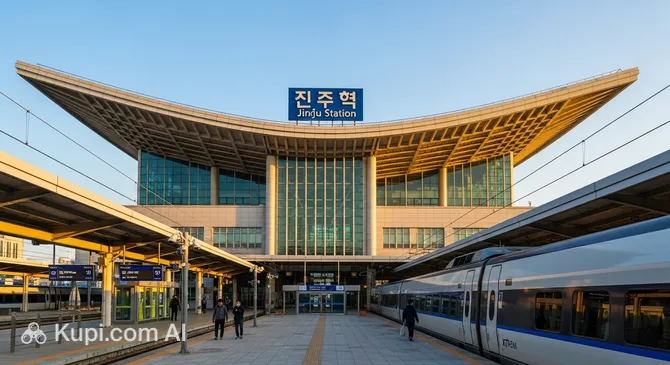
Jinju Railway Station (Jinju Station) is a modern transport gateway to the city, combining advanced technology with the aesthetics of traditional Korean architecture. Relocated to a new site in 2012, the station building serves high-speed KTX trains, as well as the ITX-Saemaeul and Mugunghwa lines, connecting the region with Seoul and Busan. The spacious and bright terminal is designed to resemble a *hanok* — a traditional Korean house — creating a special atmosphere immediately upon arrival.
It is important for passengers to know that navigation inside the station is intuitive and duplicated in English. The building has a compact structure: the main waiting hall is located on the ground floor, from where escalators and lifts lead to the platforms. Electronic schedule boards are located at the entrance and in the waiting area, allowing you to easily track the status of your journey.
Contact Information
To plan your trip and clarify details, please use the following contact information for Jinju Station:
Official Website:letskorail.com (available in English for ticket booking).
Helpline: +82-1544-7788 (Korail unified support centre).
Address: Jinju-yeok-ro, Gajwa-dong, Jinju-si, Gyeongsangnam-do, South Korea.
Opening Hours: Daily from 05:00 to 00:00 (depends on the schedule of the first and last train).
Luggage Storage: Automatic lockers are available in the main hall.
Accessibility: The station is fully equipped for passengers with reduced mobility (lifts, ramps, specialised restrooms).
How to Get There
You can reach Jinju Railway Station in several ways, keeping in mind that it is located in the Gajwa-dong district, slightly south of the historical centre.
Public Transport: Many city buses run to the station (for example, routes in the 100 and 200 series). The stop is located directly in front of the terminal exit. A bus ride to Jinju-seong Fortress or the Intercity Bus Terminal will take about 30–40 minutes.
Taxi: This is the most convenient way to reach the centre, especially if you are travelling with luggage or family. The taxi stand is located to the left of the main exit. A trip to the city centre will take approximately 15–20 minutes and will cost around 10,000 – 12,000 KRW.
On Foot: Walking from the centre is not recommended due to the significant distance; however, if you are in the university campus area (Gyeongsang National University), you can reach the station in 20–30 minutes.
Services and Amenities
The station offers a full range of services for a comfortable wait for your train. The main hall features a spacious waiting area with seating and televisions. Tickets can be purchased both at counters with staff and through self-service kiosks which support the English language.
Other amenities include:
Free Wi-Fi via the Public WiFi Free network.
Power outlets for charging gadgets in designated zones.
Automatic luggage lockers of various sizes.
Clean washrooms and restrooms.
A mother and child room for passengers with children.
Assistance service for citizens with reduced mobility (provision of wheelchairs, escort to the train).
Where to Eat
Dining options within the station grounds are limited but sufficient for a quick snack before your journey.
Inside the terminal, there is a Storyway convenience store where you can buy ready-made meals (dosirak), sandwiches, snacks, water, and hot coffee. This is an excellent option for those in a hurry. Additionally, a small coffee shop or bakery (such as Dunkin' Donuts or a local brand) usually operates in the building, where you can enjoy coffee with fresh pastries. The average bill here will be around 5,000 – 8,000 KRW.
If you have more time available (about an hour), you can exit the station and visit one of the restaurants in the university area, located a 10–15 minute walk away, where the selection of Korean cuisine is significantly wider.
Station History
The history of railway communication in Jinju began back in 1925, when the old station was opened in the city centre. For decades, it served as the region's main transport hub. The old station building has now been transformed into an exhibition space and park, serving as a local landmark.
The modern era began in October 2012, when the station was relocated to its current site in the Gajwa-dong district. This was connected to the large-scale reconstruction of the Gyeongjeon Line and the launch of high-speed KTX trains. The new complex was built taking into account the growth in passenger flow and the need to integrate the city into the national high-speed railway network, which significantly reduced travel time to Seoul.
Passenger Tips
To ensure your trip goes smoothly, we recommend arriving at the station 20–30 minutes before your train departs. Boarding for KTX trains ends strictly according to the schedule, and doors close automatically.
Tips for passengers:
Tickets: For popular destinations (especially on weekends and holidays, such as during the Lantern Festival), it is better to book tickets in advance via the KorailTalk app or the website.
Luggage: Trains have spaces for large luggage between carriages, but valuable items should be kept with you on the shelf above your seat.
Safety: The station is very safe, with security staff and video surveillance in operation.
Overnight Waiting: The station closes for several hours at night after the arrival of the last train, so please plan your accommodation in the city in advance; staying overnight in the waiting hall is not possible.