Support

مسنة الوطية

About

Al-Watiya Museum, part of the National Museum of Kuwait, is a prominent architectural and cultural complex in the heart of Kuwait City. Opened in 1983, this center has become a true stronghold of history and tradition, telling the story of the people of Kuwait from ancient times to the present day. Designed by the famous French architect Michel Écochard, the complex consists of five buildings connected by elegant walkways.
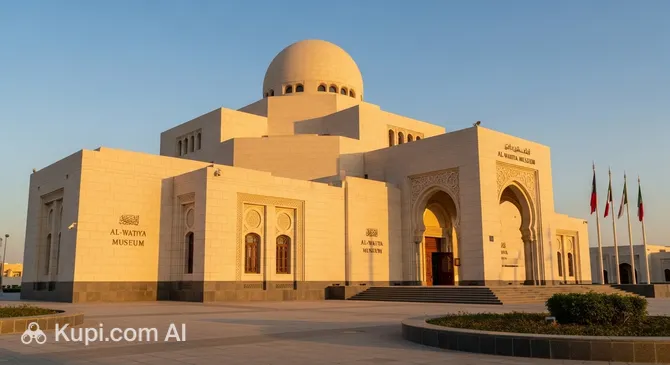
Al-Watiya Museum
Al-Watiya Museum. Иллюстрация. Источник: Kupi.com AI

A unique feature of the museum is its layout: the buildings are grouped around a central garden, referencing the architecture of a traditional Arab home with a courtyard. This design creates an atmosphere of comfort and peace, despite the scale of the exhibitions. The museum is considered a national symbol and a must-visit for anyone wishing to understand the identity of this region.

Here, visitors can see not only archaeological treasures but also items of applied art, as well as visit a planetarium. The Al-Watiya Museum is a place where the history of the Persian Gulf comes to life in detail, from Bronze Age artifacts to exquisite Islamic relics.

Contacts

For those planning a visit to the Al-Watiya Museum, it is helpful to have the exact coordinates on hand. While the museum's official online resources do not always provide extensive contact details, the main address remains a constant landmark in the heart of the city.

To find up-to-date information or official pages, it is recommended to use Google Maps with the place ID ChIJ83qdrRiFzz8RMj0lEt_sFtA.

How to contactContact
Address9X74+8G7, Эль-Кувейт, Кувейт

What to Do

A visit to the museum turns into a fascinating journey through seven thematic sections. Start with the ancient artifacts section, where you can see unique seals and ceramics from Failaka Island dating back to the Sumerian-Babylonian and Greek periods. Maritime history enthusiasts will be drawn to the seafaring section, featuring models of traditional ships and pearl divers' tools—symbols of the region's former prosperity.

Equally interesting is the ethnographic part: halls dedicated to urban and Bedouin life showcase traditional furniture, jewelry, utensils, and musical instruments. This allows you to literally step into the past and imagine what life was like for nomads and residents of traditional Kuwaiti homes many decades ago.

Be sure to visit the Islamic House of Artifacts, which houses the famous Sabah collection. Here, rare items such as a 10th-century bronze astrolabe from Iraq and elegant Persian candlesticks are on display. You can conclude your visit at the modern two-level Planetarium, which broadcasts exciting programs about celestial phenomena and the structure of the cosmos.

Getting There

Finding the Al-Watiya Museum is easy, as it is located in the very center of Kuwait City, in the historic Qibla district. The main landmark is the picturesque Arabian Gulf Street, along which many of the city's iconic buildings are located. Additionally, the museum is in close proximity to the famous Liberation Tower, which is visible from almost anywhere in the capital.

For travelers, the most convenient way to get around is by taxi or private car. The drive from the central districts of the city takes only a few minutes, and there is convenient parking for visitors on the complex grounds. If you prefer to use GPS navigation, use the address code 9X74+8G7 to set your route accurately.

Public transport is also an available option, although the city's bus network is still developing. It is recommended to check the route numbers passing through the central part of the waterfront in advance. A walk to the museum can also be a pleasant addition to your tour if you are already in the Persian Gulf waterfront area.

Ближайший город: Kuwait City

History & Facts

The history of this cultural center began long before the current buildings were constructed. Back in 1957, Sheikh Abdullah Al-Jabir Al-Sabah opened the first exhibition in his palace, seeking to preserve folk artifacts. Gradually, the collection grew, enriched by unique finds from Danish archaeological expeditions that worked on Failaka Island in the late 1950s.

The modern architectural complex we see today was officially opened on February 24, 1983. This event was timed to coincide with the country's national holiday and became a symbol of cultural revival. Architect Michel Écochard succeeded in creating a space where the functionality of modern halls harmoniously combines with traditional Arabic planning.

In the early 1990s, the museum went through a difficult period when a significant part of its holdings, including the scientific library and rare collections, was damaged. Remarkably, one of the few surviving objects was a set of carved 14th-century Moroccan doors, which still stand today as a reminder of the resilience of cultural heritage. Since then, immense work has been done to restore and return lost items.

Today, the museum continues to develop actively, becoming not just a repository of antiquities but a living educational platform. Constant updates to the exhibitions and scientific research make it a key link in studying the history of the entire Persian Gulf region.

Time Needed

To stroll leisurely through all the halls and soak in the museum's atmosphere, a typical visitor usually needs about 2–3 hours. This is quite enough time to see the main archaeological finds and explore the exhibitions dedicated to the country's maritime heritage.

If you plan to study each of the seven sections in detail, including a visit to the Planetarium and viewing the rare Islamic artifacts from the Sabah collection, you should budget 4–5 hours for your visit. The museum complex is quite large, so it is worth taking small breaks in the inner garden to make your visit as comfortable as possible.

Working Hours

According to available data, the grounds of the National Museum are open to the public 24/7. This makes it a unique site that can be included in your itinerary at any time of day, whether it's early morning or late evening.

However, please note that access to the indoor galleries for specific exhibitions and the Planetarium may have its own regulations. For the most accurate planning, we recommend checking the current schedule on the official website or inquiring directly at the entrance to the complex.

Круглосуточно

Nearby

Its location in the heart of the capital makes the Al-Watiya Museum an ideal starting point for further exploration of the city. The museum's surroundings are full of interesting places that will help make your day rich and varied, especially if you are traveling with family.

A stroll through the nearby neighborhoods will allow you to feel the contrast between Kuwait's historical heritage and modern entertainment centers. Below are some interesting sites located nearby:

NameDistance
Sheikh Jaber Al-Ahmad Cultural Centre0.4 km
Holy Family Cathedral0.4 km
Al Bahhar Historical Village0.8 km
Shuwaikh Beach0.8 km
Ave Restaurant1.5 km
Kuwait National Museum1.5 km
Naif Palace1.7 km

What to see in nearby cities

Reached the end of the page?

That means the route is fully explored