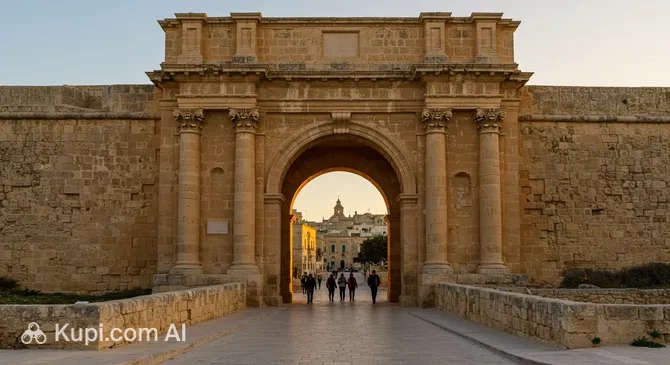
Mdina is a true jewel of Malta, a city seemingly frozen in time and shrouded in the mysterious atmosphere of the Middle Ages. It rises majestically in the heart of the island atop a hill, offering breathtaking panoramic views of the picturesque surroundings and the azure waters of the Mediterranean Sea. This strategically advantageous location has been valued since ancient times, and today, Mdina invites its guests to embark on an unforgettable journey into the past.
With a population of only about 300 people, Mdina is a remarkably intimate and quiet city where time seems to have stood still. Despite its modest size, Mdina was once the capital of Malta and still retains its cultural significance. Especially in the evenings, when the narrow streets empty, the city sinks into a mysterious silence, earning its nickname, the "Silent City."
Mdina. Illustration.
Source: Kupi.com AI
A walk through Mdina is like traveling through the centuries. The city is a veritable open-air museum: its mighty fortress walls, founded back in the Roman Empire and reinforced during the Middle Ages, still leave a lasting impression. Among the key attractions are the majestic St. Paul's Cathedral, ancient noble palaces, and charming squares, each holding its own history.
Mdina is a must-visit on the itinerary of anyone seeking to feel the authentic spirit of Malta. Here, you will find architecture untouched by time, exquisite views, and a completely unique aura. This city is the perfect place for romantic strolls, for history buffs, and for anyone seeking inspiration and peace away from the urban bustle.
You can find more interesting facts on the history of Mdina page.
Weather Overview
The weather in Mdina is characterized by distinct seasonality. Summer, especially from June to August, is very warm and dry. Average temperatures during this period range from 23.1°C in June to 27.1°C in August, with virtually no precipitation (0 mm) and minimal rainy days (0-1 day). Winter, from December to February, is mild, with average temperatures around 14-16°C. Small amounts of precipitation (1-2 mm) fall during winter months, and the number of rainy days varies from 6 to 10.
Expect hot and very dry summers in Mdina, and mild winters with light precipitation, most likely from October to February. Spring and autumn are transitional months, with gradual changes in temperature and rainfall. For example, October and November see the highest amount of rainfall (3 mm) and rainy days (8-12 days). For a more detailed study of weather conditions, you can check information about the Mdina climate.
Average monthly temperature
Average monthly precipitation
Interesting Facts
Beyond its majestic walls and rich history, ancient Mdina hides many surprising details and stories that don't always make it into standard guidebooks. Ready to learn some intriguing facts about this "Silent City"?
Mdina Gate. Illustration.
Source: Kupi.com AI
Traveler photos:
The nickname "Silent City" is not just a poetic metaphor. After the capital of Malta was moved to Valletta, Mdina gradually lost its former importance, and today fewer than 300 people live here permanently. Car traffic within the city walls is strictly limited, making its streets remarkably quiet, especially after sunset, immersing you in a medieval atmosphere.
Mdina is one of Europe's oldest continuously inhabited fortresses. Its history spans over 4,000 years! The city was founded by the Phoenicians, then ruled by the Romans, Arabs, and Normans. It was the Arabs who gave the city its modern name—"Mdina," which means "fortified city."
The walls of Mdina remember the Great Siege. While the main battles of the Great Siege of Malta in 1565 took place at the forts of Birgu and Senglea, the resilience of Mdina and its defenders was of great importance. Holding the city diverted some of the enemy's forces and served as a crucial morale factor for the entire island.
A home for aristocrats and mysterious legends. For centuries, Mdina was home to the most noble Maltese families. Their magnificent palaces, such as Palazzo Falson, still adorn the city today. Additionally, according to local legends, you might encounter the ghost of the "Lady in Red" in the narrow alleys at night, adding a touch of mystery to walks through the ancient streets.
How to Get There
When planning a trip to the ancient capital of Malta, it is important to think about your route in advance. Since Mdina is located on an island, the primary way for most international tourists to arrive is by air. You can find all the details and alternative options by following the link: all ways to get to the city.
Mdina itself does not have its own airport, as it is a small fortified city. The main gateway for all travelers is Malta International Airport (IATA: MLA). It is located in the municipality of Luqa, which is often associated with the nearest large city, Valletta, just 7.4 km from Mdina. This is the only airport in the archipelago that accepts international flights. A trip from the terminal to the fortress walls of Mdina by taxi or rental car will take about 30-35 minutes, depending on traffic. There are also direct bus routes linking the airport to the city.
If you are planning a complex journey that includes a visit to Sicily, you might consider flying into Catania-Fontanarossa Airport (IATA: CTA). It is located in the Italian city of Catania, approximately 185 km from Mdina (across the sea). This is a major international hub with a large passenger flow. From Sicily, you can reach Malta by high-speed ferry, which arrives at the port of Valletta, from where Mdina is easily reached by bus or taxi.
For convenience, here is a summary of the main airports through which you can reach the region:
Regarding rail transport, it is important to note that on Malta itself, and in Mdina specifically, there are no railways. The nearest major railway station is located on mainland Italy—the Reggio di Calabria Centrale Station (IATA: RCC). It is located in the city of Reggio Calabria, about 269 km from Mdina. Travelers choosing this route usually take a train to the south of Italy, then take a ferry to Sicily, and from there a ferry to Malta.
Below is information about the nearest significant railway station on the continent:
Mdina, known as the "Silent City," holds many historical and cultural treasures within its walls. A stroll through its narrow streets is an attraction in itself, but there are several key sites that should not be missed.
Mdina Gate. Illustration.
Source: Kupi.com AI
Traveler photos:
One of the first iconic landmarks to greet visitors is the majestic Mdina Gate. This is the main entrance to the ancient city, built in the Baroque style in 1724. Passing through it, you feel as though you have been transported to another era. The gate is frequently featured in photographs and has become a symbol not only of Mdina but of all Malta.
St. Paul's Cathedral. Illustration.
Source: Kupi.com AI
Traveler photos:
In the very heart of the city stands the magnificent St. Paul's Cathedral. Built on the site where, according to tradition, the Apostle Paul met the Roman Governor Publius, this Baroque cathedral impresses with its rich interior decoration, including frescoes, marble inlays, and an impressive dome. It is not only an important religious center but also an architectural masterpiece.
Palazzo Falson. Illustration.
Source: Kupi.com AI
Traveler photos:
For those who want to glimpse the lifestyle of Maltese nobility from past centuries, Palazzo Falson, also known as the Norman House, is a must-visit. This is one of the oldest buildings in Mdina, now converted into a museum. Inside, the atmosphere of a medieval home is preserved with a collection of antiques, weapons, paintings, and books that belonged to its last owner.
Domus Romana. Illustration.
Source: Kupi.com AI
Traveler photos:
Located just outside the city walls but closely tied to Mdina's history is the Domus Romana (Roman Villa). This museum is built around the remains of an aristocratic Roman house from the 1st century BC. Its crowning jewels are the beautifully preserved mosaic floors, considered among the finest in the Western Mediterranean. The exhibition also includes household items and statues from the Roman period found at the site.
Local Cuisine
The gastronomy of Mdina is a fascinating journey where Mediterranean culinary traditions intertwine harmoniously with a unique Maltese flavor. This ancient city offers guests not just food, but a true cultural experience reflecting the island's rich history. Mdina's gastro scene is characterized by the use of fresh local products and the ability to combine simplicity with sophistication.
Be sure to start your introduction to the local cuisine with pastizzi—crunchy puff pastry pies filled with ricotta or pea puree. This is a popular street food and a true symbol of Malta. For a more substantial lunch, choose dishes made from the freshest fish and seafood, which are so abundant in the Mediterranean. You should definitely try stuffat tal-fenek—a traditional Maltese rabbit stew, considered a national delicacy. Another hallmark is the Maltese bread hobz biz-zejt: appetizing slices with olive oil, juicy tomatoes, capers, and other local ingredients.
For those with a sweet tooth, Mdina offers delightful desserts. Look for imqaret—deep-fried pastry rolls with a delicate date filling, as well as other sweets based on almonds and honey. An excellent addition to any meal is a glass of local wine produced at one of the Maltese wineries. Among non-alcoholic drinks, freshly squeezed juices and traditional lemonade are popular.
Root 81. Illustration.
Source: Kupi.com AI
Traveler photos:
The food culture in Mdina is diverse. You can grab a quick snack of pastizzi on the go from one of the many street stalls. For a leisurely dinner, the cozy restaurants hidden within the city's ancient walls are perfect, many of which offer traditional Maltese dishes. For example, you can visit the restaurant Root 81 to enjoy local specialties in an authentic atmosphere. Mdina also has many charming cafes where it is pleasant to have a cup of coffee with dessert. For those who want to dive deeper into the gastronomic life, it is worth looking for farmers' markets in the vicinity or finding out about culinary festivals where Maltese treats are prepared in the open air.
Travel Tips
Welcome to Mdina, the ancient capital of Malta, also known as the "Silent City"! To ensure your trip to this amazing place, shrouded in silence and history, is as comfortable as possible and leaves only the most pleasant impressions, we have prepared some practical tips.
Clothing and Essentials: The climate in Malta is Mediterranean. In summer (May to October), choose light, breathable clothing made from natural fabrics, a hat, sunglasses, and high SPF sunscreen. In the shoulder season and winter (November to April), warmer items like a sweater or fleece, as well as a light jacket and an umbrella in case of rain, will come in handy. A key element of your wardrobe is comfortable flat shoes, as Mdina's streets are paved with stone. When visiting cathedrals and churches, such as St. Paul's Cathedral, do not forget the dress code: shoulders and knees should be covered. Electrical outlets in Malta are Type G (British standard), so don't forget to bring an adapter.
Transport: Mdina is predominantly a pedestrian city. Vehicle traffic inside the fortress walls is strictly limited and mostly allowed only for residents and service vehicles. The best way to explore Mdina is on foot. Getting to Mdina from Valletta or other cities in Malta is easy by public bus—the stop is right at the main city gates. Taxis are also available and can be found at the city entrance or ordered via apps (e.g., Bolt). Car rental is not necessary for visiting Mdina but can be useful for exploring the rest of the island.
Finance: The official currency of Malta is the Euro (EUR). ATMs can be found in the neighboring town of Rabat, which is just a few minutes' walk from Mdina; there may be very few or none within Mdina itself. Credit and debit cards (Visa, Mastercard) are widely accepted in most restaurants, cafes, and souvenir shops. Nevertheless, it is recommended to have some cash on hand for small purchases or in case cards are not accepted somewhere. Tipping in restaurants is usually 5-10% of the bill if service is not included; it is also customary to round up the fare in taxis.
Health and Safety: Mdina is considered a very safe city, even after dark. It is one of the quietest places in Malta. Pharmacies (marked by a green cross) are located in Rabat. Information on duty pharmacies operating on weekends and holidays can be found online or in local newspapers. For medical assistance, EU tourists are recommended to have a European Health Insurance Card (EHIC); tourists from other countries should arrange travel medical insurance. General precautions, such as watching your personal belongings, apply, although the crime rate here is extremely low.
Communication: The official languages of Malta are Maltese and English. English is widely spoken, so you won't have trouble communicating in tourist areas, shops, and restaurants. Learning a few simple phrases in Maltese, such as "Bonġu" (Bon-ju) for Good morning/day and "Grazzi" (Grat-si) for Thank you, is a nice gesture. Local SIM cards can be purchased at the airport or at mobile phone shops across the country. Wi-Fi is available in many cafes, restaurants, and hotels, and there may also be public hotspots.
Local Etiquette: The Maltese are known for their friendliness and hospitality. A polite greeting and a smile are always appropriate. When meeting people, it is customary to shake hands. The main rule in Mdina is to observe silence, especially in the evening and at night. The city is not called the "Silent City" for nothing, and locals highly value this atmosphere. Before taking photos of locals, politely ask for permission.
What to Avoid: Try not to make noise or speak too loudly, especially in the evening and at night, so as not to disturb the peace of Mdina's residents. Also, avoid trying to drive a rental car inside the city walls without special permission (unless you are a hotel guest with parking), as most streets are strictly for pedestrians.
Extra Tip:Be sure to visit Mdina in the evening or at night. When the daytime tour groups leave, the city transforms and becomes even more mysterious and atmospheric. A walk through the narrow, lantern-lit streets will provide unforgettable impressions, and the bastions offer a magnificent panoramic view of Malta at night.
We hope these tips help you plan the perfect trip to Mdina and fully enjoy its unique beauty and tranquility. Enjoy your trip to this magical corner of Malta!
Entertainment & Nightlife
Mdina, known as the "Silent City," offers unique evening experiences. As the sun sets, its narrow streets, lit by antique lanterns, take on a special, almost mystical atmosphere. Nightlife here differs from bustling resort centers—it is more intimate and sophisticated, ideal for those seeking tranquility and romance rather than loud parties until dawn within the walls of the ancient city.
Inside the walls of Mdina, you will find several charming restaurants where you can enjoy dinner in a historical setting, as well as cozy wine bars. These establishments usually stay open until late evening, offering a relaxing atmosphere. One such place is the wine bar L’Enoteca, where you can taste local and imported wines accompanied by light snacks. It is a wonderful choice for a leisurely evening for two or in small company.
However, if you are looking for livelier entertainment, such as large nightclubs and dance floors, you should look to the areas located outside Mdina's ancient walls. The main centers of Malta's vibrant nightlife are concentrated in other parts of the island, such as Paceville (St. Julian's). Nevertheless, large entertainment complexes can be found relatively close to Mdina, attracting young people and dance music fans.
One of the most famous places for club music lovers is the Gianpula Village complex, located near Mdina in the Rabat area. Here you will find popular clubs such as UNO Malta, considered one of the largest open-air clubs in Malta, and the Gianpula Main Room. These venues come alive closer to midnight, especially during the summer season and on weekends, attracting both locals and tourists with their large-scale parties, performances by famous DJs, and a variety of musical styles from house to commercial pop. The atmosphere here is usually very energetic and crowded.
UNO Malta. Illustration.
Source: Kupi.com AI
Traveler photos:
To visit major clubs like those at Gianpula Village, the best time is after 11:00 PM, and parties often continue until 4:00 or 5:00 AM. Getting to these places from Mdina is most convenient by taxi; it is recommended to use official services or mobile apps to book a ride, as public transport runs less frequently at night. Average prices for entry tickets and drinks in clubs are comparable to European standards. The dress code usually varies from smart casual to clubwear, depending on the venue and the specific event.
Regarding safety, Malta is generally considered a safe country. However, in crowded places, especially at night, it is always worth following standard precautions: keep an eye on your belongings, do not leave drinks unattended, and avoid walking alone in poorly lit or deserted areas. Booking a taxi through trusted companies is a good way to ensure a safe return to your hotel.
During the day, Mdina offers completely different but no less fascinating entertainment. You can immerse yourself in the city's rich history by visiting numerous museums, such as Casa Bernard or the Wignacourt Museum. Be sure to see the majestic St. Paul's Cathedral, walk along the ancient bastions offering stunning panoramic views of the island, or explore the mysterious Mdina Dungeons Museum. For nature lovers and outdoor enthusiasts, the Ta' Qali National Park is located nearby.
Parks & Museums
Mdina, the "Silent City," offers not only an immersion into the history of its ancient walls but also opportunities for outdoor recreation in the surrounding area and an introduction to rich cultural heritage through its unique museums.
Although Mdina itself, being a medieval fortress, does not abound with extensive parks inside the walls, beautiful green zones can be found in its vicinity. One such place is Ta' Qali National Park. This is a popular spot for relaxation, picnics, and walks, which also houses a crafts village and hosts various events. It is especially pleasant to spend time here on a warm day, enjoying nature and tranquility.
Ta' Qali National Park. Illustration.
Source: Kupi.com AI
Traveler photos:
For families with children and fans of active recreation, the Adventure Park is of interest, offering various attractions and rope courses. This park is located near Mdina and is easily accessible for visitors wishing to add a little adrenaline to their cultural program.
Adventure Park. Illustration.
Source: Kupi.com AI
Traveler photos:
The heart of Mdina's cultural life is its museums, each of which tells its part of the city's and Malta's history. Palazzo Falson, also known as the Norman House, is one of the oldest buildings in the city. Today it is a house-museum with a rich collection of antiques, weapons, paintings, and books, offering a glimpse into the lifestyle of Maltese nobility from past centuries.
Palazzo Falson. Illustration.
Source: Kupi.com AI
Traveler photos:
Be sure to visit the Domus Romana, where you can see beautifully preserved mosaics of a Roman villa from the 1st century BC. This museum is built directly over the archaeological excavations and offers a unique immersion into the island's ancient past, demonstrating the sophistication of Roman life.
Domus Romana. Illustration.
Source: Kupi.com AI
Traveler photos:
For those not afraid to delve into darker but fascinating pages of history, the Mdina Dungeons Museum offers reenactments of various events from Malta's past, from the times of Arab rule to the Knights of the Order of St. John. The museum's exhibition is located in ancient dungeons and creates a special, memorable atmosphere.
Mdina Dungeons Museum. Illustration.
Source: Kupi.com AI
Traveler photos:
One cannot overlook the majestic St. Paul's Cathedral. This is not just an active church but a true treasury of art, housing many relics and masterpieces, including works by Mattia Preti. A museum also operates at the cathedral, with an exhibition that complements the experience of visiting this iconic site.
St. Paul's Cathedral. Illustration.
Source: Kupi.com AI
Traveler photos:
A simple walk through the Old City of Mdina is a cultural adventure in itself. The majestic Mdina Gate, narrow winding streets, ancient palazzos, and powerful bastions create a unique medieval atmosphere where every stone holds its own history.
Mdina Gate. Illustration.
Source: Kupi.com AI
Traveler photos:
To get a truly authentic experience, climb onto the city walls (bastions) of Mdina at sunset—they offer stunning panoramic views of the island, especially picturesque in the rays of the setting sun. Also, don't be afraid to turn off the main streets into quiet alleys—there you can discover charming courtyards and small chapels hidden from most tourists.
Getting Around
Mdina, known as the "Silent City," has its own peculiarities regarding public transport. Within the ancient city walls, motor vehicle traffic is strictly limited, and the primary way of moving around is on foot, which allows you to fully enjoy its unique atmosphere. To get to Mdina, the main form of public transport is buses operated by Malta Public Transport, which connect it with Valletta, Sliema, Bugibba, and other key points in Malta.
The fare payment system on Maltese buses is quite flexible. You can purchase a ticket for cash directly from the driver when boarding (the cost is usually around 2-3 euros, depending on the season and time of day, and the ticket is valid for two hours on any route). A more advantageous option for tourists is the Tallinja Card. There are various types of cards: a personalized top-up card, the Explore card (unlimited travel for 7 days), the ExplorePlus card (also includes ferry trips and other bonuses), or a card for 12 single trips. Information on fares and routes, as well as the ability to top up cards, is provided by the Tallinja App.
Tallinja Cards can be purchased at the airport, at main bus terminals (for example, in Valletta), or at authorized points of sale throughout the island. When boarding a bus, you must validate your card or ticket by holding it against a special reader. The Mdina bus stop is located directly outside the main city gates. Buses run quite regularly, but it is always useful to check the current schedule, especially if you plan to travel early in the morning or late in the evening.
As an alternative to public transport for a trip to Mdina, you can use a taxi. Ride-hailing apps (such as Bolt, eCabs) are popular in Malta. Car rental or car-sharing is also possible, but keep in mind that parking near the walls of Mdina can be limited and paid. Directly in Mdina, as a tourist activity, horse-drawn carriage rides (karozzini) are offered, adding local flavor to your visit. Bicycle rentals exist in Malta, but Mdina itself, with its narrow streets and cobblestones, is more conducive to leisurely walks.
The main feature of Mdina's transport system is its almost completely pedestrian nature. Public transport will take you to its gates, and from there it is best to explore this ancient city on foot, immersing yourself in its centuries-old history and the silence that gave it the nickname "Silent City."
Accommodation
Finding suitable accommodation in Mdina is an important part of planning a trip to this unique fortified city. Although the choice of accommodation directly within the walls of the old city may be limited due to its historical nature and small size, you can find several charming options here, as well as more offers in the immediate vicinity.
Inside Mdina itself, boutique hotels and guesthouses predominate, often located in historical buildings, which adds a special flavor to your stay. Some offer luxurious conditions, while others are geared toward the mid-price segment. Short-term rental apartments may also be available, offering more space and a homey feel. Outside the walls of Mdina, in the neighboring town of Rabat, the choice may be wider, including more budget-friendly options.
Mdina Old City. Illustration.
Source: Kupi.com AI
Traveler photos:
Staying directly within the walls of Mdina allows you to fully immerse yourself in the atmosphere of this ancient city, especially in the evening after day-trippers have left. All the main attractions, such as St. Paul's Cathedral or Palazzo Falson, will be just a few steps away. If you are looking for more options or a different price category, it is worth considering accommodation in Rabat, which is within walking distance of Mdina.
Given Mdina's popularity and the limited number of places to stay within the walls, it is highly recommended to book accommodation in advance, especially if your trip falls during the peak tourist season. Prices can range from mid-level to high, depending on the type of accommodation and its location. Bookings can be made through popular online platforms or directly on the hotels' websites.
Nearby Cities
For those who want to explore the surrounding area, Mdina serves as an excellent starting point for day trips to several interesting nearby locations:
These nearby destinations provide insight into the diverse culture and landscapes of the Malta region. Each of these towns offers its own unique attractions, whether historical monuments, picturesque bays, or lively local markets. For example, Mosta is famous for its Rotunda—a church with one of the largest domes in the world. Birkirkara, one of Malta's oldest towns, offers an authentic atmosphere with its narrow streets and ancient churches. St. Paul's Bay attracts tourists with its beaches and water sports opportunities, as well as historical sites associated with the shipwreck of the Apostle Paul.
Shopping & Souvenirs
Shopping in Mdina is not a chase for brands in huge malls, but rather a fascinating immersion into the world of crafts and unique souvenirs. The "Silent City" offers a special shopping experience where every little shop and stall holds a piece of history and Maltese flavor. The main focus here is on handmade items, especially the famous Mdina glass, as well as traditional delicacies.
Primary shopping opportunities in Mdina are concentrated on its narrow, winding streets within the ancient city walls. The main street, Villegaignon Street, and the adjacent alleys are the main places where you can find souvenir shops, stores with glass and ceramic products, and small art galleries. A walk through the Old City of Mdina turns into a treasure hunt in its own right.
Inside Mdina itself, you won't find large shopping centers—its historical appearance and compact size do not accommodate them. For large-scale shopping with a wide selection of international brands, it is worth heading to other, larger cities in Malta, such as Sliema or Valletta.
Although there are no traditional markets within the walls of Mdina, right nearby, in the Ta' Qali area, is the famous Crafts Village. This is a place where you can not only buy authentic Maltese products but also watch the process of their creation—from glassblowing to lace-making and ceramic production. Next to the village is the Ta' Qali National Park, where you can relax after shopping.
Ta' Qali National Park. Illustration.
Source: Kupi.com AI
Traveler photos:
From Mdina, it is worth bringing back unique souvenirs reflecting the culture of Malta. First and foremost, these are Mdina glass products—vases, candlesticks, animal figurines, and jewelry known for their bright designs. Also popular are silver filigree items, traditional Maltese handmade lace, and colorful ceramics. Gastronomic souvenir lovers will enjoy local nougat (qubbajt), honey, and various liqueurs. Figurines of the Knights of Malta will also serve as a wonderful reminder of your trip to this ancient city.
Shops in Mdina are usually open from 9:00-10:00 AM to 6:00-7:00 PM. Some small shops may close for a siesta in the middle of the day (roughly from 1:00 PM to 4:00 PM), especially in the hot summer months or during the off-peak season. In tourist areas and during peak season, working hours may be extended. Credit cards (Visa, MasterCard) are accepted in most stores; however, for small purchases in tiny souvenir shops, it is recommended to have some cash in euros (€) with you.
For tourists from countries outside the European Union, a Tax Free refund system is available. If you make purchases of a certain amount in stores participating in this program (they usually have a corresponding sticker), ask the seller for a special Tax Free receipt. By presenting this receipt along with your unopened purchases and passport at customs when leaving the EU, you can receive a VAT refund.