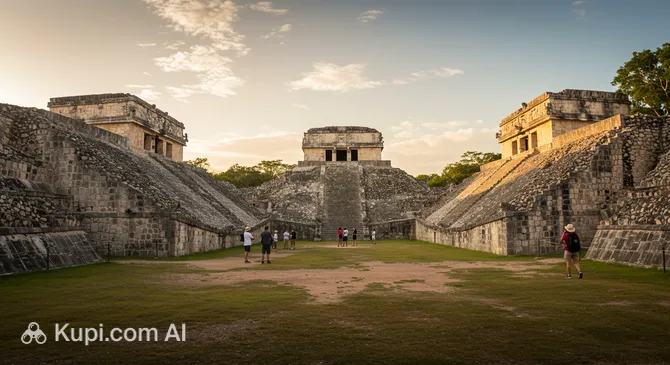
Imagine an arena whose size exceeds a modern football field. The Great Ball Court is the most grand and best-preserved venue of its kind in all of ancient Mesoamerica. Located within the famous archaeological complex of Chichen Itza, this site captures the imagination with its scale: 168 meters long and 70 meters wide.
Great Ball Court. Illustration.
Source: Kupi.com AI
Traveler photos:
This unique historical site, gifted to the world by Mexico, consists of two parallel platforms with walls 8 meters high. Massive stone rings decorated with carvings of intertwined feathered serpents are fixed in the center of each wall. It is not just a sports facility, but a complex architectural ensemble including the Temples of the Jaguar and sloping benches with intricate sculptural panels.
One of the site's most amazing features is its incredible acoustics. Even a soft handclap here turns into a series of loud echoes, demonstrating the Maya's deep knowledge of sound physics. The architecture of the court combines Puuc style traditions with Toltec influence, creating a unique look for this "stadium" of antiquity.
Contacts
To check the latest information before your visit, you can refer to the official data of the archaeological park. Below are the contact details for the site:
Once inside this giant rectangle, the first thing to do is test the famous Maya acoustics. Clap your hands, and you will hear the sound reflect off the walls multiple times, mimicking—according to legend—the cry of a sacred bird or a tree frog. This simple action allows you to instantly feel the engineering genius of the ancient builders.
Be sure to take time to study the bas-reliefs at the base of the walls. The sculptural panels depict processions of players, ritual symbols, and even sacrifice scenes in detail, providing a vivid idea of the harsh rules of the game Pok-ta-Pok. Try to spot the stone rings at a height of eight meters—this is where the players had to throw a heavy rubber ball using only their hips.
Don't forget to look into the Upper Temple of the Jaguar to see the remains of ancient frescoes with battle scenes, and the Lower Temple, where a jaguar-shaped throne has been preserved. Walking the full length of the court will allow you to take impressive panoramic photos and appreciate the true scale of this ritual space where the fates of people and cities were once decided.
Getting There
Getting to this majestic structure is easy, as it is located within the popular archaeological complex of Chichen Itza. The court itself is located just 150 meters northwest of the famous Kukulcan Pyramid. Within the park grounds in a country like Mexico, it is best to move around on foot following the signs—the walk from the main entrance will take no more than 10 minutes.
If you are coming from Cancun or Merida, it is most convenient to use a rental car (the trip from Cancun via the toll road takes about 2 hours) or ADO buses. Also, shuttle taxis—colectivos—regularly run from the nearby village of Piste. Many tourists prefer to book organized tours from Riviera Maya hotels, which already include a transfer to the gates of the complex.
Nearest city: Chichen Itza
History & Facts
This monumental structure dates back to the city's heyday in the 10th century. Historians link its construction to the arrival of the Toltecs from the central part of the country, who brought new architectural trends to Maya culture. The "Maya-Yucateco" style is harmoniously combined here with Puuc elements, and specific details can be seen on the walls, such as snail-shaped breastplates characteristic of northern tribes.
In total, archaeologists have discovered 13 such courts in the ancient city, but it is the Great Ball Court that surpasses the others in scale and preservation. For the Itza people, the game of Pok-ta-Pok was not just a sports competition, but a profound religious ritual symbolizing myths of creation and the movement of celestial bodies.
Symbolism can be traced in every detail here: from the field's orientation along astronomical lines to the bas-reliefs depicting sacrifices. It was believed that the outcome of the game directly influenced the favor of the gods, future harvests, and the prosperity of the entire civilization, turning the sports arena into a place of sacred action.
Time Needed
To leisurely explore all the details of this grand structure, study the bas-reliefs, and test the acoustics, the average tourist needs about 1 to 1.5 hours. This is quite enough time to visit the Jaguar temples and take atmospheric photos against the backdrop of the massive walls.
However, remember that the court itself is only part of a huge archaeological complex. If you plan a full tour of the entire ancient city territory with a guide, allow at least 2–3 hours to cover other iconic sites nearby.
Working Hours
The archaeological zone is open to visitors daily, from Monday to Sunday, including holidays. Working hours: from 08:00 to 16:30 local time.
Experienced travelers recommend arriving right at opening time. This will allow you to enjoy the silence and majesty of the site before the arrival of large tour groups and avoid the exhausting midday heat, which can be quite severe in this part of the country.
08:00–16:30
Nearby
A visit to the ancient Maya city is not limited to just the ball court. The surroundings of the Great Ball Court are literally dotted with unique monuments, each revealing new facets of Mesoamerican culture and architecture.