Support

Benito Juarez International Airport

About the Airport

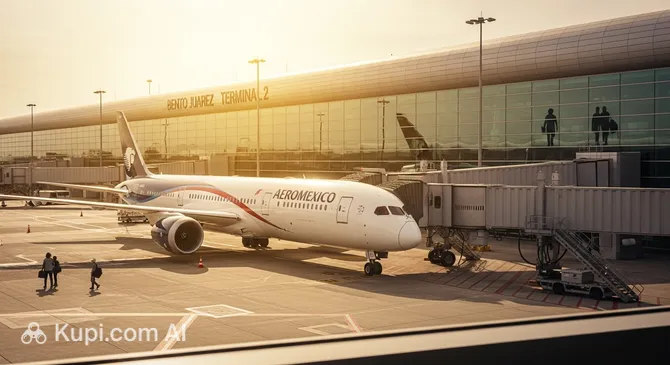
Benito Juarez International Airport. Source: Kupi.com Binoculars

Welcome to Benito Juárez International Airport — the main air gateway not only for Mexico City, but for all of Latin America. Located at an altitude of over 2,200 metres above sea level, this bustling transport hub connects the Mexican capital with hundreds of cities around the world daily. As one of the busiest airports on the continent, it serves as a key hub for Aeromexico and the SkyTeam alliance, offering travellers endless opportunities for discovery.

IATA Code MEX
ICAO Code MMMX
City Mexico City
Distance to centre approx. 5-13 km
Status International
Passengers per year approx. 48.4 million (2023)
Popular Airlines Aeromexico, Volaris, VivaAerobus
Schedule Benito Juárez International Airport online schedule

The airport offers passengers a high level of comfort and developed infrastructure. It consists of two terminals (T1 and T2). For the convenience of transit passengers, the free Aerotren monorail operates between them, while shuttle buses are available for all other visitors. Terminal 1 is one of the largest on the continent, while Terminal 2 primarily serves SkyTeam alliance flights. Travellers have access to numerous cafes, shops, VIP lounges, currency exchange points, and Tax-Free refund facilities. Thanks to its location within the city limits, it is easy to get from the airport to the centre of Mexico City by metro (Terminal Aérea station), Metrobús, or official taxi.

Contact Information

For your convenience, we have compiled key contact information for Benito Juárez International Airport (MEX).

  • Official Website: www.aicm.com.mx. On the site, you will find the most up-to-date information on flight schedules, services, security regulations, and terminal maps.
  • Help Desk Phone: +52 (55) 2482-2424. Please note that calls are charged as international.
  • Address: Av. Capitán Carlos León S/N, Peñón de los Baños, Venustiano Carranza, 15620 Ciudad de México, CDMX, México.
  • Social Media: The airport is present on major platforms; for example, on X (formerly Twitter), their official account is @AICM_mx. This is a good way to receive prompt updates.
  • Lost Luggage Information: If you have lost luggage or personal items on board the aircraft, you should immediately contact your airline's representative. If an item was lost within the airport building (in Terminals 1 or 2), you need to contact the Lost and Found Office (Oficina de Objetos Extraviados). Contact details and opening hours can be found on the airport's official website.
  • Passenger Support Service: For general inquiries, you can call the main phone number. For specific issues (customs, migration service), it is recommended to use the contacts of the relevant services, which are also listed on the airport website.

How to Get to the Airport

There are several ways to get from Benito Juárez International Airport (MEX) to the centre of Mexico City, suitable for any budget and travel style. The airport is conveniently located within the city limits, which is a major advantage for tourists arriving in the capital of Mexico. The choice of optimal transport depends on your comfort preferences, amount of luggage, and time of day.

Public Transport is the most economical option. The most convenient is considered the Metrobús express bus: route No. 4 runs between Terminals 1 and 2 and goes directly to the historic centre. It is a modern and comfortable method with designated space for suitcases. An alternative is the Metro. The "Terminal Aérea" station (Line 5) is located within walking distance of Terminal 1. The metro helps avoid traffic jams, but during peak hours the carriages are extremely overcrowded, creating inconvenience for passengers with bulky luggage. To pay for travel on the Metrobús and Metro, a unified rechargeable "Movilidad Integrada" card is required.

For those who value comfort and personal space, a taxi is ideal. The safest option is the official airport taxi ("Taxis Autorizados"). Their counters are located in the arrival halls. You pay for the trip at a fixed rate at a special kiosk and proceed to boarding with the receipt. Ride-hailing apps such as Uber and DiDi also operate actively in the city. There are special waiting zones for them, which signs will help you find. Prices in apps are often lower than official taxis, but may increase during periods of high demand.

If you plan to actively travel around the capital's surroundings, consider renting a car. Offices of leading international and Mexican rental companies operate in both airport terminals. For those arriving at the airport in their own vehicle, parking lots with options for both short-term and long-term parking are provided.

Travel time from the airport to central districts such as Zócalo or Roma depends heavily on traffic. Under ideal conditions, the journey will take about 25–30 minutes. However, during peak hours, the same trip can stretch up to one and a half hours. It is strongly recommended to allow extra time for the journey, especially when departing from the airport.

Terminals and Map

Benito Juárez International Airport (MEX), the main air hub of Mexico City, consists of two main terminals: Terminal 1 (T1) and Terminal 2 (T2). It is important to check in advance which terminal your flight departs from, as they are located at a significant distance from each other, and each has its own specialization.

Benito Juarez International Airport. Source: Kupi.com Binoculars

Terminal 1 (T1) is the older and larger building, serving the majority of international and domestic airlines not part of the SkyTeam alliance. Its structure may seem a bit confusing due to numerous expansions. Departure zones (Salidas) are located on the upper level, and arrival zones (Llegadas) on the lower level. Navigation is guided by signs, but due to the terminal's size, it is worth allowing extra time for movement.

Terminal 2 (T2) is more modern and compact. It is the main base for Aeroméxico and its SkyTeam alliance partners (such as Delta, Air France, KLM). The structure of T2 is more intuitive, with a clear division into zones for domestic and international flights. As in T1, departures are on the upper floor, and arrivals on the lower floor.

To move between terminals, the special automated Aerotrén train is provided. It is important to know that access is granted only to passengers with a valid boarding pass or confirmed booking. The trip takes about 5-7 minutes. If you do not have a boarding pass (for example, if you are meeting someone), you can use the paid shuttle buses that run between the terminals via the external airport territory.

It is recommended to allow sufficient time for check-in and security screening. For international flights, arrive at the airport at least 3 hours before departure, and for domestic flights — 2 hours. Queues can be significant during peak hours. Watch the signs and information boards carefully to easily find your check-in counter, boarding gate, and other necessary services.

Airport History

The history of Benito Juárez International Airport is a chronicle of aviation development in Mexico and a reflection of the rapid growth of its capital. Its story began in 1928 when the Central Air Port was built on the eastern outskirts of Mexico City. Regular civil flights started in 1931, and the official opening took place on November 19, 1952, with the commissioning of the first passenger terminal, which remains the core of Terminal 1 today.

The airport received a significant boost for development ahead of the 1968 Olympic Games held in Mexico City. The infrastructure was substantially modernized and expanded to welcome athletes and guests from around the world. Over the years, passenger traffic grew steadily, and by the beginning of the 21st century, the airport became one of the busiest in Latin America, operating at the limit of its capacity. This led to the need for radical expansion.

A key stage in the airport's modern history was the construction of Terminal 2. It opened in 2007 and allowed for a significant increase in capacity. Both terminals were connected by the automated Aerotrén monorail, which became a hallmark of the airport. In 2006, the airport was officially renamed in honour of Benito Juárez, a prominent President of Mexico, to commemorate the 200th anniversary of his birth.

One of the most interesting facts about the airport is its location at an altitude of 2,238 metres above sea level. This altitude affects aircraft performance: the thinner air requires a longer runway and reduces payload capacity. For decades, Benito Juárez Airport has consistently held the title of Mexico's main air gateway, serving tens of millions of passengers annually and standing as a living monument to the history of Mexican aviation.

Services and Amenities

Benito Juárez International Airport (MEX) offers passengers a full range of services for a comfortable wait for their flight. In both terminals, you will find numerous restaurants and cafes offering both Mexican and international cuisine — from fast food to full-service establishments. For shopping enthusiasts, there are numerous shops, including Duty Free, where you can purchase souvenirs, clothing, cosmetics, and local delicacies.

For a more comfortable wait, the airport features VIP lounges available to business class passengers and loyalty program members. Free Wi-Fi is provided throughout the airport, as well as numerous charging stations for mobile devices so you can always stay connected.

Financial matters are easily resolved at the airport: bank branches, ATMs, and currency exchange points are at your service in both terminals. In case of necessity, passengers can seek medical assistance at 24-hour medical units ready to provide first aid.

For travellers with children, nursing rooms are provided where you can take care of your baby in a quiet environment. The airport is also fully equipped for passengers with reduced mobility: there are ramps, elevators, and special restrooms. If necessary, an assistance service can be booked in advance.

If you have a long layover or an early departure, you can stay at hotels located directly on the airport grounds. For example, the Hilton Mexico City Airport is located in Terminal 1, and the NH Collection Mexico City Airport T2 is in Terminal 2. For business travellers, business centres and conference rooms are available where you can hold a meeting or work in silence.

Where to Eat

At Benito Juárez International Airport (MEX), passengers have access to a wide selection of venues for every taste and budget. Whether you are looking for a quick snack before departure or a full dinner, you will find plenty of restaurants, cafes, and lounges in Terminals 1 and 2.

Authentic Mexican Cuisine

To experience local gastronomy without leaving the airport, pay attention to restaurants offering traditional dishes. This is a great opportunity to try real Mexican tacos, quesadillas, or hearty tortas sandwiches.

  • For a full lunch: Venues like Potzollcalli (Terminal 2) and Modelo Cocina Urbana (Terminal 2, airside zone) offer a diverse menu, including soups, fajitas, and grilled dishes. The latter, by the way, is open 24 hours a day.
  • For a quick snack: Chains like El Fogoncito (Terminals 1 and 2), Taco Inn (Terminal 1), and Tortas Locas Hipocampo (Terminal 1) are ideal for grabbing a quick and tasty bite of authentic street food.

Cafes and International Chains

For those who prefer more familiar flavours, numerous international chains operate in both terminals. Here you can find coffee shops, such as Starbucks, and fast-food restaurants (for example, Burger King, Subway) offering sandwiches, burgers, salads, and pastries. These establishments are located both in the public zone (landside) and in the departure zone after security control (airside).

Dining Options in Different Terminals

  • Terminal 1: Being the largest and oldest terminal, it offers the greatest variety of venues located on different levels, including a food court. Here you will find both local eateries (Tacanon, Taco Inn) and full-service restaurants.
  • Terminal 2: This terminal primarily serves SkyTeam alliance flights. There is also an excellent selection here, including the 24-hour Modelo Cocina Urbana restaurant and Mexican food spots such as Potzollcalli and El Fogoncito.

Special Dietary Needs

While finding certified Halal or gluten-free dishes can be challenging, many restaurants accommodate passengers' needs. Vegetarians will easily find options in Mexican establishments — for example, tacos or quesadillas with beans and cheese. In international cafes, you can always order a meat-free salad or sandwich. For precise information on dish ingredients, it is recommended to ask the restaurant staff directly.

Prices and Opening Hours

The price range at the airport varies from budget fast food to more expensive full-service restaurants. On average, the cost of food here is higher than in the city. Most cafes and restaurants operate on a standard schedule, but the airport also has 24-hour establishments, especially in Terminal 2, which is convenient for passengers on night flights.

Tips for Travellers

Travelling through Benito Juárez International Airport in Mexico City can be comfortable if you prepare in advance. The airport is one of the busiest in Latin America, so follow these tips to ensure your journey through Mexico begins and ends without stress.

Arrival Time and Check-in. The airport consists of two terminals: Terminal 1 (T1) and Terminal 2 (T2). Check in advance which terminal your airline departs from. For international flights, it is recommended to arrive 3-4 hours before departure, and for domestic flights — 2-3 hours. To save time, complete online check-in and print your boarding pass or save it on your phone.

Security Control and Hand Luggage. Security queues can be long, especially during peak hours. Hand luggage rules are standard: liquids in containers no larger than 100 ml, packed in a transparent bag. Be prepared that you may be asked to remove your shoes and outerwear during screening. Do not pack sharp objects or other prohibited items in your hand luggage.

Customs Control. After passing passport control and collecting luggage (on international flights), you will have to go through customs. Mexico uses a "traffic light" system: you press a button, and if a green light turns on, you pass without inspection; if red, your luggage will be inspected. The procedure is random.

Passengers with Transfers. If you have an international transfer to a domestic flight, you will likely need to pass passport control, collect your luggage, pass customs, and then re-check it for the next flight. Consider this when planning your connection time — allow at least 3 hours.

Saving Time and Money. To avoid inflated prices, use only official taxi services, tickets for which are sold at special counters in the arrival hall, or book cars via apps (Uber, DiDi) in specially designated zones. It is better to exchange currency in the city, as the exchange rate at the airport is less favourable.

Seat Selection and Flight Delays. When choosing a seat on a plane departing from Mexico City, sit by the window — in clear weather, you will have a breathtaking view of the giant metropolis. In case of a flight delay, contact your airline's counter for information and possible food vouchers. The airport has plenty of cafes, shops, and free Wi-Fi to pass the time.

Reached the end of the page?

That means the route is fully explored