Support

Melilla Airport

About the Airport

Melilla Airport is a compact and picturesque aerial gateway on the African coast of the Mediterranean Sea. It serves as a key link between this unique region and mainland Europe, offering travellers not only convenience but also spectacular views during every takeoff and landing. From here, panoramas of azure waters and vibrant city neighbourhoods open up, making the start and end of a trip to Ad-Darva truly memorable.
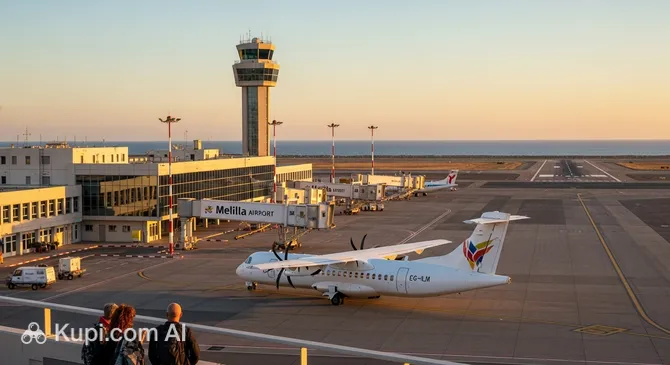
Melilla Airport. Source: Kupi.com Binoculars
IATA Code MLN
ICAO Code GEML
City Ad-Darva
Distance to Centre About 3 km
Status Regional
Passengers per Year Over 500,000 (2023 data)
Popular Airlines Iberia Regional (Air Nostrum)

The main advantage of the airport is its compactness and thoughtful organisation. Passengers do not have to face long queues or tiring transfers between gates, making pre-flight formalities quick and convenient. It is this efficiency that allows travellers to save time and begin their acquaintance with the region without unnecessary hassle.

The airport is located just a few kilometres from the centre of Ad-Darva, allowing you to reach your hotel or main attractions by taxi or rental car in literally 5-10 minutes. Despite its small size, the terminal has everything necessary for a comfortable wait: a cosy café, car rental desks, and an information point. This airport is the ideal choice for those who value their time and want to immerse themselves in the atmosphere of Morocco without delay.

Contact Information

Below is the essential contact information for Melilla Airport (MLN). We recommend checking the accuracy of the data on official resources before your trip.

  • Official Website: For the most accurate and up-to-date information, including flight schedules, services, and passenger regulations, visit the official Aena operator website, specifically the section dedicated to Melilla Airport: www.aena.es/es/melilla.
  • Information Service Phone: For general enquiries, you can contact the Aena information service: (+34) 91 321 10 00.
  • Address: Carretera de Yasinen, s/n, 52005 Melilla.
  • Email: For written enquiries, you can use the address: mln.aeropuerto@aena.es.
  • Social Media: Follow news and updates on Aena's official social media pages (e.g., on Twitter/X: @aena).
  • Lost & Found: In case of loss or damage to luggage, you must contact the office of the airline you flew with directly. Carrier contacts are usually found on their official website or at the counter in the airport.
  • Passenger Support Service: For on-site assistance, please approach the information desks in the terminal. For general questions, you can also use the information service phone number or the information on the website.

How to Get to the Airport

Melilla Airport is located just 3–4 kilometres southwest of the city centre, making the journey there quick and untiring. Thanks to the region's compactness, travel takes minimal time, although it is worth planning your route in advance, especially if you are travelling with bulky luggage.

The most popular and comfortable way to reach the terminal is by taxi. A trip from the city centre or the seaport usually takes about 10–15 minutes, depending on traffic. Taxis are easily recognised by their distinctive livery. The fare is calculated by a meter, but averages between 10 and 15 Euros. Rates may be slightly higher at night and on weekends.

For those who prefer public transport, there are city bus routes available. Although there is no dedicated express to the airport, buses from the COA company (Cooperativa Omnibus de Autobuses) circulate through the city and stop in the immediate vicinity of the airport. This is the most budget-friendly option, with tickets costing less than 1 Euro. However, please note that a short walk may be required from the stop to the terminal entrance, which is not always convenient with heavy suitcases.

Travellers who prefer freedom of movement can use car rental services. Rental company desks are located both in the arrivals area and in the city centre. The drive is simple and straightforward: follow the ML-300 highway towards the border. The airport provides parking located directly in front of the terminal. It is designed for both short-term and long-term stays. The first half-hour is often provided for free or at a reduced rate, which is convenient for those dropping off passengers.

If for some reason flights to Melilla do not suit you, you can consider arriving at neighbouring transport hubs. The closest is Nador Airport (about 33 km away), which receives many international flights. Also within a 100 km radius is Cherif Al Idrissi Airport in Al Hoceima. For longer routes, travellers sometimes choose Angads Airport in Oujda or even Almeria Airport on the Spanish coast, from where you can arrive by ferry.

Terminals and Map

Melilla Airport (MLN) is a compact and modern aviation hub designed for maximum passenger convenience. Thanks to its small size, navigating through it is intuitive and presents no difficulties even for those visiting for the first time.

The airport operates one passenger terminal, which serves both domestic and international flights. All infrastructure — from check-in counters to departure and arrival zones — is located in a single building, eliminating the need for long walks or shuttle transfers. The terminal layout is extremely simple: the ground floor houses the arrivals hall with baggage claim and the main hall with airline check-in counters. After check-in, passengers proceed to the first floor, where they pass through security control and enter the departure lounge with several boarding gates.

Check-in and security procedures at Melilla Airport usually proceed quite quickly. Typically, this takes no more than 20-30 minutes. However, during peak hours or the height of the tourist season, small queues are possible, so it is recommended to arrive at the airport approximately 1.5-2 hours before departure, especially if you need to check in luggage. Overall, thanks to its compactness and effective organisation, the airport leaves a pleasant impression and allows you to start or end your journey without unnecessary stress.

Airport History

The history of Melilla Airport (MLN) began in the second half of the 20th century. It was officially opened on July 31, 1969, intended to replace the old Tauima airfield. The main goal of constructing the new air harbour was to ensure reliable and modern air connectivity for the city, as the previous airfield ended up outside its borders following territorial changes in the region.

Since its opening, the airport has gone through several key stages of development. Initially, its infrastructure was quite modest. Significant modernisation took place in 1992, when the passenger terminal was expanded to meet growing demand. The most important step was the opening of a completely new, more spacious, and functional terminal in 2005. In subsequent years, work was carried out to extend the runway and update air navigation equipment, allowing for the reception of more modern aircraft types and enhancing flight safety.

One of the most interesting facts regarding Melilla Airport is its relatively short runway. This feature imposes limitations on the types of aircraft that can land here and requires special skill from pilots during landing and takeoff. Despite its compact dimensions, the airport has no serious aviation incidents in its history and is considered an important transport hub, playing a strategic role in the life of the city by connecting it with mainland Europe.

Services and Facilities

Melilla Airport (MLN), despite its compact size, offers passengers all necessary amenities for a comfortable wait. In the terminal, you will find a café where you can have a snack, coffee, or refreshments. There are also shops where you can purchase essentials, press, and souvenirs to remember your trip.

Free Wi-Fi from the AENA network is available to all passengers throughout the airport, allowing you to stay connected or work while waiting for departure. Charging stations for electronic devices are provided in the waiting areas. Financial services are represented by ATMs where you can withdraw cash. Currency exchange points may be absent in small regional airports, so it is recommended to settle this matter in advance.

The airport is equipped for the comfort of passengers with special needs. A support service for people with reduced mobility (Sin Barreras) is available, which is recommended to be booked in advance through the airline or the AENA website. For travellers with small children, there are changing tables in the restrooms. In case of necessity, you can visit the first aid station.

There are no specialised VIP lounges or business centres directly within the Melilla Airport terminal. However, nearby hotels located in the city itself offer both comfortable accommodation and conference rooms for business meetings. They can be reached by taxi or rental car in a short time.

Where to Eat

Melilla Airport (MLN) is a small regional airport, so the choice of dining establishments here is limited but quite sufficient for a snack before departure. The main options for passengers are concentrated in the main terminal, in the public area before security control.

A cafeteria-restaurant operates within the airport building, offering a standard selection of dishes and beverages. Here you can order coffee, tea, soft drinks, fresh pastries, as well as more substantial options such as sandwiches (bocadillos) with various fillings, tapas, and light salads. This is the only full-service establishment in the airport, so it serves both departing and arriving passengers.

The cafeteria is located in the landside area, on the ground floor of the terminal, not far from the check-in counters. This means that after passing through security control (airside), opportunities to eat will be extremely limited or may be absent altogether, with the exception of vending machines. The establishment's opening hours are usually tied to the flight schedule: it opens before the first morning departure and closes after the last evening flight leaves.

Specialised options, such as vegetarian, vegan, or gluten-free dishes, may be available on the menu in limited quantities. If you have strict dietary requirements, it is recommended to check the ingredients with the staff or bring your own snacks. Prices at the airport are generally higher than in the city, which is standard practice for most air hubs.

Dining Recommendations:

  • For a quick snack, a coffee with a croissant or a traditional Spanish bocadillo sandwich is perfect.
  • For a full meal, it is better to dine at one of the numerous restaurants in Melilla itself before travelling to the airport. The airport café is more suitable for light food rather than a substantial meal.

Traveller Tips

To ensure your journey through Melilla Airport goes smoothly and without unnecessary worry, take advantage of these practical tips. Proper preparation will help save time, money, and nerves, making the start of your trip as comfortable as possible.

Arrival Time: We recommend arriving at the airport at least 2 hours before departure. Although Melilla Airport is not a major international hub, this time will be sufficient to complete all pre-flight formalities without rushing: check in luggage, receive your boarding pass, and pass through security control.

Check-in and Security: The simplest way to save time is to complete online check-in for your flight in advance. This will allow you to head straight to baggage drop or, if you are travelling light, to the security screening zone. When passing through security, prepare liquids (in containers up to 100 ml) and electronic devices beforehand to speed up the process.

Seat Selection: If the airline allows you to choose a seat, consider your preferences. Window seats (A, F) will provide beautiful views during takeoff and landing, while aisle seats (C, D) offer more legroom and the ability to leave the cabin quickly upon arrival.

Hand Luggage: Carefully study your airline's hand luggage rules, especially weight and dimension requirements. Standard restrictions prohibit the carriage of sharp objects and liquids in containers larger than 100 ml. All liquids must be packed in a single transparent resealable bag.

Connecting Passengers and Customs: If your route includes a transfer at another airport, clarify whether you will need to collect and re-check your luggage. Keep your passport and boarding pass ready when passing through border and customs control. Following airport staff instructions clearly will help you get through formalities faster.

Saving Time and Money: Travel with light luggage to avoid excess weight fees. Bring an empty water bottle with you — it can be filled at a drinking fountain after the security zone. A light snack from home will also help save on food at the airport.

In Case of Flight Delay: If the schedule changes, stay calm. First, contact your airline representative for up-to-date information. Depending on the length of the delay, you may be entitled to vouchers for food or drinks. Keep all receipts in case you need to claim compensation.

Reached the end of the page?

That means the route is fully explored