Support

Sania Ramel

About the Airport

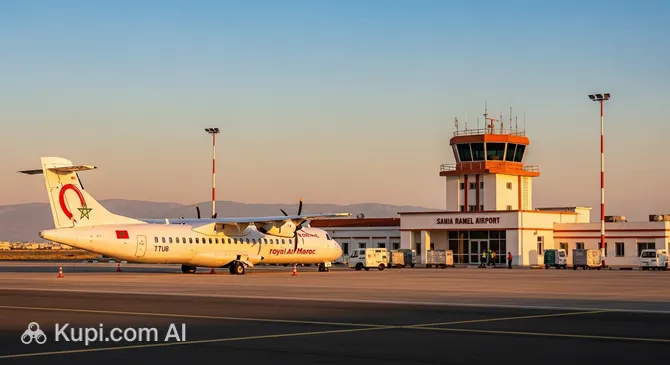
Sania Ramel. Source: Kupi.com Binoculars

Sania Ramel Airport is not just a transport hub, but a cosy aerial gateway to the "White Dove" of Morocco, as the city of Tetouan is often called. Located in a picturesque valley between the Rif Mountains and the Mediterranean coast, this airport immerses guests in an atmosphere of tranquillity and anticipation of their holiday from the very first minutes. Thanks to its intimate size and the absence of the hustle and bustle typical of giant hubs, it allows travellers to begin their acquaintance with the kingdom's northern region as quickly and comfortably as possible.

IATA Code TTU
ICAO Code GMTN
City Tetouan
Distance to Centre ~6 km
Status International
Passengers per Year Over 250,000

The main advantage of Sania Ramel Airport is its exceptional location. The terminal is situated just a few kilometres from the city centre and in immediate proximity to popular beach resorts such as Martil, M'diq, and Cabo Negro. This means that the transfer to your hotel takes minimal time, allowing tourists to find themselves by the sea or in the ancient medina almost immediately after landing.

Thanks to the terminal's compactness, all arrival and departure procedures are intuitive and swift. Passengers do not have to cover long distances on foot or search for the right counter for a long time, and passing through passport control and baggage claim typically takes less time than in the country's major airports. This makes Sania Ramel an ideal choice for those who value their time and comfort.

One cannot overlook the aesthetic aspect of flying into Tetouan. The approach for landing here is considered one of the most beautiful in the region: the aircraft descends over the azure waters of the Mediterranean Sea against the backdrop of majestic mountain ranges. Furthermore, the recent modernisation of the runway and infrastructure has allowed the airport to receive more modern liners and expand its flight geography, whilst preserving the cosy atmosphere of a small regional airport.

Contact Information

  • Official Website: The airport is managed by the National Airports Office of Morocco (ONDA). All current information regarding flights and services can be found on their official website: www.onda.ma.
  • Information Desk Phone: +212 539 97 95 14
  • Airport Address: Aéroport Tétouan Sania R'mel, Route de Sebta, Tétouan, Maroc.
  • Email: A separate email address for Tetouan Airport is not provided. For official enquiries, it is recommended to use the contact form on the ONDA website.
  • Social Media: It is most convenient to follow news and updates on ONDA's official social media pages (e.g., Facebook and X/Twitter).
  • Lost Luggage Information: In case of lost or damaged luggage, you must first contact your airline's representative at the airport. If the issue cannot be resolved, you may contact the airport information service.
  • Passenger Support Contacts: For all questions related to your stay at the airport, please contact the main information desk number.

How to Get to the Airport

Sania Ramel Airport (TTU) is located just a few kilometres from the city centre of Tetouan, making the journey there quick and convenient. Travellers can choose from several ways to reach the terminal depending on their budget and preferences. A trip from the city centre to the airport in Morocco usually takes no more than 15-20 minutes.

Public Transport is the most budget-friendly way to get to the airport. Although there is no dedicated shuttle to the terminal, city bus routes pass near the airport. This option is suitable for travellers without heavy luggage who are ready to walk a little. The cost of the trip will be minimal. You can also use "Grand Taxi" services — these are shared taxis that can take you to the airport area for a very affordable price.

The most popular and convenient option is a taxi or private transfer. In Tetouan, blue-coloured "Petit Taxis" operate, which will take you from any point in the city directly to the terminal. This is a fast and relatively inexpensive method. Important: always agree on the trip price in advance or ask the driver to turn on the meter. For maximum comfort, especially if you are travelling with family or a large amount of luggage, you can book a private transfer in advance. The driver will meet you at the specified location and take you to the airport for a fixed price.

If you plan to actively explore the northern region of Morocco, it makes sense to rent a car. Many rental companies have offices both in the city and at the airport, allowing you to easily pick up a car upon arrival or return it before departure. Sania Ramel Airport has a car park where you can leave a personal or rented car for a short or long term.

Overall, thanks to its close proximity, getting to Sania Ramel Airport is not difficult. A taxi remains the optimal choice in terms of price and comfort. Since this is a small regional airport, travellers often use larger air hubs for a wider choice of international flights, such as Tangier Ibn Battuta Airport (56 km) or Malaga Airport in neighbouring Spain.

Terminals and Map

Sania Ramel Airport (TTU) is a compact and convenient aviation hub serving the city of Tetouan and the northern region of Morocco. Its main feature is a simple and clear structure, which makes navigation intuitive even for first-time visitors.

The airport operates one passenger terminal, which serves both domestic and international flights. Thanks to this, you do not have to worry about transferring between terminals — all zones are located in one building. The terminal layout is logical: the ground floor houses check-in counters, the arrival area with baggage claim belts, and exits to the city. The departure zone is located after passing through security control.

Departure and Arrival Zones are clearly separated. After checking in for a flight, you proceed to pre-flight security screening, and for international destinations — passport control as well. The waiting hall is small but has everything necessary for comfortably awaiting boarding. The arrival zone includes passport control counters, a baggage claim area, and a customs corridor leading to the general hall where you can meet a taxi or transfer.

Completing all formalities at Sania Ramel Airport usually takes little time. It is recommended to arrive 1.5–2 hours before a domestic flight and 2–3 hours before an international one. During the peak tourist season (especially in summer), it is worth allocating a little more time due to the increase in charter flights. Thanks to the small size of the terminal and clear signage, you will easily find your way from the entrance to the gate.

Airport History

The history of Sania Ramel Airport (TTU) is inextricably linked with the rich past of the city of Tetouan. Its foundation dates back to 1913, making it one of the oldest airports in Morocco. Originally created as a military airfield during the Spanish protectorate era, it played a key role in aviation communication in the north of the country. It was a strategically important base ensuring connections with Spain and other territories.

After Morocco gained independence, the airport gradually began to transform from a military facility into a civil one. Over the decades, it served as an important transport hub for the region, although it remained relatively small. Its main role was to serve domestic flights and a limited number of international destinations, mainly linking the north of the country with Europe, especially Spain.

A real breakthrough in the development of Sania Ramel Airport occurred in the 21st century. Understanding the region's tourism potential, the government initiated a large-scale modernisation programme. A key stage was the expansion project launched in recent years. It includes the construction of a completely new, more spacious terminal capable of serving up to 1.5 million passengers per year, as well as lengthening the runway to accommodate larger aircraft. These changes are designed to turn the airport into a modern aerial gateway ready to welcome a growing flow of tourists.

Interesting fact: the name of the airport "Sania Ramel" translates from Arabic as "sand garden" or "sandy patch", which likely describes the landscape of the area where it was built. Today, having undergone massive reconstruction, the airport not only preserves its historical significance but also becomes a symbol of renewal and Tetouan's aspiration to the status of one of the leading tourist centres of northern Morocco.

Services and Amenities

Sania Ramel Airport (TTU) provides passengers with all key services necessary for a comfortable start or end to a journey in Morocco. Despite its relatively small size, the terminal is well-organised and offers amenities for both tourists and business travellers.

Several cafes and snack bars operate within the airport, where you can drink coffee, eat a sandwich, or try local pastries. There are also small shops offering souvenirs, press, and travel essentials. For those who value enhanced comfort, a VIP lounge is available with a more secluded atmosphere, beverages, and snacks.

Passengers can stay connected thanks to free Wi-Fi, which is available throughout the terminal. Waiting areas are equipped with power outlets and charging stations for electronic devices. For financial matters, the airport has ATMs and a currency exchange point, which is very convenient for arriving tourists.

The airport is equipped to serve all categories of passengers. There is a medical point for first aid. A mother and child room is provided for travellers with small children. Passengers with reduced mobility are provided with necessary assistance, including escort and access to special facilities.

There are no hotels directly within the airport building, however, many accommodation options, from budget to premium, can be found in the nearby city of Tetouan, which is easily accessible by taxi. Specialised conference rooms are absent in the airport, but basic conditions for work can be found in the VIP lounge.

Where to Eat

Sania Ramel Airport (TTU) is small and compact, so the choice of dining establishments here is appropriate. One should not expect a huge variety of restaurants as in major international hubs, however, options can be found to have a coffee or a snack before departure.

The main dining point is typically a small cafe or cafeteria located in the public zone (landside), before passing security control. Here, both departing passengers and those seeing them off can have a bite. In the departure hall (airside), after passing screening, the choice is usually even more limited and may be represented by a small kiosk with beverages and snacks.

In the main cafe's menu, you will likely find a standard set: sandwiches, pastries, crisps, and sweets. Beverages on offer include coffee, bottled water, and carbonated drinks. To experience the local flavour, we recommend ordering traditional Moroccan mint tea — sweet and aromatic. Also, look out for local pastries if available. This is an excellent option for a light and quick snack.

Specialised dietary options, such as vegan or gluten-free dishes, will be extremely difficult to find at Tetouan Airport. All food is generally Halal. If you have strict dietary restrictions, it is more reliable to bring food with you. Prices for food and drinks at the airport are noticeably higher than in the city, which is standard practice for most airports worldwide.

Establishments at the airport operate in accordance with the flight schedule. Usually, they are open a few hours before departure and may close during quiet periods. In general, Tetouan Airport offers basic capabilities to satisfy hunger or thirst before a flight. This is a place for a quick snack, whilst for a full lunch or dinner, it is better to head to one of the restaurants in the city itself.

Traveller Tips

Planning a trip through Sania Ramel Airport in Tetouan can be easy and pleasant if you know a few key points. To ensure your journey begins and ends without unnecessary hassle, make use of these tips.

Arrival Time and Check-in. Sania Ramel Airport is not very large, but it is better not to take risks. Arrive 2–2.5 hours before an international flight and 1.5–2 hours before a domestic one. This will give you enough time for a calm check-in and security control, especially during the peak tourist season. If your airline offers online check-in, be sure to use it to save time.

Seat Selection and Hand Luggage. Want to enjoy picturesque views? Choose a window seat. During take-off or landing in Morocco, impressive panoramas of the Rif mountain range or the Mediterranean coast may open up to you. Regarding hand luggage, standard international rules apply: liquids in containers no larger than 100 ml must be packed in a single transparent bag. Sharp objects, weapons, and flammable substances are prohibited. Always check your airline's rules, as they may differ slightly.

Transfers and Customs Control. Tetouan Airport mainly serves direct flights and is rarely used as a transit hub. If you do have a transfer planned, it will likely be a self-transfer. This means you will need to collect your luggage, exit the transit zone, and go through check-in and control again for the next flight. Allocate enough time for this. When passing through customs, be prepared for standard questions and possible luggage inspection. Large amounts of cash must be declared.

Savings and Flight Delays. To save money, book a taxi or transfer from/to the airport in advance via online services — this is often cheaper than negotiating with drivers on the spot. Prices for food and drinks at the airport are generally higher, so it is better to have a snack before arriving. In case of a flight delay, immediately contact your airline representative for information on the flight status and possible compensation. Given the modest size of the terminal, the range of entertainment is limited, so it is worth having a book, headphones, or a charged power bank with you in case of a long wait.

Reached the end of the page?

That means the route is fully explored