Support

Tauranga City Airport

About the Airport

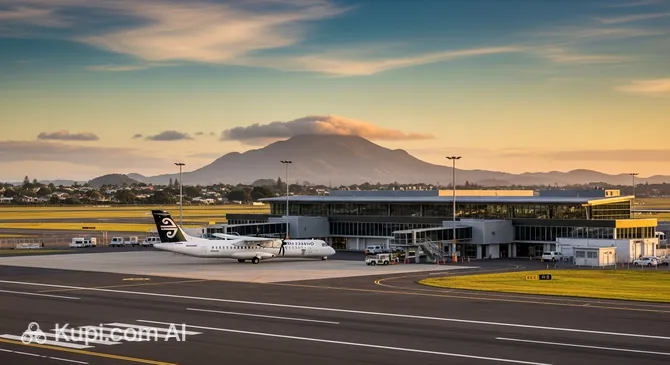
Tauranga City Airport. Source: Kupi.com Binoculars
Tauranga Airport is not just a transport hub, but a scenic gateway to one of the sunniest regions in New Zealand, the Bay of Plenty. Instead of the endless corridors of giant terminals, you will be welcomed here by a cosy, relaxed atmosphere and breathtaking views of the harbour right from the runway. It is the perfect place to start your journey to golden beaches: the airport is located so close to the city and the famous Mount Maunganui that your holiday begins literally minutes after landing.
IATA Code TRG
ICAO Code NZTG
City Tauranga
Distance to City Centre 4–6 km
Status Domestic
Passengers per Year ~553,000 (2024)
Schedule Available on the airport website

Airport Features and Highlights:

Scenic Approach. The flight to Tauranga is often described as an excursion: during descent, a stunning panorama of the ocean, the harbour, and the majestic volcano Mauao (Mount Maunganui) opens up. Take a window seat to capture excellent photos even before disembarking.

Convenience and Speed. The terminal is compact and intuitive, eliminating long walks and queues. Baggage claim and access to transport take just a few minutes. For those who value comfort, the airport features the Air New Zealand Koru Lounge, which is a pleasant rarity for regional airports of this size.

Ideal Location. The airport is located practically within the city limits, on the isthmus next to the prestigious resort area of Mount Maunganui. The journey to the centre of Tauranga or the main beaches by taxi or shuttle will take only about 10 minutes, making logistics as simple as possible.

Contact Information

If you need to contact representatives of Tauranga Airport, please use the following contact information. We recommend checking the official website for the most up-to-date data, as details may change.

  • Official Website: www.airport.tauranga.govt.nz
  • Information Desk Phone: +64 7 575 2456 (for calls from outside New Zealand) or 07 575 2456 (for calls within the country).
  • Address: Jean Batten Drive, Mount Maunganui, Tauranga 3116, New Zealand.
  • Email: airport@tauranga.govt.nz
  • Social Media: The airport maintains a Facebook page where news and operational information are published. You can find it by searching for "Tauranga Airport".
  • Lost Luggage Information: For all issues related to lost, delayed, or damaged baggage, you must contact your airline directly. Airport staff do not handle baggage tracing.
  • Passenger Support Contacts: For assistance directly within the terminal, please speak to staff at the information desk.

How to Get to the Airport

Tauranga Airport (TRG) is conveniently located just a few kilometres from the centre of Tauranga city, making the journey there quick and simple. Depending on your budget, time, and preferences, you can choose one of several convenient ways to reach the terminal.

Public Transport is the most economical option. The local BayBus network operates routes passing near the airport. A trip from the city centre by bus will cost approximately 3-5 NZD and take about 20-30 minutes. This is an excellent choice for travellers with light luggage who wish to save money. Be sure to check the current schedule on the operator's official website in advance, as service intervals may change.

Taxis and Shuttles offer greater comfort and convenience. A taxi ride from the centre of Tauranga to the airport will take only about 10-15 minutes and cost around 20-30 NZD. This is the fastest method, ideal if you are in a hurry or travelling with bulky luggage. Shuttles—minibuses that transport multiple passengers—serve as an alternative. They are cheaper than a taxi for one or two people (about 15-25 NZD per passenger), but the trip may take slightly longer due to stops along the way.

Car Rental is a wonderful solution for those planning to actively explore the Bay of Plenty region and other beauties of New Zealand. Representatives of several major rental companies operate at Tauranga Airport. You can both pick up and return a rented car directly at the airport. If you are arriving in your own vehicle, parking facilities are available, offering options for both short-term and long-term stays. It is recommended to book a spot online in advance to secure a more favourable rate.

Terminals and Map

Tauranga Airport (TRG) is a modern and compact regional airport distinguished by a structure that is simple and clear for passengers. Navigating here is very easy, even if you have arrived for the first time.

The airport operates one passenger terminal, which services all domestic flights. Thanks to this, there is no need for complex transfers or the use of shuttles—all zones are located in one building within walking distance of each other. The terminal building was updated in 2019, so it offers comfortable conditions for travellers.

The terminal layout is intuitive. Upon entering, you find yourself in the general area where airline check-in counters and self-service kiosks are located. Immediately behind the check-in area is the security screening point leading to the departure lounge. The arrivals area with the baggage claim belt is located in another part of the building, which helps separate the flows of arriving and departing passengers. The terminal also houses car rental desks, a cafe, and restrooms.

Passing through procedures at Tauranga Airport generally takes minimal time. Due to its small size and good organisation, queues for check-in and security are usually short. It is recommended to arrive at the airport approximately 60 minutes before the departure of a domestic flight—this time will be more than sufficient to check in luggage, pass through control, and reach the boarding gate without rushing.

Airport History

The history of Tauranga Airport (TRG) began in the 1930s, when the first runway appeared on this site. The official opening of the airfield took place in 1939. During World War II, it played an important role as a base for the Royal New Zealand Air Force (New Zealand), highlighting its strategic importance from the very beginning. After the war, the airport switched completely to serving civilian flights, becoming a key transport hub for the region.

A significant stage in the airport's development occurred in the 1960s, when the first paved runway was constructed. This allowed for the accommodation of larger and more modern turboprop aircraft, which contributed to an increase in passenger traffic and strengthened Tauranga's connection with other cities in the country. During this same period, the first proper passenger terminal was erected, replacing modest initial structures.

With the growth in popularity of the Bay of Plenty region as a tourist destination and one of the fastest-growing centres in the country, the airport has been modernised repeatedly. In the 1990s and 2000s, works were carried out to expand the terminal and improve infrastructure to cope with the constantly growing number of travellers. Each stage of reconstruction was aimed at increasing passenger comfort and the operational efficiency of the air harbour.

The most large-scale modernisation in the airport's recent history was completed in 2019. Within the framework of this project, the terminal area was practically doubled, new boarding gates appeared, a modern baggage handling system was installed, and zones for cafes and shops were expanded. This project transformed Tauranga Airport into a modern and convenient hub, fully meeting the needs of one of New Zealand's most dynamic cities.

Services and Amenities

Tauranga Airport (TRG) is a modern and compact regional aviation hub offering all necessary amenities for a comfortable wait for your flight. Despite its small size, the airport is well-thought-out and oriented towards the needs of passengers travelling around New Zealand.

In the terminal, you will find a cosy cafe where you can have a snack, drink coffee, or purchase light refreshments before departure. There is also a small shop selling newspapers, magazines, books, and travel goods. The selection is limited but includes all the essentials.

Free Wi-Fi is available throughout the airport, allowing you to stay connected or work while waiting for your flight. Charging stations for electronic devices are also available. For eligible passengers (such as Air New Zealand Koru members), the Koru Lounge is open, offering a more secluded atmosphere, beverages, and snacks.

ATMs are installed in the airport, but there are no specialised bank branches or currency exchange points, so it is recommended to arrange for cash in the city beforehand. For passengers with small children, parents' rooms are provided. Although there is no dedicated medical centre in the terminal, in an emergency, you can always ask airport staff for first aid or to call medics. The airport is fully equipped for people with reduced mobility: there are ramps, accessible restrooms, and staff assistance is provided upon prior request to the airline.

While there is no hotel within the airport building itself, many accommodation options are located in the immediate vicinity, just a few minutes' drive away. There are no specialised conference rooms in the airport; however, for business travellers, access to Wi-Fi and comfortable waiting areas, including the Koru Lounge, allow for effective use of time before departure.

Dining

Despite its compact size, Tauranga Airport (TRG) offers passengers convenient options for a snack or a full lunch before departure. All catering establishments are concentrated in the main terminal building, making them easily accessible.

The main place to eat is Veloce Cafe. It is located landside (before security screening), so it is accessible to both departing passengers and those meeting them. The menu features a classic cafe assortment: freshly brewed coffee, including the Flat White popular in New Zealand, tea, soft drinks, as well as fresh pastries, sandwiches, salads, and light snacks. This is an excellent choice for both a quick bite and a more relaxed wait for a flight over lunch.

Regarding special dietary needs, vegetarian and gluten-free options can usually be found at the cafe, although the selection may be limited. Passengers with strict dietary requirements, such as vegans or those seeking Halal dishes, are advised to check information on-site or plan their meals in advance. The cafe's opening hours generally correspond to the flight schedule—it opens before the first departure and closes after the last one. The price range is average, typical for airports.

Travel Tips

To ensure your journey through Tauranga City Airport goes smoothly, make use of these tips. It is a small and convenient regional airport, so finding your way around is quite simple.

Arrival Time: For domestic flights within New Zealand, it is recommended to arrive at the airport approximately 60-90 minutes before departure. This is enough time to check in luggage, pass through security, and reach the boarding gate without haste.

Check-in and Security: The fastest way to check in for a flight is to do it online on your airline's website. Security checkpoints at Tauranga Airport usually work quickly, but small queues are possible during peak hours. Ensure you do not have prohibited items in your carry-on luggage.

Seat Selection: Most flights are operated on small turboprop aircraft. Window seats will gift you breathtaking views of the Bay of Plenty during take-off and landing. If comfort and legroom are important to you, choose an aisle seat.

Carry-on Luggage: Standard security rules apply here as well. All liquids must be in containers of no more than 100 ml and packed in a single transparent bag. Sharp objects, weapons, and flammable substances are strictly prohibited. To clarify weight and size limits for carry-on luggage, check your airline's regulations.

Connecting Passengers: Tauranga Airport serves domestic flights, so transfers are usually made in major hubs such as Auckland, Wellington, or Christchurch. When purchasing a ticket, verify whether you will need to collect and re-check your luggage yourself at the transfer point.

Customs Control: Since this is an airport for domestic flights, there is no international customs or passport control here. Passengers undergo all these procedures at their first airport of arrival in the country from abroad.

Saving Time and Money: Book flight tickets and airport transfers online in advance—this is almost always more cost-effective. Travelling light, with only carry-on luggage, will save you both time and money on baggage fees. There are drinking fountains in the departure lounge where you can refill your water bottle after security screening.

Flight Delays: In the event of a flight delay, current information can be found on the airport's online display boards or the airline's website. There is a cafe in the terminal where you can wait comfortably. If the delay is lengthy, contact an airline representative to clarify your rights to compensation, meals, or rebooking.
Reached the end of the page?

That means the route is fully explored