Support

Whangarei Airport

About the Airport

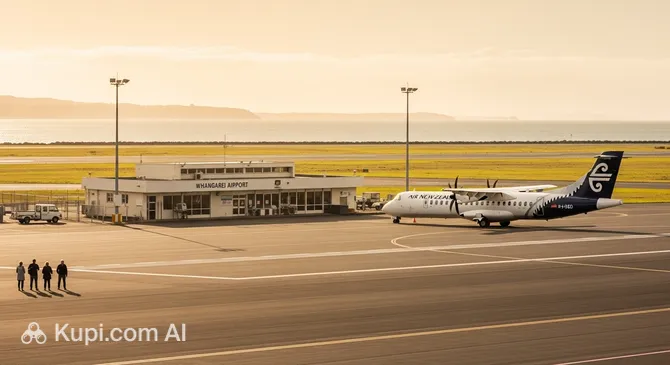
Whangarei Airport. Source: Kupi.com Binoculars

Whangarei Airport (WRE) is not merely a runway but the aerial gateway to Northland, the northernmost and subtropical region of New Zealand. Located in the picturesque suburb of Onerahi, on the shores of the harbour of the same name, this compact and modern airport welcomes travellers ready to explore the "boundless north" with its pristine beaches, ancient kauri forests, and rich Maori culture. Your acquaintance with the city of Whangarei and its surroundings, full of natural wonders, begins here.

IATA Code WRE
ICAO Code NZWR
City Whangarei
Distance to centre approx. 8 km
Status Domestic
Annual Passengers approx. 130,000 (pre-2020)
Popular Airlines Air New Zealand
Schedule Whangarei Airport Online Board

Despite its modest size, Whangarei Airport offers everything necessary for a comfortable start or end to your journey. The modern and cosy terminal is equipped with free Wi-Fi, a café where you can enjoy a coffee while waiting for your flight, and counters for car rental companies such as Avis, Budget, and Hertz. The main carrier is the national airline Air New Zealand, which operates regular flights to Auckland, connecting the region with the rest of the country and the world. Its convenient location, just a 10-15 minute drive from the city centre, makes the airport an ideal starting point for exploring the numerous attractions of Northland.

Contact Information

To contact representatives of Whangarei Airport (WRE), you can use the following contact details:

  • Official Website: www.whangarei-airport.co.nz
  • Help Desk Phone: +64 9 436 0054
  • Airport Address: Handforth Street, Onerahi, Whangārei 0110, New Zealand
  • Email: admin@whangarei-airport.co.nz
  • Social Media: The airport does not have dedicated social media pages. It is recommended to check airline websites for up-to-date flight information.
  • Lost Luggage Information: For all issues related to finding and retrieving lost luggage, please contact your airline's representative office directly. Airport staff do not handle such requests.
  • Passenger Support Contacts: For general inquiries and reference information, you may use the airport's main phone number or email address.

How to Get to the Airport

Whangarei Airport (WRE), also known as Onerahi Airport, is located just 8 kilometres southeast of the Whangarei city centre. Thanks to this proximity, the journey to the terminal does not take much time — on average, the trip takes about 10-15 minutes depending on the chosen transport and traffic conditions.

The simplest and most convenient way to get to the airport is to use taxi or shuttle services. Several taxi companies operate in the city; a car can be ordered by phone or via an app. The cost of a taxi ride from the city centre is usually between 30-40 New Zealand dollars. Shuttles can be a more economical option, especially if you are not travelling alone. It is recommended to book a transfer in advance to guarantee vehicle availability at the required time.

For budget travellers, there is the option to use public transport. The CityLink bus route No. 3 (Onerahi direction) passes near the airport. However, please note that the bus does not drive directly up to the terminal building, and you will need to walk some distance from the nearest stop (about 10-15 minutes). Be sure to check the current schedule and route on the carrier's website.

If you prefer independence in your movements, travelling by private or rented car is an excellent choice. The road from central Whangarei to the airport is simple and well-signposted. Offices of several rental companies are present in the city and directly at the airport, allowing you to conveniently pick up or drop off a car right before departure. Car rental is particularly convenient for those planning further travel through the picturesque surroundings of New Zealand.

For those arriving at the airport in a private vehicle, convenient parking is provided. Both short-term and long-term parking spaces are available at Whangarei Airport, located in immediate proximity to the terminal. This is a paid service, and the cost depends on the duration of the stay. This option is ideal for those seeing someone off or for travellers leaving their car for the duration of their trip.

Terminals and Map

Whangarei Airport (WRE) is a small regional airport primarily serving domestic flights within New Zealand. Its main feature is simplicity and convenience, as it operates with just one passenger terminal. This makes it ideal for travellers who appreciate fast and hassle-free service without the hustle and bustle of major aviation hubs.

The airport terminal is very compact and has a simple, intuitive layout. All key areas — check-in counters, security screening, the departure lounge, and the arrival area with baggage claim — are located in one small building on a single level. You can walk between them in a matter of minutes, so it is practically impossible to get lost here. Consequently, separate transfers between terminals are not required.

Departure and arrival zones are clearly separated but located in close proximity to each other. After check-in, passengers pass through a brief security screening and enter a cosy departure lounge. The arrival zone consists of a small hall where passengers collect their luggage and exit to meet those waiting for them. The infrastructure includes basic amenities sufficient for a comfortable wait for your flight.

Thanks to the low passenger traffic, all pre-flight formalities at Whangarei Airport take minimal time. Typically, arriving at the airport 30-45 minutes before the departure of a domestic flight is sufficient to complete check-in and security. Queues here are a rarity, allowing travellers to avoid unnecessary stress.

The main advice for navigation at Whangarei Airport is simply to follow the signs. All necessary information is presented clearly, and staff are always ready to help. The compactness of the terminal is its main advantage: you spend time not searching for the right boarding gate, but relaxing before your flight.

Airport History

Whangarei Airport (WRE), situated in the scenic suburb of Onerahi, serves as the main aerial gateway to the city of the same name and the entire Northland region in New Zealand. Its history is closely linked to the development of aviation in the country and the desire to ensure reliable connections with the northernmost territories.

Officially, the airport at its current location was opened in 1964. This event was a significant milestone for Whangarei, as the previous airfield on Pohe Island was prone to flooding, creating serious problems for regular flights. The new airport in Onerahi offered more stable and safe conditions for aircraft operations. Initially, flights were mainly operated by Douglas DC-3 aircraft, which were later replaced by turboprop Fokker F27 Friendships, becoming the workhorse of regional aviation for many years.

Throughout its history, the airport has been modernized repeatedly to meet the growing needs of passengers and new aviation safety standards. One of the most significant stages of reconstruction took place in 2015-2016. During these works, the terminal was significantly expanded and updated, waiting areas were improved, capacity was increased, and the baggage handling system was upgraded. These changes allowed the airport to accommodate more modern aircraft, such as the ATR 72 and Bombardier Q300, and to serve a larger number of passengers with enhanced comfort.

An interesting fact: thanks to its location on a peninsula surrounded by the waters of Whangarei Harbour, the airport offers passengers breathtaking views during takeoff and landing. Today, WRE continues to play a key role in the economic and tourist life of the region, ensuring fast and convenient connections with Auckland and other major cities in the country.

Services and Facilities

Whangarei Airport (WRE), being a compact regional hub, provides passengers with all necessary services for a comfortable wait before departure. You will not find huge shopping galleries here, but you can pass the time pleasantly before boarding your flight. The terminal building features a cosy café where you can have a snack, order sandwiches, pastries, and enjoy a cup of aromatic coffee.

For those who need to stay connected, free Wi-Fi is available throughout the airport. Charging stations for electronic devices are also provided in the departure lounge. There are no specialized business centres or conference rooms at the airport, but the quiet atmosphere allows you to work on a laptop while waiting for a flight.

The airport has ATMs for withdrawing cash. However, please note that currency exchange points and full-service bank branches are absent here, so it is better to take care of money exchange in the city beforehand. There is no separate medical centre in the terminal, but airport staff are trained to provide first aid in emergency situations.

The airport is equipped to receive passengers with reduced mobility: there are ramps and specially equipped restrooms. Passengers requiring additional assistance or a wheelchair are recommended to contact their airline in advance. For travellers with small children, baby changing tables are provided in the restrooms.

There are no specialized VIP lounges at Whangarei Airport; all passengers wait for departure in the general waiting hall. There are no hotels within the airport territory itself, but a multitude of accommodation options — from budget motels to comfortable hotels — can be found in the city of Whangarei, which is just a few minutes' drive away.

Where to Eat

Whangarei Airport (WRE) is a compact regional airport, so all services, including dining, are conveniently located in its single terminal. Although you won't find the wide variety of restaurants seen in large international hubs, there is everything necessary for a comfortable wait for your flight.

The main and only place to get a snack is the café in the main hall. It is located in the public area (landside), before security control, making it convenient for both departing passengers and those seeing them off. The café usually opens shortly before the first flight and operates until the departure of the last aircraft, so you will always have time for a coffee or a snack.

What you can try here:

  • Quick Snack: Excellent coffee, especially the famous New Zealand flat white, fresh pastries, muffins, and sandwiches. An ideal option if you are short on time.
  • Full Lunch: Pay attention to the classic New Zealand meat pies — this is a hearty and tasty dish that allows you to experience the local gastronomic culture. The menu also usually includes light salads and more substantial sandwiches.
  • Dietary Options: The assortment may be limited, but café staff can usually offer vegetarian or gluten-free options. It is recommended to check the availability of such dishes on-site.

Prices in the café correspond to the average level for New Zealand. This cosy spot is perfect for relaxing before a flight, enjoying a cup of aromatic coffee, and recharging for the journey.

Travel Tips

Travelling through Whangarei Airport, which serves the picturesque Northland region, is usually easy and hassle-free. As it is a small regional airport, there are no queues like those in major international hubs. Nevertheless, to avoid rushing, it is recommended to arrive at the airport approximately 60-90 minutes before the departure of your domestic flight. This time will be sufficient to calmly check in luggage, pass through security control, and reach the boarding gate.

The check-in and screening process at Whangarei Airport is as simplified as possible. To save time, use online check-in, which is offered by most airlines. If you are travelling with hand luggage only, this allows you to proceed directly to security. When choosing a seat on the plane, try to get a window seat — during takeoff and landing, stunning views of the coast and green hills of New Zealand open up.

Rules for carrying hand luggage are standard: liquids in containers of no more than 100 ml, packed in a transparent bag, as well as the absence of sharp objects. Although customs control is relevant only for international flights, remember New Zealand's strict bio-security rules. If you are arriving from abroad via another city, ensure you do not have prohibited products (fruits, honey, meat) to avoid large fines.

Passengers with connections in larger airports, for example, in Auckland, should study the terminal map in advance to orient themselves quickly upon arrival. Book transport from the destination airport and back in advance to save money. It is also a good idea to take an empty water bottle with you, which can be filled after security, and a light snack.

In case of a flight delay, remain calm. First, contact your airline representative at the check-in counter or boarding gate for up-to-date information. There is a café in the small airport terminal where you can wait. Keep all receipts for food and drinks — depending on the length of the delay, the airline may compensate these expenses.

Reached the end of the page?

That means the route is fully explored