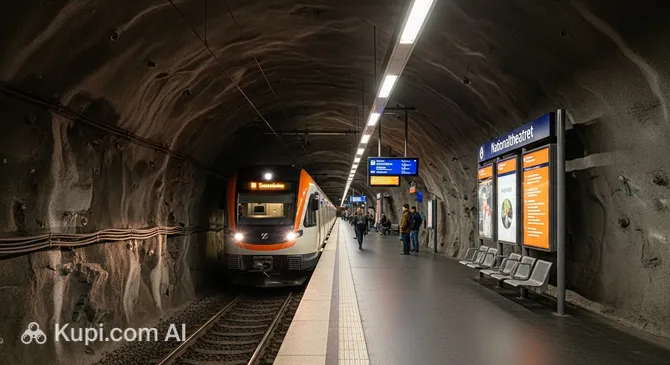
Nationaltheatret Station (Nationaltheatret stasjon) is the second largest and busiest railway hub in Oslo, located underground in the very heart of the Norwegian capital. The station serves as a key point for passengers travelling west of the city and is also a major stop for the Airport Express Train (Flytoget). Thanks to its location between the Royal Palace and the Parliament building, the station is ideal for tourists wishing to get straight to the centre of the action.
It is important for passengers to know that the station is located underground and has several entrances leading to different ends of the platforms. The main exits lead to Johanne Dybwads plass and Ruseløkkveien street. The station is integrated with the metro station of the same name (T-bane), making transfers to city transport extremely convenient. Please note that trains heading east (towards Oslo S) and trains heading west depart from different tracks, so watch the signage carefully when descending to the platform.
Contact Information
To plan your trip and receive up-to-date information, please use the following contacts:
Official Website: It is recommended to use the website of the national operator Vy or Bane NOR for timetables and regulations.
Helpline: Unified customer service line for Vy (+47 61 05 19 10).
Address: Ruseløkkveien 26, 0251 Oslo, Norway (entrances also available from Karl Johans gate).
Opening Hours: The station is open daily from early morning (around 04:30) until the arrival of the last train (around 01:30).
Luggage Storage Information: Automatic lockers are available during station opening hours.
Accessibility: The station is equipped with lifts and escalators for passengers with reduced mobility; an assistance service is available (must be booked in advance).
How to Get There
Getting to Nationaltheatret Station is very simple, as it is a major transport hub in the centre of Oslo.
Public Transport: All main metro lines (T-bane) lead here, with the stop located within the same complex. Trams on lines 13 and 19, as well as numerous city buses, stop right outside the station exits.
On Foot: From the Royal Palace or Oslo City Hall, it is just a 3–5 minute walk. A walk from the Central Station (Oslo S) along the main street, Karl Johans gate, will take about 15–20 minutes.
Taxi: Taxi ranks are located at the main exits on street level. A trip within the city centre will take 5–10 minutes, though it is often faster to use the metro due to traffic.
Services and Amenities
The station offers a wide range of services for a comfortable wait and journey. The lobbies feature ticket machines for long-distance trains, local commuter trains, and the Flytoget airport express. Free Wi-Fi is available throughout the area, though registration may be required to connect.
For the convenience of travellers, the following are provided:
Luggage Lockers: Automatic lockers of various sizes for luggage (paid service).
Waiting Areas: Small zones with seating on the platforms and in the upper lobby.
Restrooms: Facilities are located in the passageways (entry is paid, card payment accepted).
Accessibility: Lifts connect the street level with the ticket hall and platforms; tactile paving is present.
Where to Eat
Directly within Nationaltheatret Station, food options are limited to "on-the-go" formats. In the lobbies and passageways, you will find kiosks from well-known chains (such as Narvesen, 7-Eleven, or Deli de Luca), where you can buy fresh pastries, hot dogs, sandwiches, and hot coffee. The average cost for such a snack is around 100–150 NOK.
If you have time, head up to the surface. You will find yourself in an area with a huge variety of gastronomy. Just a stone's throw away, towards Aker Brygge or on Karl Johans gate, there are dozens of restaurants and cafes — ranging from budget-friendly burger joints to exquisite establishments serving Norwegian cuisine.
Station History
The history of Nationaltheatret Station is inextricably linked to the development of railway connections through the capital's centre. It was opened in 1928 as the terminus of the first underground line connecting the western suburbs with the centre. For a long time, it was the only underground railway station in Norway.
A key stage was the massive reconstruction and expansion in 1980, when the Oslo Tunnel was built, connecting the western and eastern railway networks. This transformed the station from a dead-end into a transit hub. In recent decades, the station has undergone several stages of modernization to cope with growing passenger traffic and to meet modern standards of safety and comfort.
Passenger Tips
Arrival and Boarding: Arrive at the station at least 15 minutes before departure. The station has a complex structure of passageways, and descending to the platform may take time. During peak hours (07:30–09:00 and 15:30–17:00), it is very crowded here.
Tickets: The most convenient way to pay for travel is via mobile apps (such as Vy or Ruter). If you are travelling to the airport on Flytoget, you can simply swipe your bank card at the turnstile or validator on the platform.
Safety: The station is safe and guarded, but as with any major transport hub, please keep an eye on your personal belongings. At night (after midnight), some entrances may be closed; please follow the signs.