Support

Vadso Airport

About the Airport

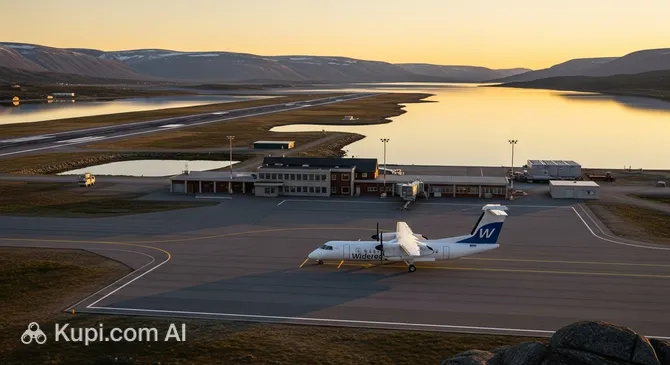
Vadso Airport. Source: Kupi.com Binoculars

Vadsø Airport (VDS) is the aerial gateway to one of Norway's northernmost regions, situated on the picturesque coast of the Varanger Peninsula. Despite its modest size, this airport plays a key role in the transport system of Finnmark county, connecting remote communities with the rest of the country. For travellers eager to explore the unique Arctic nature and Sami culture, Vadsø Airport serves as a convenient starting point for an unforgettable adventure in the Far North.

IATA Code VDS
ICAO Code ENVD
City Vadsø
Distance to centre 4 km
Status Regional (Domestic)
Annual Passengers approx. 100,395 (2018)
Popular Airlines Widerøe
Schedule Online schedule "Vadsø Airport"

Features and Advantages

Managed by the state-owned company Avinor, Vadsø Airport is characterised by its compactness and efficiency. Located in the small village of Kiby, just a few minutes' drive from the centre of Vadsø, it ensures quick and convenient arrivals. Taxi and car rental services are available to passengers, allowing them to immediately set off to explore the Varanger Peninsula. The main flights are operated by Widerøe using Dash 8 aircraft, connecting Vadsø with other towns in Finnmark and major hubs such as Tromsø. This makes it an indispensable transport hub for locals and tourists who value time and comfort.

Contact Information

To ensure your trip to Vadsø goes smoothly, save the airport's contact information. Always verify the data on official resources before your flight.

  • Official Website: The airport is managed by the state company Avinor. All official information, including flight schedules and services, is available on the page: avinor.no/en/airport/vadso-airport/.
  • Information Desk Phone: For general enquiries, you can use the Avinor contact centre number: +47 67 03 00 00.
  • Airport Address: Flyplassveien, 9811 Vadsø, Norway.
  • Email: A direct email address for general queries is usually not provided. It is recommended to use the feedback form on the Avinor website.
  • Social Media: Small regional airports typically do not have their own pages. Follow the official Avinor accounts for news and updates.
  • Lost Luggage Information: If your luggage has been lost or damaged, you must first contact your airline's Lost & Found service.
  • Passenger Support Contacts: For most questions related to airport services, you should contact the general Avinor phone number or visit the official website.

How to Get to the Airport

Vadsø Airport (VDS) is located just a few kilometres east of the city centre, making the journey there quick and convenient. You can get from Vadsø to the airport in several ways, each with its own features depending on your budget and preferences.

Public Transport is the most economical option. Generally, local bus routes serve the airport, although services may not be very frequent. Bus schedules are often coordinated with aircraft arrival and departure times. A bus ride from the city centre will take about 10-15 minutes. It is recommended to check the current timetable on the local transport company's website in advance to avoid long waits.

Taxi or Pre-booked Transfer is the fastest and most comfortable way to reach the terminal. A car journey takes only 5-7 minutes. This is the ideal choice for travellers with a lot of luggage or those flying early in the morning or late at night. The cost of a taxi will be higher than a bus ride, but it provides "door-to-door" convenience. It is advisable to book a car in advance, especially during peak season or for flights at odd hours.

For those planning to actively explore the picturesque surroundings of the Finnmark region in Norway, car rental is an excellent solution. Car rental desks are usually available right at the airport, but to guarantee the availability of the car you want, it is better to book online. Next to the Vadsø Airport terminal, there is parking where you can leave both rental and private vehicles for short or long periods. Given the small size of the airport, the parking is within walking distance of the entrance.

Terminals and Map

The Vadsø Airport (VDS) is a small regional airport in northern Norway, which defines its simple and convenient structure. Travellers should not expect a complex system of terminals here typical of large international hubs — everything is arranged as compactly and clearly as possible.

The airport operates with just one terminal, which serves both departing and arriving passengers. The building is very compact, and all its zones are within walking distance of each other. Thanks to this, navigation through the airport is intuitive, and it is practically impossible to get lost. There are no transfers between terminals because there is only one building.

The terminal layout is extremely simple:

  • Check-in Zone: Several check-in counters are located immediately at the entrance.
  • Security Zone: One or two security control points are located immediately after the check-in area.
  • Departure Zone: A small waiting hall with a boarding gate.
  • Arrival Zone: A separate part of the hall where passengers collect their luggage. There is only one baggage claim belt.

All these zones are located on the same level, making movement around the airport convenient, including for passengers with reduced mobility.

Completing all pre-flight formalities at Vadsø Airport takes a minimum amount of time. Due to the low passenger flow, queues for check-in and security are usually non-existent. On average, all procedures can be completed in 15-20 minutes. Nevertheless, it is recommended to arrive at the airport approximately one hour before the departure of a domestic flight to check in luggage and pass through control without rushing.

Airport History

The history of Vadsø Airport (VDS) is closely linked to the programme for developing transport accessibility in the northern regions of Norway. The official opening of the air harbour took place on 1 August 1974. This airport became one of many regional Short Take-Off and Landing (STOL) airfields built in that decade to ensure reliable year-round connections with remote settlements.

Before the appearance of a proper airport, air connections to the city were carried out via seaplanes that landed on the water in Vadsø harbour. However, with the construction of the runway in 1974, a new era began for the region's residents. Initially, the airport was designed to service small aircraft, such as the de Havilland Canada Twin Otter, which became the "workhorses" on short routes along the coast.

Over the years, the airport's infrastructure has undergone significant improvements. A key stage was the modernisation and extension of the runway, which allowed for the accommodation of larger and more modern turboprop aircraft. In 2007, a new, more spacious and comfortable terminal building was constructed, meeting modern safety and passenger service requirements. These changes were aimed at improving service quality and increasing capacity.

Although Vadsø Airport cannot boast record passenger numbers on a national scale, its main achievement is stable and uninterrupted operation in harsh Arctic conditions for nearly half a century. It remains a vitally important transport hub for the local population, businesses, and tourists wishing to experience the unique nature of the Varanger Peninsula. An interesting fact: Vadsø Airport is one of the easternmost in Norway, playing an important role in connections with the country's Arctic coast.

Services and Facilities

Vadsø Airport (VDS) is a small regional airport serving the city of the same name and its surroundings in northern Norway. Given its size, the range of services is focused on meeting the basic needs of passengers before departure.

The terminal usually houses a small café or kiosk where you can buy drinks, sandwiches, and light snacks. There is generally no selection of shops, as the airport is not designed for high passenger traffic. For passenger convenience, free Wi-Fi is available in the waiting area, along with power outlets for charging electronic devices.

There are no specialised VIP lounges, bank branches, or currency exchange points at the airport. It is recommended to handle all financial transactions in the city of Vadsø beforehand. For passengers with reduced mobility, assistance with boarding and disembarking the aircraft is provided. This service must be booked in advance through the airline. Families with small children can use the nursing room or changing tables in the restrooms.

There are no hotels directly on the Vadsø Airport premises, but several accommodation options can be found in the city itself, which is just a few kilometres away. Specialised business centres or conference rooms are absent from the terminal building.

Where to Eat

Vadsø Airport (VDS) is a compact regional aviation hub, so the choice of dining establishments here corresponds to its size and is focused on passengers' essential needs. There is no division into terminals or a wide variety of restaurants at the airport. Typically, all catering services are concentrated in one small café located in the main hall.

In the local café, travellers can have a quick and convenient snack before their flight. The assortment usually includes:

  • Hot drinks: coffee, tea, cocoa.
  • Cold drinks: juices, water, sodas.
  • Fresh pastries and desserts.
  • Ready-made sandwiches and rolls with various fillings.
  • Light snacks: crisps, chocolate, nuts.
This is an excellent option for a quick bite, but you are unlikely to find a full hot lunch or dinner here.

Local cuisine dishes, for which northern Norway is famous, such as king crab or venison, should be tried in restaurants in the city of Vadsø itself, as they are not represented at the airport. Passengers with special dietary needs (Halal, vegan, gluten-free) should note that the selection for them will be very limited. It is recommended to bring food with you to avoid inconvenience.

The café is located in the public zone (landside), before passing security control, so it can be used by both departing passengers and those seeing them off. The opening hours of the establishment depend directly on the flight schedule: it opens before the first departure and closes after the last one leaves. Prices correspond to the average level for Norwegian airports, which may seem quite high.

Travel Tips

To ensure your journey through Vadsø Airport (VDS) goes as smoothly as possible, make use of our tips. This is a small regional airport, so navigating it is very simple. For domestic flights, it is recommended to arrive approximately 1–1.5 hours before departure. This is enough time to pass all formalities without rushing, even if you are travelling with luggage.

Check-in and security control procedures here are quite fast. To save time, check in for your flight online and save the boarding pass on your phone. Security control is standard: be prepared to take out liquids (in containers up to 100 ml, packed in a transparent bag), as well as laptops and other large electronics from your hand luggage. Sharp and pointed items are prohibited in the cabin.

When choosing a seat on the plane, especially if you are flying during daylight hours, opt for a window seat. It offers stunning views of the Arctic landscapes of Norway. Carry-on luggage rules may differ between airlines, so be sure to check the permissible dimensions and weight on your carrier's website before the trip.

If you have a connecting flight, for example, in Tromsø or Oslo, verify in advance whether you will need to collect and re-check your luggage at the transit airport. Since Vadsø Airport mainly serves domestic flights within the Schengen area, customs control is not required for most passengers. It is mandatory only for those arriving from countries outside the Schengen Agreement.

To save money, book flight tickets in advance, especially during the high tourist season. You can also bring an empty water bottle to fill after passing security, and some light snacks. This will help avoid extra expenses while waiting for your flight.

Flight delays in this region sometimes occur due to harsh weather conditions, especially in winter. Always check the status of your flight before leaving for the airport. In case of a delay, keep the airline's contact details handy, as well as a charged power bank and a book or downloaded films to pass the time.

Reached the end of the page?

That means the route is fully explored