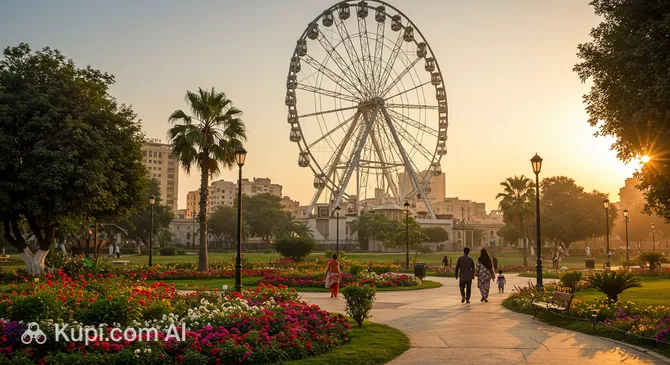
The history of Bagh Ibne Qasim Park, one of the iconic landmarks of Karachi, is quite eventful and full of transformations. Originally, this vast green area was known as Rupchand Bilaram Park and stretched over an impressive area of about 400 acres (approximately 160 hectares). However, by 1964, its size was significantly reduced to 132 acres after the Karachi Municipal Corporation leased part of the park lands for development. This was the first of many transformations this important urban space was to undergo.
In 1966, the park came under the management of the Karachi Development Authority, which in 1974 made efforts to restore some of the structures on its territory. Notably, during the same period, a seawall was built on the eastern side of the park, leading to the shoreline receding further from the park's southern boundary. Despite these efforts, by 2001, the park had unfortunately fallen into great disrepair and was even described as a “virtual wasteland,” highlighting the need for drastic measures for its revival.
A new chapter in the life of Bagh Ibne Qasim Park began on July 22, 2005, when large-scale reconstruction work started. The grand opening of the renovated park took place on February 27, 2007, with the participation of then-President Pervez Musharraf. The cost of this ambitious project was an impressive 600 million Pakistani rupees. However, as sometimes happens, the park's history continued to be cyclical: by 2015, it began to fall into decay again due to insufficient maintenance and attention.
Fortunately, this was not the end of its story. In April 2017, the Karachi Metropolitan Corporation took on another renovation of this iconic place. The renovated and once again transformed Bagh Ibne Qasim Park was officially opened to the public on March 30, 2019, by Prime Minister Imran Khan, once again returning a favorite space for relaxation and strolls to the residents and guests of the city. These repeated restoration efforts clearly demonstrate how important the park is to Karachi and its residents.