Support

Jinnah International Airport

About the Airport

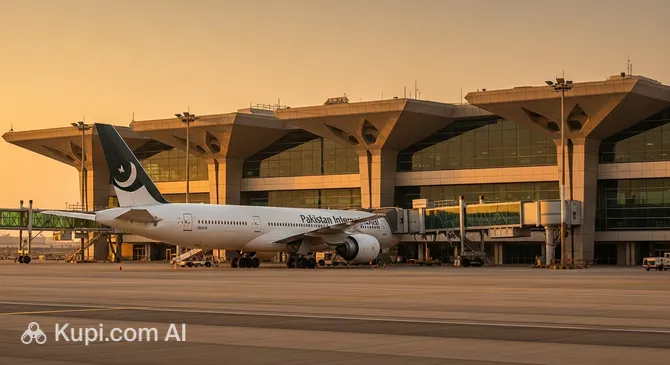
Jinnah International Airport. Source: Kupi.com Binoculars

Jinnah International Airport (IATA: KHI) is not just the main air gateway to Karachi, the largest metropolis and economic hub of Pakistan, but also a symbol of the country's rich history and modern ambitions. Named after the nation's founder, Muhammad Ali Jinnah, this airport welcomes and bids farewell to millions of travellers, serving as a vital node for both domestic and international flights. Its spacious and well-organised complex serves as a starting point for exploring the region's vibrant culture and business opportunities.

For the convenience of travellers, key information about the airport is provided below in an easy-to-read format.

IATA Code KHI
ICAO Code OPKC
City Karachi
Distance to Centre Approximately 15-20 km
Status International
Annual Passengers Over 6.4 million (2023-2024)
Popular Airlines Pakistan International Airlines, Emirates, Turkish Airlines
Schedule online board "Jinnah International Airport"

The main feature of the airport is the Jinnah Terminal Complex, which handles the majority of flights. It is designed with a capacity of up to 12 million passengers per year and offers all necessary amenities for a comfortable journey. Passengers have access to spacious lounges, duty-free shops, various cafes and restaurants, currency exchange counters, and car rental agency desks. The airport serves as the primary hub for the national carrier Pakistan International Airlines (PIA) and other Pakistani airlines, such as airblue and SereneAir, providing a wide network of routes across the country and beyond.

Contact Information

For your convenience, we have compiled the essential contact information for Jinnah International Airport (KHI). We recommend checking official resources for the most up-to-date data before your trip.

  • Official Website: www.karachiairport.com.pk, as well as the Pakistan Civil Aviation Authority website www.caapakistan.com.pk.
  • Helpline: +92-21-99071111
  • Address: Airport Road, Faisal Cantonment, Karachi, Sindh Province, Pakistan.
  • Email: For official enquiries, it is recommended to use the contact forms on the airport or Civil Aviation Authority websites. A direct email address for general passenger queries may not be available.
  • Social Media: Current information and news can be found on the official social media pages of the Pakistan Civil Aviation Authority (PCAA).
  • Lost Luggage Information: For issues related to lost or damaged baggage, you should first contact your airline's representative at the airport directly. If you have lost personal items within the terminal, please contact the airport's Lost and Found service.
  • Passenger Support: For advice and assistance with general questions regarding airport operations, you may use the helpline number.

Getting to the Airport

There are several ways to get to Jinnah International Airport (KHI) from the centre of Karachi, each with its own specific features. The airport is located approximately 15-20 kilometres northeast of the city centre, and travel time depends heavily on the chosen mode of transport and traffic conditions.

The most convenient and popular option for tourists is taxi or ride-hailing services. In Pakistan, apps such as Uber and the local equivalent Careem are widely used, offering rides at fixed or pre-calculated rates. This is a reliable and relatively inexpensive way to reach the airport. A trip from central areas, such as Saddar or Clifton, usually takes from 45 to 90 minutes depending on traffic congestion. You can also use official airport taxis stationed at the terminal exits, although their fares may be slightly higher.

For the most budget-conscious travellers, there is public transport in the form of local buses. Routes connect various parts of the city with the airport area. However, it is worth noting that buses are often overcrowded, and the route system may seem confusing to those unfamiliar with the city. This option is the cheapest but least comfortable and is not recommended for tourists travelling with heavy luggage.

If you prefer to drive yourself, you can use a car rental service. Both international and local rental agencies operate at the airport and in the city. For those arriving at the airport in their own or a rented vehicle, parking is provided. There are zones for short-term and long-term parking located in immediate proximity to the passenger terminals.

Terminals and Map

Jinnah International Airport in Karachi, the main aviation hub of Pakistan, features a well-thought-out and relatively simple structure for passengers. The main passenger flow is handled in one large terminal complex, known as the Jinnah Terminal or Terminal 1. It accommodates both international and domestic flights. Apart from this, there are older terminals (Terminal 2 and 3), which are currently used primarily for charter flights during Hajj, cargo operations, and general aviation.

The main terminal is a single building, which significantly simplifies navigation. Inside, it is logically divided into two main sections — or concourses. The East Satellite Concourse is dedicated to handling all international flights, while the West Satellite Concourse serves domestic flights within the country. Since everything is under one roof, there is no need to go outside or use transport to transfer between zones.

The airport layout is standard for major transport hubs. Departure areas with check-in counters and passport control are located on the upper level, while arrival halls and baggage claim are on the lower level. Signage in English and Urdu helps with orientation, and numerous information boards display current flight information. For international flight passengers, immigration and customs control must be cleared after check-in, located in the East Satellite Concourse.

To avoid rushing, it is recommended to arrive 3 hours before departure for international flights, and 1.5-2 hours for domestic ones. During peak seasons, such as holidays or pilgrimages, the time required to complete all procedures may increase, so it is worth allowing extra time. Overall, navigation through the airport is intuitive: simply follow the signs to your boarding gate, the number of which will be indicated on your boarding pass and information screens.

Airport History

The history of Jinnah International Airport begins in the era of early global aviation. Its predecessor was an airfield established in 1929, when a giant hangar was built here for airships on the British Imperial route. Although the famous R101 airship never arrived in Karachi, the infrastructure created laid the foundation for the future airport, which by the 1930s was receiving Imperial Airways flights linking London with the Far East.

During World War II, the airfield gained strategic importance, serving as a major base for the US Air Force and the Royal Air Force. This period contributed to the significant expansion of runways and the development of ground services. After 1947, with the formation of Pakistan, the airport became the country's main international hub and received its modern name in honour of its founder, Muhammad Ali Jinnah.

The airport's "Golden Age" occurred in the 1960s and 1970s. At that time, it was one of the busiest in Asia, hosting flights from giants such as Pan Am, British Airways, and Lufthansa. Karachi became an important transit point on routes between Europe and Asia, attracting travellers and celebrities from all over the world to the city.

By the end of the 20th century, it became clear that the existing infrastructure could not cope with the growing passenger traffic. This led to a massive modernisation, culminating in the opening of the modern "Jinnah" Terminal Complex in 1992. This complex, comprising the main building and two satellites, significantly increased capacity and set new service standards. Today, Jinnah International Airport remains the busiest in Pakistan, continuing to play a key role in the country's transport system.

Services and Amenities

Jinnah International Airport in Karachi offers passengers a wide range of services to make waiting for a flight as comfortable as possible. In the terminal, you will find various cafes and restaurants where you can try both local cuisine and familiar international snacks. For those wishing to shop, there are stores, including Duty Free, where you can purchase souvenirs, perfumes, electronics, and travel essentials.

For a more comfortable wait, the airport features VIP lounges and business lounges. Guests in these lounges can enjoy a quiet atmosphere, complimentary snacks and beverages, and fresh newspapers. Free Wi-Fi is available throughout the terminal, and numerous charging stations allow you to stay connected. For financial matters, bank branches, ATMs, and currency exchange counters are at your service.

The airport caters to all categories of passengers. Mother and child rooms are equipped for travellers with children. Passengers with reduced mobility can count on special assistance, and the terminal infrastructure, including ramps and lifts, is adapted to their needs. If necessary, you can visit the medical centre for first aid.

If you need to stay overnight or rest between flights, several hotels of varying comfort levels are located in the immediate vicinity of the airport. For business travellers, business centre services and meeting rooms may be available at the airport, allowing for effective use of time even while waiting for departure.

Where to Eat

At Jinnah International Airport in Karachi, passengers won't have to go hungry while waiting for a flight. The airport offers diverse dining options, from a quick snack on the go to a full lunch or dinner in a relaxed setting. Food outlets are located both in the public area before security and in the sterile departure zone.

For those wanting to enjoy a final taste of local cuisine, this is an excellent opportunity. In several restaurants, you can order traditional Pakistani dishes such as aromatic biryani, various types of kebabs, or hearty naan bread. Almost all food at the airport is Halal by default, complying with local standards. You can also find many establishments offering familiar international cuisine, including popular fast-food chains, pizzerias, and coffee shops.

The main food courts and restaurants are concentrated in the departure lounges for international and domestic flights, after passport and customs control. Here you can find both places for a leisurely dinner and fast-food outlets. For greeters and arriving passengers, several cafes and snack bars operate in the public arrivals area. Many key establishments, especially in the departure zone, operate 24/7 or on extended schedules to serve passengers of all flights.

If you are short on time, a coffee with pastries at one of the coffee shops or a sandwich from a snack bar is the ideal choice. For a more substantial meal, head to one of the restaurants offering set meals. Vegetarians should look for lentil dishes (daal) and vegetable curries, although it is always best to check ingredients with the staff. Specialised vegan or gluten-free menus are rare, so it is recommended to check for suitable options in advance.

Prices for food and beverages at the airport are higher than in the city, which is standard practice for most air hubs worldwide. Nevertheless, the cost remains within reasonable limits: from affordable options in fast-food chains to moderate prices in full-service restaurants.

Travel Tips

To ensure your journey through the airport of Karachi goes smoothly and without stress, take advantage of our tips. These recommendations will help you save time, nerves, and money.

Arrival time at the airport. For international flights, it is recommended to arrive at the airport 3-4 hours before departure, and for domestic flights — at least 2 hours prior. This time will be sufficient to calmly complete all formalities, even taking into account possible queues and heavy traffic on the city roads.

Check-in and security. If possible, check in for your flight online — this will save you a lot of time. Security checkpoints can be quite busy. Keep your passport and boarding pass ready, remove outerwear and belts in advance, and take all metal objects out of your pockets. Be prepared for several stages of checks.

Seat selection. If you want to enjoy views of the Arabian Sea coast during takeoff and landing, choose a window seat. If the ability to stand up and move freely without disturbing neighbours is more important to you, your choice is an aisle seat.

Hand luggage. Rules for carrying hand luggage are standard: liquids in containers of no more than 100 ml each must be packed in a single transparent bag. Sharp objects, weapons, and flammable substances are prohibited. We recommend checking the full list of restrictions on your airline's website in advance.

Connecting passengers. If you have a connecting flight in Karachi, verify at check-in whether your luggage will be automatically transferred to the final destination. Follow the signs for "Transit" or "Connecting Flights" to quickly find the way to your next boarding gate. Check if you need a transit visa for Pakistan if the layover is long and you plan to exit into the city.

Customs control. When entering the country, be prepared that your luggage may be inspected. Honestly declare all goods subject to declaration (large amounts of cash, expensive electronics). This will help avoid misunderstandings and delays.

Saving time and money. To save on transfers, use official taxi services or mobile apps like Uber or Careem instead of hailing a car at the exit. Prices for food and beverages at the airport are traditionally higher, so it is better to have a snack beforehand. Bring an empty bottle with you and fill it with water at drinking fountains after passing security control.

In case of flight delay. If your flight is delayed, the first thing to do is find your airline's counter and ask for information. Depending on the length of the delay, you may be provided with vouchers for meals or even hotel accommodation. Remain calm and keep all documents handy, including boarding passes and receipts.

Airports in nearby cities

Reached the end of the page?

That means the route is fully explored